
Countertop sealing frequency by material has no single reliable average: engineered quartz needs no routine sealing, while granite, marble, and quartzite require slab-specific assessment rather than a fixed resealing range. This 2026 guide separates maintenance requirements from calendar-based assumptions so you can protect your countertop without applying unnecessary sealer.
- Countertop sealing frequency by material depends on absorption and product instructions, not a universal annual schedule.
- Engineered quartz needs no routine sealer; natural stone requires slab-specific assessment.
- Soares Stone fabricates and installs marble, granite, quartz, and quartzite countertops for New England homeowners.
- Sealing helps resist absorption; it does not prevent marble etching or repair existing damage.
Why this matters
A reminder to inspect your countertop is not an instruction to reseal it. Applying more product to a surface that does not absorb it can leave residue instead of improving protection. Waiting for a visible stain is not a useful maintenance strategy either.
For a 2026 kitchen or bathroom project, start with the exact material and its care instructions. Soares Stone is a family-owned New England countertop fabricator and installer for homeowners planning custom stone and quartz surfaces. The relevant maintenance question is what your selected slab needs—not what another homeowner applies to a different countertop.
Countertop sealing frequency by material: the comparison
Sealing frequency means how often a surface requires a compatible protective treatment to reduce liquid absorption. It does not mean cleaning frequency, polishing frequency, or how often you should inspect the surface.
Overall benchmark: there is no defensible pooled resealing interval across these 4 materials. Engineered quartz and natural stone do not share the same maintenance requirements, and natural stone varies within each material category.
| Material | Routine sealing benchmark | What determines the next application? | Best for | Main maintenance limitation |
|---|---|---|---|---|
| Overall: all materials | No single average or shared range | Material identity, absorption, existing treatment, and written care instructions | Comparing maintenance requirements before choosing a surface | An overall average hides essential differences |
| Engineered quartz | 0 routine sealing applications | Follow the surface manufacturer's care instructions | Homeowners who want to avoid routine sealing | No sealing requirement does not mean immunity to heat or chemical damage |
| Granite | Reseal only when needed; no universal interval | The particular slab's absorption and compatible sealer instructions | Homeowners who want natural stone and accept condition-based care | Different granites do not absorb liquids equally |
| Marble | Reseal only when needed; no universal interval | Absorption, existing treatment, and compatible sealer instructions | Homeowners who accept natural stone care and surface changes | Impregnating sealer does not prevent acid etching |
| Quartzite | Reseal only when needed; no universal interval | Verified material identity, absorption, and compatible sealer instructions | Homeowners who want natural stone and accept slab-specific maintenance | The material name alone does not establish a resealing schedule |
Engineered quartz has the lowest routine sealing requirement at 0 applications; granite, marble, and quartzite cannot be reliably ranked by resealing frequency from their names alone. Marble has a separate care concern: reducing absorption does not stop acid from etching its surface.
Source and methodology: this 2026 comparison summarizes the Natural Stone Institute's undated Care & Cleaning of Natural Stone guidance on assessing sealing needs and established engineered-quartz care guidance, including Caesarstone's undated care and maintenance guidance. Its scope is residential countertop maintenance—not measured sealer service life—and its limitation is that it cannot establish an average or predict an individual slab's next application date.
How to use these benchmarks
Use the table to decide which maintenance questions to ask, not to assign every surface a replacement coating date. These recommendations distinguish the confirmed requirement from the decision that still depends on your countertop.
- For engineered quartz, plan for 0 routine sealing applications. Spend your attention on approved cleaners, spill removal, and heat protection instead.
- For granite, marble, and quartzite, request slab-specific instructions. A material label is not a substitute for information about the existing treatment and the selected sealer.
- Separate inspection from application. A 12-month calendar reminder is a practical recordkeeping choice, not evidence that sealer expires after 12 months.
- Keep staining and etching separate. A dull marble patch calls for diagnosis, not an automatic extra coat of sealer.
For your 2026 maintenance calendar, record the last known treatment and its instructions together. A date without a product name tells you little about compatibility, preparation, or the conditions required before the countertop returns to use.
Why natural stone does not follow one sealing calendar
Absorption varies within a material category
Granite is not one uniform countertop material with one absorption rate. Marble and quartzite also vary, so a schedule copied from another installation does not establish what your surface needs.
The Natural Stone Institute explains that many stones do not require sealing and recommends assessing whether treatment is appropriate. That distinction matters: choosing natural stone does not automatically create an annual sealing obligation.
Assess the actual slab before choosing an interval. Ask whether the countertop was treated during fabrication or installation and whether the installer documented the product. If that information is unavailable, identify the surface and its condition before adding another treatment.
A sealer's instructions govern its use
An impregnating sealer works within an absorbent surface rather than serving as a general-purpose repair layer. Product selection, surface preparation, application, excess removal, and curing all affect the result.
Do not transfer instructions between different sealers. A drying or curing period printed on one container does not establish the timing for another product, and a label claim does not replace checking whether that product suits your countertop.
Room labels are not maintenance measurements
A kitchen island, bathroom vanity, and fireplace surround have different exposures. That does not establish a numerical resealing interval for any of them.
Describe the actual conditions instead: repeated spills, cleaning products, standing water, and any visible changes. Those details help frame an assessment without assuming that every kitchen needs more sealer than every bathroom.
Granite: inspect absorption rather than following a slogan
Granite is best for homeowners who want natural stone and accept checking its condition. Its practical advantage is that maintenance can follow the installed surface's needs rather than an arbitrary recurring application.
The limitation is variation. A dense slab and a more absorbent slab do not become equivalent because both were sold as granite. Neither a neighbor's experience nor a generic maintenance calendar establishes your countertop's requirements.
Begin with the written care information for your installation. If sealing is recommended, confirm the compatible product and how to evaluate whether protection remains adequate. Read the guide to caring for granite countertops for the broader maintenance context.
A recurring wet-looking area deserves attention, but it is not proof of permanent damage or a complete diagnosis. Note where it appears, what caused it, and whether it disappears after drying. Avoid applying treatment over an unidentified mark.
Marble: sealing and etching are different problems
Marble is best for homeowners who accept that stain resistance and acid resistance are separate issues. A compatible impregnating sealer helps reduce absorption; it does not make marble resistant to acidic spills.
Lemon juice, vinegar, and other acidic substances can etch marble. An etched area often looks dull because the surface has changed, not because it simply needs more sealer. Adding sealer does not restore the original finish.
This is the key disadvantage of choosing marble solely on a sealing schedule. Even a correctly maintained surface still needs prompt spill care and appropriate cleaning products. See how to prevent etching on marble countertops before treating dullness as a sealing failure.
For a 2026 marble project, ask for separate instructions covering routine cleaning, absorption protection, and finish damage. Keeping those tasks distinct prevents a stain-prevention product from becoming the default response to every mark.
Quartzite: confirm the stone and its care requirements
Quartzite is best for homeowners who want natural stone and accept a slab-specific care plan. It is not engineered quartz, and the similarity between the names does not make their maintenance interchangeable.
The important limitation is that the word quartzite does not tell you the existing treatment, absorption behavior, or compatible sealer. Ask for documentation tied to the selected slab rather than relying on the showroom category alone.
If the countertop needs resealing, follow the approved product's preparation and application directions. Do not assume that applying additional coats will compensate for incomplete cleaning, retained moisture, or a product that is unsuitable for the surface.
The guide to sealing quartzite countertops addresses that task directly. Keep the sealing record with your installation documents so the next assessment begins with the treatment history rather than a guess.
Engineered quartz: no routine sealing, but still routine care
Engineered quartz is best for homeowners whose priority is avoiding routine sealing. Its nonporous surface does not require the periodic impregnating-sealer treatment associated with absorbent natural stone.
That advantage has a boundary. Engineered quartz still requires manufacturer-approved cleaning and protection from damaging heat or chemicals. A zero-sealing requirement is not a promise that every cleaner or use is acceptable.
Do not apply a natural-stone sealer simply because the countertop contains quartz. Engineered quartz and quartzite are different materials. Follow the specific surface manufacturer's directions, including any instructions for removing residue or dealing with stubborn marks.
For an existing countertop with uncertain identification, settle the material question before choosing a maintenance product. Misidentifying the surface makes every later decision less reliable, including whether sealing belongs in the care plan at all.
Build a maintenance record before applying sealer
A useful 2026 maintenance record connects the countertop, the product, and the reason for treatment. It should let you explain what changed rather than merely showing that another calendar year passed.
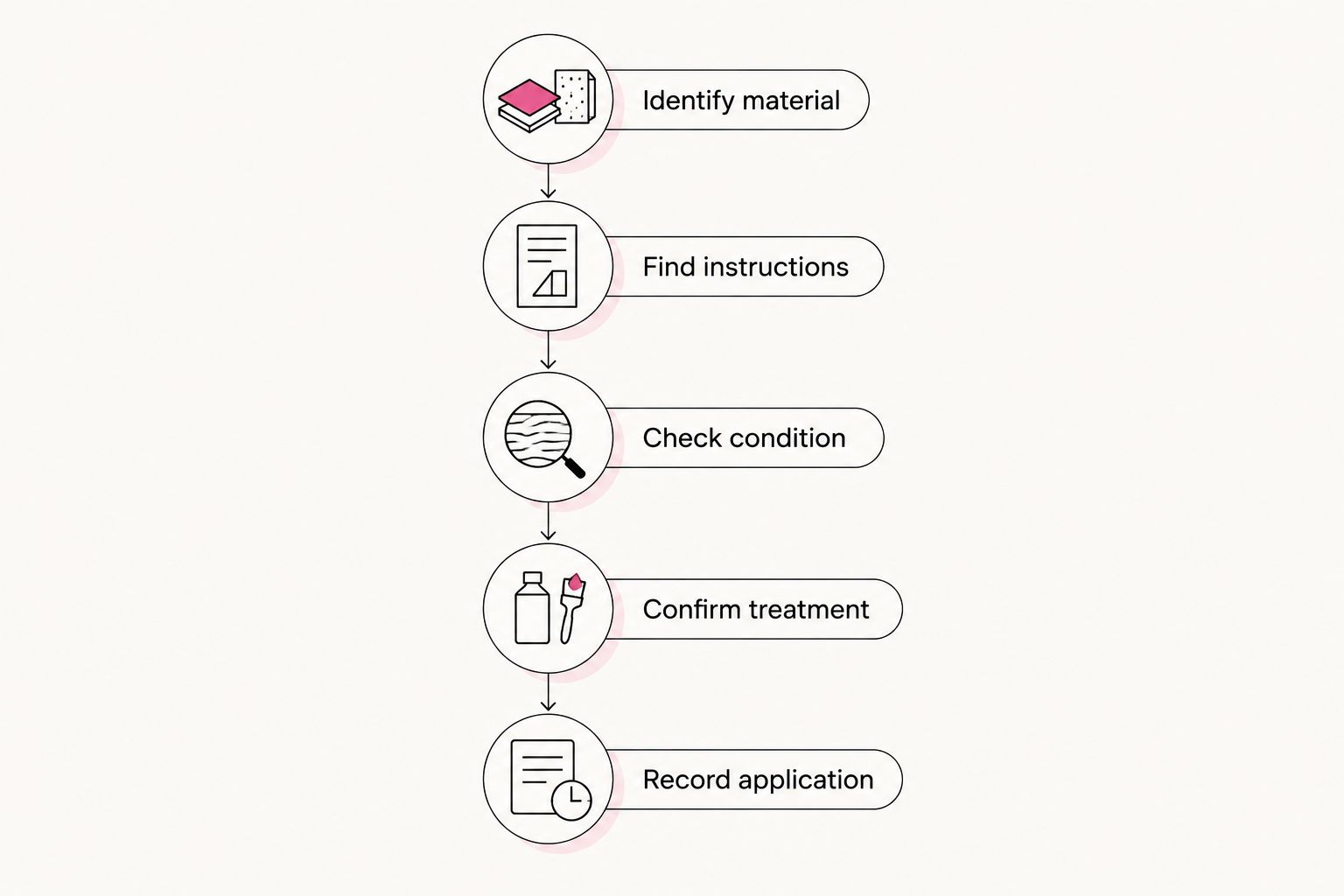
Use this sequence before a natural-stone sealing application:
- Identify material. Confirm whether the surface is granite, marble, quartzite, or engineered quartz.
- Find instructions. Collect the countertop care guidance and any previous treatment information.
- Check condition. Note absorption concerns, residue, stains, dullness, or other visible changes.
- Confirm treatment. Establish whether sealing is needed and whether the selected product is compatible.
- Record application. Save the product name, application date, and instructions for future reference.
Do not substitute a generic water-test timer for the product's instructions. Absorption checks can help assess natural stone, but one universal pass-or-fail time does not account for every material, finish, or existing treatment.
If you perform a recommended check, document the location and result consistently. Do not deliberately test with oil, wine, vinegar, or another substance that can leave a stain or damage the finish. An assessment should not create the problem it is meant to prevent.
For a new project, Soares Stone provides custom countertop fabrication and installation for New England homeowners. Ask for care instructions tied to your material choice so sealing requirements remain part of the selection discussion, not an assumption after installation.
Discuss your countertop project
Plan custom marble, granite, quartz, or quartzite surfaces for your New England home.
FAQ
How often should I seal my countertops?
Countertop sealing frequency depends on the material, its absorption, and the applicable care instructions. Engineered quartz needs no routine sealing; granite, marble, and quartzite require assessment rather than one universal interval.
Do granite countertops need sealing every year?
Granite countertops do not have a universal annual sealing requirement. Assess the particular slab and follow compatible sealer instructions instead of treating a calendar reminder as proof that another application is needed.
Does quartz need to be sealed like quartzite?
Engineered quartz does not need routine sealing, while quartzite is natural stone with slab-specific sealing requirements. Confirm which material you have before selecting a care product.
Will sealing stop my marble countertop from etching?
An impregnating sealer does not prevent acid etching on marble. It helps reduce absorption, while etching is a surface reaction that requires a different response.
Can I use a water test to decide when to reseal?
An absorption check can inform a natural-stone assessment, but there is no universal test duration that establishes every countertop’s sealing needs. Follow the instructions appropriate to the stone and existing treatment.
Is applying more sealer better for natural stone?
Applying more sealer is not automatically better. Follow the compatible product’s directions for application and excess removal; unnecessary product can leave residue.
What should I ask Soares Stone before choosing countertops?
Ask Soares Stone for care requirements tied to your selected countertop material. Discuss whether sealing is needed, the appropriate treatment, and how to distinguish staining from finish damage.
One last thing
A countertop that does not absorb a compatible sealer is not asking for a heavier application. The Natural Stone Institute's guidance explicitly allows for stones that do not need sealing—a useful correction to blanket annual-maintenance advice.
Make your 2026 reminder say check care requirements, not reseal everything. Keep the material identity and treatment record together, then base the next action on the actual surface.
Related guides