
Best overall: eased edge. Best for a softly rounded seating edge: pencil edge. Best for a defined geometric detail: bevel edge. For a waterfall island in 2026, choose the exposed edge profile separately from the joint that connects the countertop to the vertical stone panel.
- The best countertop edge profile for waterfall island designs is eased: a clean outline with softened exposed edges.
- Pencil edges suit island seating; bevel edges add a distinct geometric detail.
- A mitered waterfall joint connects panels; it is not the same choice as an exposed edge profile.
- Soaresstone provides custom stone countertop fabrication and installation for New England homeowners.
Why this matters
A waterfall island exposes more than the countertop's front edge. You also see the vertical panel, its outside corners, and the junction where horizontal stone turns toward the floor. An attractive profile cannot compensate for an awkward transition between those surfaces.
Start with the distinction between shape and construction. This guide to choosing a countertop edge profile covers the wider decision; the recommendations here focus on how each shape works with a waterfall panel.
Soaresstone is best for New England homeowners seeking custom stone countertop fabrication and installation. The family-owned business works with marble, granite, quartz, and quartzite. Bring the island layout and your preferred edge shape to the countertop discussion rather than choosing from a profile name alone.
What makes the best edge for a waterfall island?
Use these criteria for your 2026 island design before comparing profiles:
- Visual continuity: The exposed edge should complement the straight outline of the waterfall panel.
- Contact comfort: Inspect the edge where you rest your arms, sit, or walk past the island.
- Corner treatment: An edge profile and a corner radius are separate decisions; approve both.
- Material suitability: The fabricator must assess the chosen slab and the proposed edge detail together.
- Joint coordination: Specify how the profile stops or continues at the waterfall junction.
- Cleaning access: Simple shapes have fewer contours to wipe than decorative profiles.
Choose the simplest profile that delivers the look and feel you want. Extra curves draw attention to the edge; they do not improve the waterfall joint or replace a support plan.
Waterfall island edge profiles at a glance
These six profiles serve different design priorities. Names such as eased and pencil are not perfectly standardized between fabrication shops, so approve a physical sample or a section drawing.
| Edge profile | Best for | Standout feature | Key limitation |
|---|---|---|---|
| Eased | A restrained modern waterfall island | Nearly straight face with softened exposed edges | Less rounded contact surface than curved profiles |
| Pencil | Comfortable contact at island seating | Small rounded transition along the exposed edge | The radius varies by fabricator |
| Bevel | A geometric accent | Angled cut creates a distinct edge line | Needs careful coordination at the waterfall junction |
| Half bullnose | A rounded upper edge with a flatter lower detail | Curved top transition | Changes the appearance of the countertop's upper outline |
| Full bullnose | A fully rounded exposed edge | Curved upper and lower transitions | Rounded perimeter contrasts with a rectilinear waterfall panel |
| Ogee | A decorative traditional island | An S-shaped edge contour | Competes visually with a simple waterfall outline |
1. Eased: best waterfall island edge for a clean modern outline
An eased edge keeps the slab face largely straight while softening its exposed edges. It suits a waterfall island because the countertop and vertical panel retain a simple, rectangular appearance. Your eye stays on the stone rather than an elaborate perimeter.
For a 2026 kitchen with prominent veining, this is the default recommendation. Ask to see the actual easing rather than accepting a description such as square edge, which does not explain how the exposed corners will feel.
Eased edge pros:
- Preserves a restrained, straight-sided appearance.
- Keeps attention on the slab pattern.
- Offers a simple surface to wipe.
Eased edge cons:
- Feels less rounded than pencil or bullnose profiles.
- Does not determine the radius of projecting island corners.
Best for: Homeowners who want the waterfall panel and stone pattern to lead the design.
Verdict — Buy: Choose an eased edge as the default, then approve its softness on a sample.
2. Pencil: best waterfall island edge for seating contact
A pencil edge uses a small rounded transition rather than a strongly decorative shape. It keeps the island visually simple while providing a more rounded contact point where your forearms meet the countertop. The precise difference from an eased edge depends on the shop's profile definitions.
Compare samples side by side. Ask which exposed edges receive the rounding, including the vertical panel's outside edge, rather than assuming the same treatment applies everywhere.
Pencil edge pros:
- Provides a rounded contact surface.
- Retains a relatively understated outline.
- Fits an island used for dining and conversation.
Pencil edge cons:
- Profile names alone do not establish the radius.
- Softening the edge does not remove projecting plan-view corners.
Best for: Homeowners who prioritize the feel of an island's seating edge.
Verdict — Buy: Choose pencil when its sample feels better than eased without looking too rounded.
3. Bevel: best waterfall island edge for a geometric accent
A beveled edge cuts an angled face into the exposed edge. That facet creates a visible line between the countertop surface and its side. It adds definition without the curves of an ogee or bullnose.
The critical detail is where the bevel meets the waterfall panel. Request a drawing showing whether the facet continues down the exposed vertical edge or ends at the junction; either approach needs an intentional transition.
Bevel edge pros:
- Adds a clear geometric detail.
- Gives a straight-edged island more visual definition.
- Avoids an ornate curved profile.
Bevel edge cons:
- Adds an edge line that can compete with strong veining.
- Requires an explicit transition detail at the waterfall junction.
Best for: Homeowners who want an architectural accent rather than a nearly invisible edge.
Verdict — Buy: Choose bevel only after approving how the facet meets the vertical panel.
4. Half bullnose: best waterfall island edge for a rounded upper surface
A half-bullnose profile rounds the upper edge while retaining a flatter lower portion. It creates a noticeably softer top outline than eased or pencil. That makes it a distinct option when you want curvature but do not want the entire exposed edge rounded.
View the sample from across the room as well as up close. The upper curve changes the island's silhouette, so it should fit the cabinet style and the straight waterfall panel.
Half-bullnose edge pros:
- Offers a rounded upper contact surface.
- Keeps a less-rounded lower detail than full bullnose.
- Introduces softness without an S-shaped decorative contour.
Half-bullnose edge cons:
- Creates a more visible curve than eased or pencil.
- Needs careful treatment where the curved top meets the waterfall junction.
Best for: Homeowners who want a visibly rounded top edge with a more restrained underside.
Verdict — Hold: Approve a section drawing before choosing half bullnose for a waterfall island.
5. Full bullnose: best waterfall island edge for an all-around rounded perimeter
A full-bullnose edge rounds both the upper and lower transitions of the exposed slab edge. Its curved face is the defining feature. Choose it because you want that shape, not because rounding guarantees protection against impacts or chipping.
A full bullnose creates a different visual language from a straight-sided waterfall panel. Look at the countertop and panel together before approving either detail in isolation.
Full-bullnose edge pros:
- Provides a rounded upper and lower edge.
- Creates a clearly defined curved perimeter.
- Suits a preference for softer shapes.
Full-bullnose edge cons:
- Contrasts with the rectangular waterfall outline.
- Can obscure the slab's flat edge face as a design feature.
Best for: Homeowners who deliberately want a fully rounded exposed countertop edge.
Verdict — Hold: Choose full bullnose only if the combined countertop-and-panel drawing matches your intent.
6. Ogee: best waterfall island edge for a decorative traditional detail
An ogee edge has an S-shaped contour. It makes the perimeter a decorative feature rather than a quiet frame around the stone. That can suit traditional cabinetry, but it works against the restrained outline that often motivates a waterfall island.
For a 2026 remodel, choose ogee only when the decorative edge is central to the design. Ask how the contour terminates at the waterfall junction; do not assume it will turn down the panel unchanged.
Ogee edge pros:
- Adds a recognizable decorative contour.
- Complements a preference for traditional detailing.
- Makes the countertop perimeter visually prominent.
Ogee edge cons:
- Competes with a simple waterfall outline.
- Adds contours to clean and a more involved transition to resolve.
Best for: Homeowners intentionally combining traditional edge detailing with a waterfall panel.
Verdict — Skip: Skip ogee for a restrained modern waterfall island; reserve it for a deliberate decorative design.
A mitered waterfall joint is not an edge profile
The waterfall joint connects the horizontal countertop to the vertical panel. In a right-angle miter, mating cuts at 45 degrees form a 90-degree turn. Eased, pencil, and bevel describe exposed edge treatments; mitered describes how separate pieces meet.
That distinction prevents a common specification mistake. Asking for a mitered edge does not fully describe the seating edge, the vertical panel's exposed edge, or the outside corners. Specify each visible surface separately.
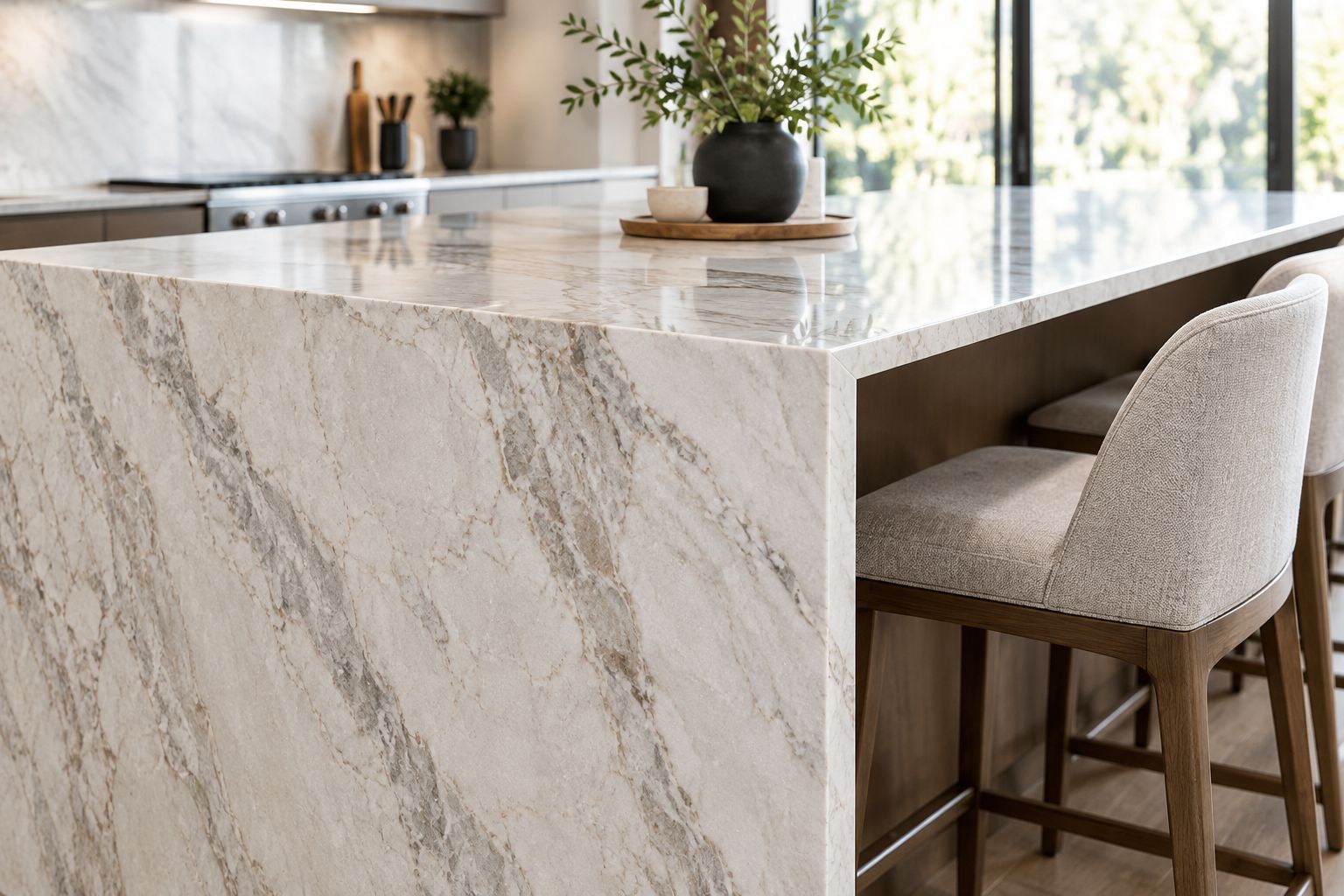
Vein continuity also needs a slab-layout decision. A miter does not automatically make patterns align, and a completed joint is not guaranteed to disappear. Approve the proposed relationship between the top and panel before cutting.
Slab thickness is another separate choice. Common countertop slab thicknesses include 2 centimeters and 3 centimeters; those measurements describe the slab, not the support needed for your particular island. A built-up edge can change apparent thickness without making the whole countertop equally thick.
What to approve before fabrication
Use this checklist with Soaresstone when discussing your custom stone countertop project. For your 2026 installation, a labeled drawing is more useful than an inspiration photo alone.
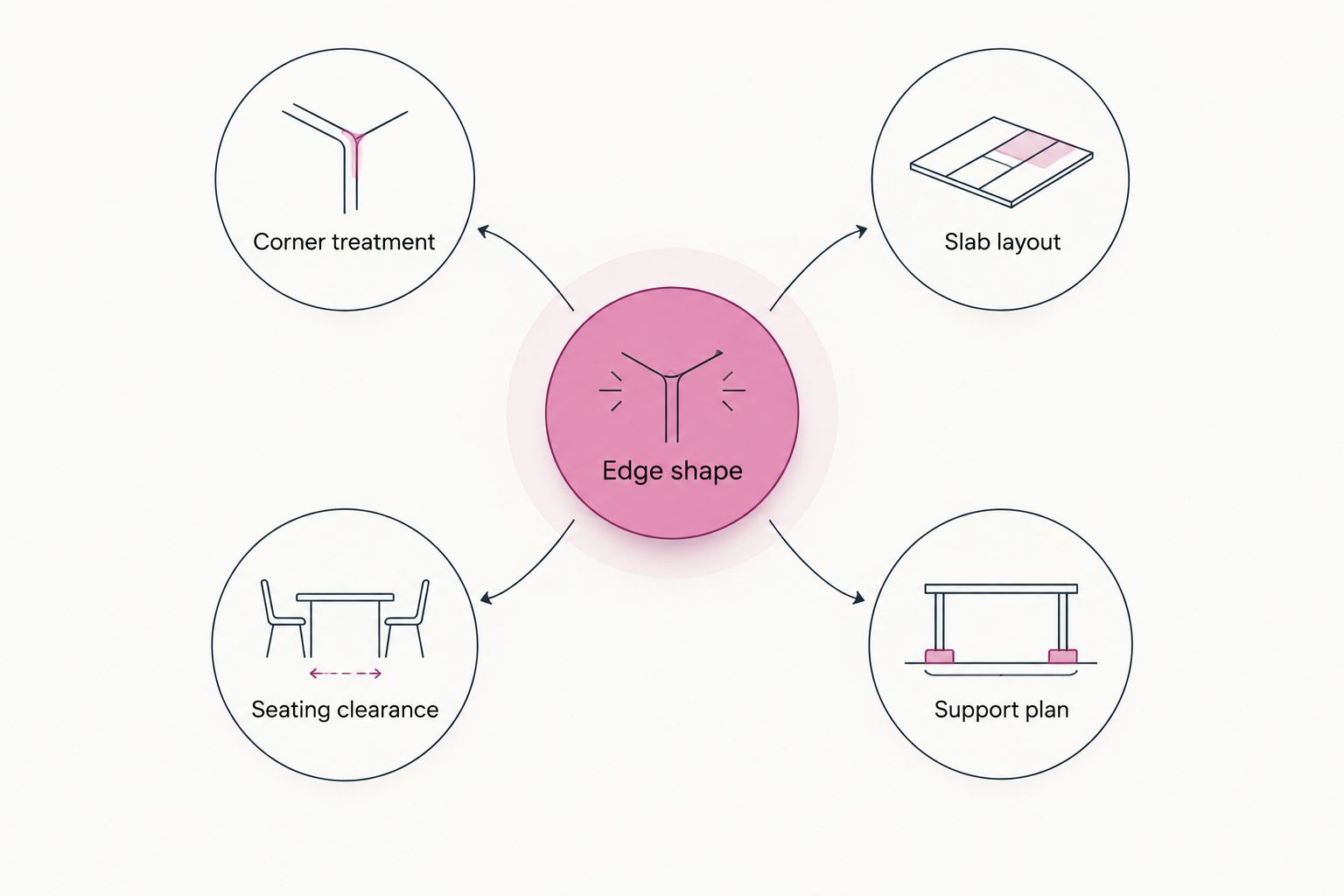
- Edge shape: Identify the profile on the seating edge and exposed panel edges.
- Corner treatment: Show the outside corners in plan view, including any rounding.
- Slab layout: Identify which pieces become the top and waterfall panel and how their patterns relate.
- Seating clearance: Show where stools, knees, and feet fit beside the panel.
- Support plan: Have the fabricator assess the countertop, overhang, cabinetry, and panel together.
The waterfall panel changes access at the end of the island. Sit at the proposed seating position before approving the layout; a pleasing edge shape cannot correct an obstructed seating area.
Ask for the edge detail to be recorded with the fabrication drawings. A reference sample shows the shape; the drawing identifies where that shape belongs. You need both to avoid ambiguity.
Discuss your waterfall island details
Bring your island layout and preferred edge profile to Soaresstone for a custom countertop discussion.
How the profiles are ranked
This ranking prioritizes visual continuity, contact comfort, and a clearly resolved waterfall junction. Eased leads because its restrained shape suits a straight-sided panel; pencil and bevel serve distinct priorities rather than acting as interchangeable runners-up. The ranking is a design guide, not a claim that any profile prevents damage.
Which edge should you choose?
Choose eased if you are undecided. Move to pencil for a rounder seating contact surface, or bevel when you want a visible geometric accent. Choose the more pronounced profiles only after reviewing their transition to the waterfall panel.
For your 2026 project, settle the slab layout and support requirements before treating the edge selection as final. The best-looking profile is the one that works with the complete island.
FAQ
What’s the best countertop edge profile for a waterfall island?
An eased edge is the best default for a waterfall island because it preserves a clean, straight-sided outline while softening exposed edges. Choose pencil for a rounder seating contact surface or bevel for a distinct geometric accent.
Is a mitered edge the same as an eased edge?
No. A miter describes a joint between pieces, while an eased edge describes the treatment of an exposed slab edge. A waterfall island can combine a mitered joint with eased exposed edges.
Is a pencil edge better than an eased edge for island seating?
A pencil edge is the better choice when you prefer a more rounded contact surface. Compare physical samples because fabricators do not always use eased and pencil to describe identical shapes.
Can I use a bullnose edge on a waterfall island?
A bullnose edge can be part of a waterfall island design, but its curved shape needs a clearly defined transition to the vertical panel. Approve a drawing that shows the countertop and panel together.
Will a mitered waterfall joint make the seam invisible?
A mitered waterfall joint does not guarantee an invisible seam. The finished appearance depends on the material, cut alignment, pattern relationship, and joint execution.
Does a waterfall panel replace support beneath island seating?
Do not treat a waterfall panel as an automatic replacement for overhang support. Have the fabricator assess the complete assembly, including cabinetry, material, overhang, and panel connections.
Can Soaresstone help with custom stone countertops?
Soaresstone fabricates and installs custom marble, granite, quartz, and quartzite countertops for New England homeowners. Discuss the exposed edge, waterfall junction, slab layout, and seating arrangement as separate project details.
One last thing
An edge profile does not round the island's footprint. A softly curved cross-section can still meet a projecting corner when viewed from above. Before approving fabrication, look down at the corner drawing and feel the edge sample; those checks answer different questions.
Related guides
- How to support a quartzite waterfall overhang
- Best quartzite slabs for waterfall edge islands
- How to plan a countertop template appointment