
Best overall: quartz. Best natural-stone all-rounder: granite. Best for dramatic natural veining: quartzite. Best for a patina-friendly entertaining bar: marble. For a 2026 indoor project, quartz is the best countertop material for built-in bar seating when easy cleanup matters more than natural-stone variation.
- Quartz is the best countertop material for built-in bar seating indoors when easy cleanup is your priority.
- Granite suits natural-stone seating counters; quartzite suits statement slabs; marble suits homeowners who accept etching.
- Soaresstone fabricates and installs custom countertops for New England homeowners planning built-in bar seating.
- Approve knee clearance, edge shape, and overhang supports before approving the countertop layout.
Your material choice and your seating layout need to work together. Soaresstone designs, fabricates, and installs custom marble, granite, quartz, and quartzite surfaces for New England homeowners.
Why this matters
A built-in seating counter has two jobs: hold drinks and food, and give people a comfortable place to sit. A surface that handles spills well still fails the project if brackets crowd your knees or the stools sit too close together.
For your 2026 remodel, separate everyday maintenance from structural design. Quartz simplifies routine care, but it does not eliminate the need for a properly designed overhang. Natural stone adds individual character, but its appearance does not establish how far it can extend unsupported.
Choose the material for your habits; design the support for your actual slab and layout. Neither decision replaces the other.
What makes the best countertop for built-in bar seating?
Use these criteria to compare materials before choosing a color:
- Spill tolerance: Think about wine, coffee, citrus juice, and cooking oils—not just water. Staining and acid etching are different problems.
- Maintenance: Quartz does not require sealing. Natural-stone sealing needs depend on the stone and its absorbency; sealing does not make marble acid-resistant.
- Edge comfort: A softened edge is a practical starting point where forearms rest and people slide onto stools.
- Support compatibility: Slab thickness, cutouts, seams, overhang depth, and cabinet construction all belong in the support discussion.
- Visual continuity: Decide whether you want controlled patterning or the individual movement of a natural slab. Review the seating edge as well as the top.
- Room conditions: This ranking assumes an indoor bar. Outdoor exposure requires a separate material review, particularly for engineered quartz.
Do not choose from a small sample alone. For your 2026 selection appointment, review the intended slab or product pattern, the finish, and the proposed seam locations together.
Built-in bar countertop materials at a glance
| Material | Best for | Standout feature | Key limitation |
|---|---|---|---|
| Quartz | Everyday indoor seating with straightforward care | Nonporous engineered surface that needs no sealing | Vulnerable to heat damage; outdoor suitability is product-specific |
| Granite | Natural-stone seating counters used daily | Individual slab patterns with good everyday durability | Absorbency varies, and some slabs need sealing |
| Quartzite | A statement bar with natural veining | Hard natural stone with distinctive movement | Sealing needs and slab characteristics require review |
| Marble countertops for built-in bar seating | Entertaining spaces where patina is welcome | Natural veining and a surface that develops visible wear | Citrus and other acids can etch the finish |
The table ranks these materials by their fit for different households, not by an assumed universal quality score. Every option needs an approved fabrication and support plan.
1. Quartz: best countertop for everyday indoor bar seating
Quartz countertops combine mineral material with binders to create an engineered surface. Their nonporous character and lack of sealing requirements make them a practical default for indoor seating counters used for meals, homework, and drinks.
You still need to wipe up spills and follow the product's care instructions. Quartz is low-maintenance, not damage-proof, and its binders make heat protection important.
Quartz pros:
- Requires no routine sealing.
- Offers many controlled color and pattern choices.
- Supports straightforward everyday cleanup with appropriate cleaners.
- Works for seating counters that visually connect to surrounding kitchen surfaces.
Quartz cons:
- Hot cookware and concentrated heat can damage the surface; use trivets.
- Engineered patterns do not reproduce every detail of a natural slab.
- Outdoor use requires explicit manufacturer approval.
Best for: Homeowners who want an indoor bar that fits ordinary family routines without adding sealing to their maintenance list.
Check the actual pattern before approving fabrication. If a design includes prominent veins, ask how those veins will meet at seams and continue across any vertical panels.
Verdict: Buy quartz for everyday indoor bar seating when easy care is your deciding factor.
2. Granite: best countertop for a daily-use natural-stone bar
Granite gives you a natural slab rather than an engineered pattern. Its combination of mineral variation and everyday durability makes it a strong choice when you want natural stone without accepting marble's sensitivity to acidic drinks.
The individual slab matters. Color, mineral structure, finish, and absorbency vary, so care requirements should follow the selected stone rather than a generic annual sealing schedule.
Granite pros:
- Offers natural variation across the slab.
- Handles everyday countertop use well with appropriate care.
- Is generally less vulnerable to acid etching than marble.
- Suits both quiet patterns and more visually active designs.
Granite cons:
- Some slabs need sealing to help resist absorbed stains.
- Strong pattern changes can make seams more noticeable.
- Edges can chip from impact, particularly around exposed corners.
Best for: Homeowners who want a natural-stone seating counter for regular meals and entertaining.
Inspect the slab as a whole, not just its most attractive corner. For a long bar, ask where the seating edge, seams, and sink cutout will fall within the pattern.
Use trivets even though granite tolerates heat better than resin-bound quartz. Thermal shock and damage to treatments remain reasons to protect the finished countertop.
Verdict: Buy granite when natural variation and daily use matter more than eliminating sealing.
3. Quartzite: best countertop for statement natural veining
Quartzite is a natural metamorphic stone; it is not another name for engineered quartz. It suits a built-in bar where you want the slab's movement to be a central part of the room.
True quartzite is hard, but hardness does not settle stain resistance or structural support. Review the slab's identity, absorbency, fissures, and fabrication requirements before committing to a large seating overhang.
Quartzite pros:
- Offers naturally occurring veining and mineral variation.
- Provides a hard surface suited to countertop use.
- Creates visual continuity when the layout follows the slab's movement.
Quartzite cons:
- Sealing needs depend on the selected slab.
- Natural fissures and variation require careful fabrication planning.
- Stone sold under informal trade names needs its care requirements confirmed.
Best for: Homeowners making natural veining the focal point of an indoor bar or adjoining kitchen.
Ask the fabricator to explain the selected slab's care requirements rather than relying on its showroom name alone. Also review how the pattern will look from a seated position, where the front edge and any vertical panels become especially visible.
Verdict: Buy quartzite for a statement bar after approving the actual slab and support design.
4. Marble: best countertop for a patina-friendly entertaining bar
Marble suits homeowners who enjoy natural veining and accept changes in the finish. It is a deliberate lifestyle choice for a bar, because citrus juice and other acids can leave etched areas even when the stone is sealed.
Etching is a chemical change to the surface, not simply a stain. If a cocktail ring would bother you every time you saw it, choose a different material.
Marble pros:
- Offers distinctive natural veining.
- Works with polished or honed finishes for different visual effects.
- Develops patina that some homeowners prefer to an unchanging surface.
Marble cons:
- Acidic drinks can etch the finish.
- Absorbed spills can stain susceptible stone.
- Softer stone requires care around impacts and abrasive cleaning.
Best for: Homeowners who prioritize marble's appearance and are comfortable with visible wear.
A honed finish changes how etching looks; it does not prevent the reaction. Coasters, prompt cleanup, and suitable cleaners help manage use, but they do not turn marble into quartz.
Verdict: Buy marble only if patina is part of the appeal; skip marble if you expect an unchanged finish.
Plan comfortable seating before approving the slab
For a 2026 bar project, start with how people sit—not how far you want the countertop to project. Seat width, knee space, stool height, and walking clearance need to work as one layout.
The National Kitchen & Bath Association's kitchen planning guidelines use 24 inches of width per seated diner. They also specify 15 inches of knee-space depth at a 36-inch-high counter, and 12 inches at a 42-inch-high counter. These are seating-planning dimensions, not permission to leave those depths unsupported.
Use this sequence with your fabricator and cabinet installer:
- Seating height: Decide between counter-height and raised-bar seating, then match the stools to the finished height.
- Knee clearance: Check both depth and width using the actual cabinet face and intended seating positions.
- Support layout: Locate brackets or other supports without sacrificing the knee space you just planned.
- Edge profile: Choose a comfortable finished edge and review exposed corners.
- Slab layout: Approve seams, cutouts, and pattern placement after the seating and support decisions.
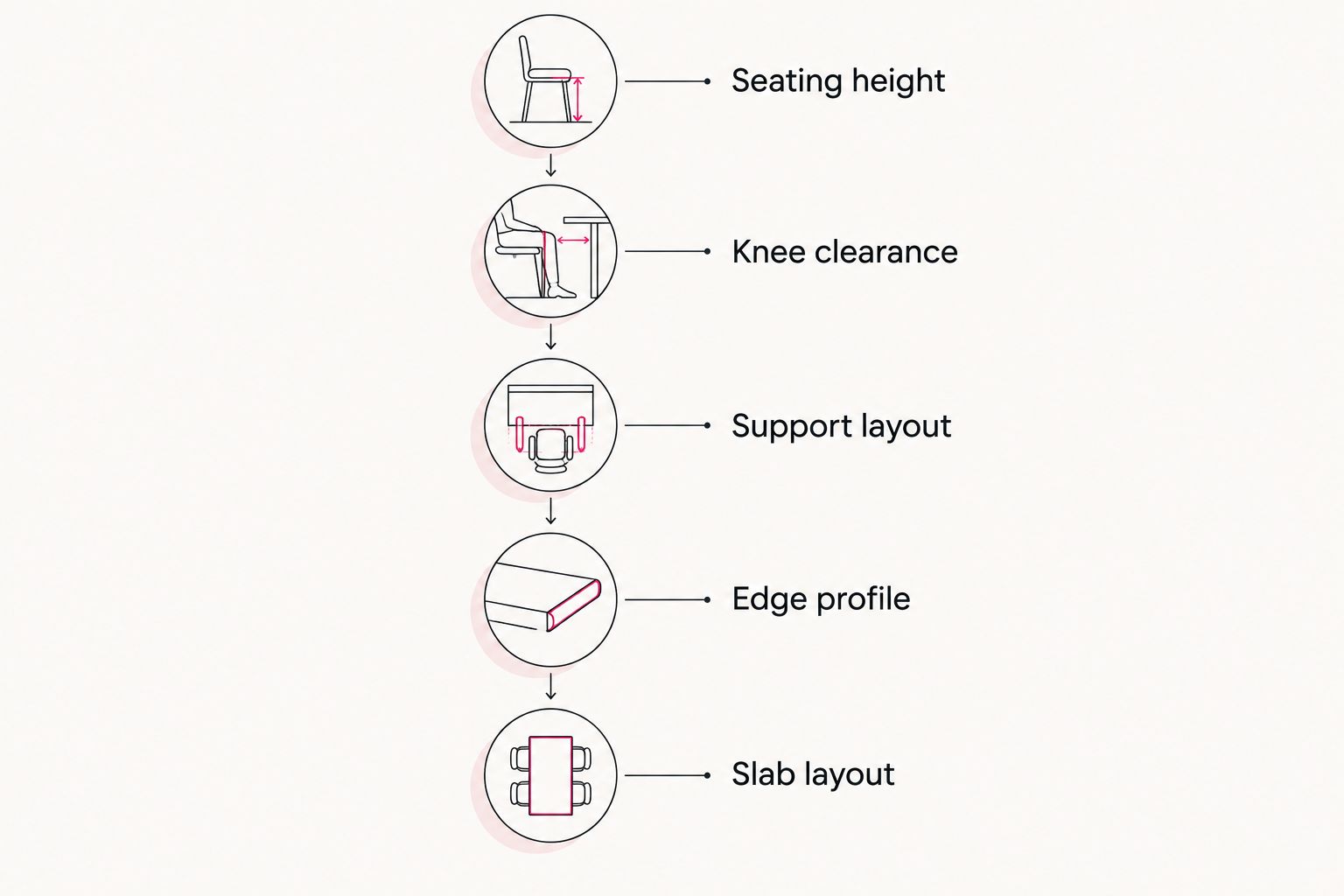
Test the proposed layout with your intended stools. Sit down, rest your forearms on a mock edge, and check whether your knees meet the cabinet or a planned bracket.
A comfortable seating space is not a structural calculation. Soaresstone's custom countertop fabrication and installation service covers the stonework; clarify responsibilities for cabinetry and support construction within your project scope.
Overhangs, edges, and seams: what to approve
No material in this ranking earns an automatic unsupported-overhang allowance. The safe design depends on the specific material, thickness, slab condition, support system, and installation instructions.
Ask for the support arrangement to be shown on the layout. A countertop described as “strong stone” still needs its overhang designed; a waterfall panel should not be assumed to provide support without confirmation.
For the seating edge, an eased or gently rounded profile is a sensible starting point. Review a physical sample and avoid making a decorative edge the priority over comfort or exposed-corner safety.
Seams deserve the same attention. Ask where each seam will sit relative to the seating area, sink, and natural pattern, and understand that good seam planning does not mean an invisible joint.
Before approving your 2026 fabrication drawing, confirm:
- The finished countertop height and seating positions.
- The intended overhang and support locations.
- The edge profile and treatment of exposed corners.
- The seam positions and relevant material instructions.
- Responsibility for any cabinet or support changes.
Plan your custom seating countertop
Discuss quartz, granite, quartzite, or marble fabrication and installation for your New England home.
How these materials are ranked
This 2026 ranking prioritizes spill tolerance, maintenance, edge comfort, support compatibility, appearance, and room conditions. Quartz leads for everyday indoor use because it removes sealing from the care routine; granite, quartzite, and marble each serve a different natural-stone preference.
The ranking does not assign laboratory scores or universal support limits. Those depend on the selected material and project details.
Which countertop should you choose?
Choose quartz if you are undecided and the bar is indoors. Choose granite for everyday natural stone, quartzite for prominent natural veining, or marble when you accept etching and patina.
Soaresstone is a fit for New England homeowners seeking custom countertop fabrication and installation for built-in bar seating. Bring the intended stool layout into that conversation, not just a color sample.
FAQ
What’s the best countertop material for built-in bar seating?
Quartz is the best default for everyday indoor built-in bar seating because it is nonporous and does not require sealing. Granite suits daily-use natural-stone counters, quartzite suits statement veining, and marble suits homeowners who accept patina.
Is quartz better than granite for a breakfast bar?
Quartz is better when avoiding sealing is your priority; granite is better when natural slab variation matters more. Both require appropriate cleaning, heat protection, and a properly designed seating overhang.
Can marble handle drinks at a built-in bar?
Marble can serve as a bar countertop, but acidic drinks can etch its finish. Sealing helps address absorbed staining; it does not prevent acid etching.
How much space does each person need at a seating counter?
The National Kitchen & Bath Association’s kitchen planning guidelines use 24 inches of width per seated diner. Check the actual stools and support locations so the planned space remains usable.
How deep should knee space be under a countertop?
NKBA kitchen planning guidelines specify 15 inches of knee-space depth at a 36-inch-high counter and 12 inches at a 42-inch-high counter. These seating dimensions do not establish a safe unsupported overhang.
Does a quartzite bar overhang need support?
A quartzite bar overhang needs a project-specific support review. The selected slab, thickness, overhang, cutouts, and support arrangement determine the design; hardness alone does not establish a safe span.
What countertop edge works best for bar seating?
An eased or gently rounded edge is a practical starting point for bar seating. Review a physical sample for forearm comfort and discuss exposed corners with the fabricator.
Can I use the same quartz countertop outside?
Use engineered quartz outside only when its manufacturer explicitly approves that application. This ranking recommends quartz for indoor seating, not as a blanket outdoor recommendation.
One last thing
Measure usable knee space, not just countertop projection. Decorative panels, cabinet faces, and supports can occupy the space beneath the edge even when the top extends far enough on paper.
For your 2026 project, approve that usable space before fabrication. A beautiful slab cannot correct a seating layout that leaves nowhere comfortable to put your knees.
Related guides
- How to choose an overhang for island seating
- Best countertop edge profile for bar seating
- How to plan a countertop template appointment