
Best overall: quartz. Best natural stone for everyday cooking: granite. Best for distinctive natural veining: quartzite. Best for a traditional kitchen where patina is welcome: marble. This guide compares the best countertop material for condo renovation by daily care, appearance, durability, and installation constraints.
- Quartz is the best countertop material for condo renovation when low maintenance is your priority.
- Granite suits everyday cooks who want natural stone and accept sealing when needed.
- Quartzite offers distinctive natural veining; marble suits homeowners who accept etching and wear.
- Soaresstone fabricates and installs custom stone countertops for New England homeowners.
- Confirm building access, cabinet support, and seam placement before approving your countertop layout.
Why this matters
A condo countertop must work inside your kitchen and make it through your building. Elevator dimensions, stair turns, renovation rules, and cabinet condition belong in the decision—not just the slab color.
For a 2026 condo renovation, start with the maintenance you will actually do. A beautiful surface becomes the wrong choice when its care requirements clash with your cooking habits.
Soaresstone is a fit for New England condo owners seeking custom stone countertop fabrication and installation. The family-owned business works with marble, granite, quartz, and quartzite for homeowners’ kitchens, bathrooms, and fireplaces.
What makes the best countertop material for a condo renovation?
These criteria separate a practical choice from a showroom favorite:
- Daily care: Decide whether you want a surface that needs no sealing or accept checking natural stone for sealing needs.
- Cooking durability: Compare resistance to scratches, stains, heat, and acidic spills separately. No material wins every category.
- Visual balance: View the surface beside your cabinets, flooring, and backsplash. A sample alone does not show the full kitchen.
- Fabrication fit: Review sink cutouts, seams, edge profiles, and overhang support before approving the layout.
- Building access: Confirm the delivery route and applicable renovation requirements with building management and your installer.
- Tolerance for wear: Choose marble only if dull spots and surface marks will feel like character rather than damage.
The best choice is the material whose limitations you can live with. In 2026, quartz remains the default recommendation here because it removes sealing from routine countertop care—not because it is indestructible.
Condo countertop materials at a glance
| Material | Best for | Standout feature | Key limitation |
|---|---|---|---|
| Quartz | Low-maintenance daily use | Nonporous engineered surface that needs no sealing | Heat can damage the resin binder |
| Granite countertops for condo renovations | Everyday cooking with natural stone | Natural patterning and strong scratch resistance | Sealing needs vary by stone |
| Quartzite | A statement kitchen with natural veining | Hard natural stone with distinctive slab variation | Requires careful slab identification and sealing assessment |
| Marble | Traditional kitchens that welcome patina | Natural veining and a classic appearance | Acids cause etching; scratches are a concern |
The table ranks materials by use case, not by a universal quality score. Quartzite is not automatically better than granite, and marble is not a failed countertop simply because it develops wear.
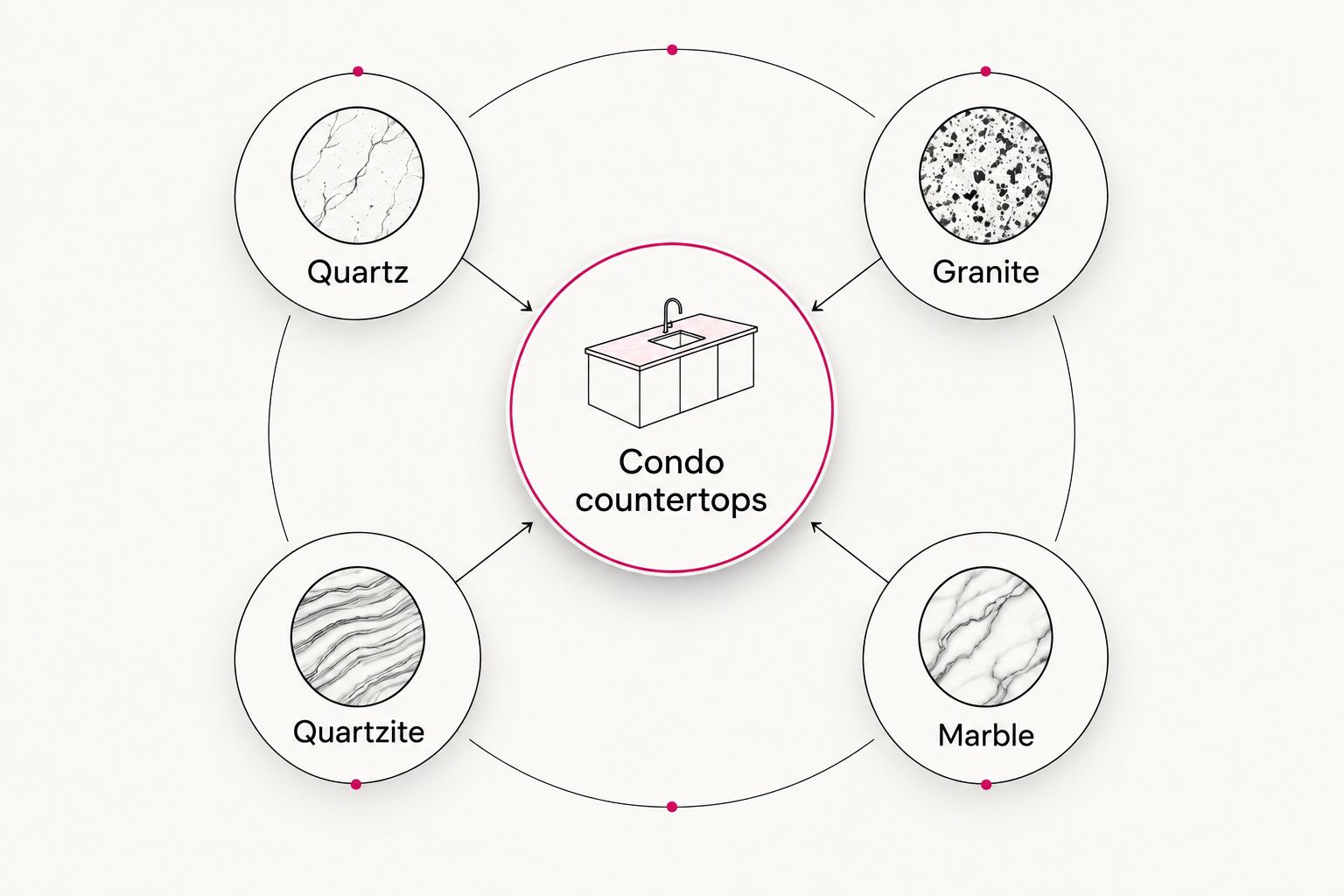
1. Quartz: best condo countertop material for low-maintenance use
Quartz countertops are engineered surfaces made with mineral content and binders. They are nonporous and do not require sealing, making them a practical choice when you want straightforward daily care.
Quartz also gives you more control over the overall pattern than a naturally variable stone slab. Still, inspect the selected design across a larger surface: a small sample cannot show how a prominent vein will cross an island or meet a seam.
Quartz pros:
- No routine sealing requirement.
- Nonporous surface resists absorption of everyday spills.
- Manufactured patterns support a coordinated kitchen design.
- Suitable for homeowners who want simple countertop care.
Quartz cons:
- Direct heat can damage the resin binder; use trivets.
- Harsh cleaners and abrasive pads can damage the surface.
- Strong patterns require attention at seams and corners.
Best for: Condo owners who cook regularly and want low-maintenance countertops without choosing natural stone.
For a compact kitchen, assess quartz under your actual lighting before choosing a bright white or strongly veined design. Keep the backsplash sample beside it. Two individually appealing patterns can compete when installed together.
Verdict: Buy quartz if easy daily care is your first priority.
2. Granite: best condo countertop material for everyday natural stone
Granite is natural stone with patterns that vary from slab to slab. It offers strong resistance to everyday scratching and suits homeowners who want a natural surface for an active kitchen.
Granite tolerates heat better than resin-bound quartz, but that is not permission to place hot cookware directly on it. Use trivets to reduce thermal stress and protect the surface treatment.
Granite pros:
- Natural mineral patterns give each slab an individual appearance.
- Strong scratch resistance supports regular kitchen use.
- Better heat tolerance than resin-bound quartz.
- Different patterns support both understated and expressive kitchens.
Granite cons:
- Absorption and sealing needs vary by slab.
- Busy patterns need careful coordination with cabinets and tile.
- Edges can chip, especially around exposed corners.
Best for: Everyday cooks who prefer natural stone and accept checking whether the surface needs sealing.
Ask to see the actual slab rather than choosing entirely from a small sample. Check the areas intended for the sink run and peninsula; a mineral cluster that looks attractive in isolation can become distracting beside a cutout.
Verdict: Buy granite if natural stone and everyday cooking durability matter more than eliminating sealing checks.
3. Quartzite: best condo countertop material for distinctive natural veining
Quartzite is a natural metamorphic stone, not another name for engineered quartz. It suits a kitchen where the countertop is a main design feature and you want natural variation across the surface.
True quartzite is hard, but a material name alone is not enough to approve a slab. Confirm the stone’s identity, care requirements, and fabrication details before committing to a heavily veined layout.
Quartzite pros:
- Natural veining creates an individual surface.
- True quartzite offers strong scratch resistance.
- Large slab patterns can become the kitchen’s visual focal point.
Quartzite cons:
- Absorption and sealing needs depend on the stone.
- Slab variation makes layout approval especially important.
- Cutouts and exposed edges require careful fabrication planning.
Best for: Condo owners who want a statement natural-stone kitchen and will review the slab layout closely.
For an island or peninsula, discuss where prominent veins stop, turn, or meet another piece. Do not assume a waterfall panel will match automatically. Ask how the selected slab will be divided and which transitions will remain visible.
Soaresstone includes quartzite among its custom countertop fabrication and installation materials. Discuss the actual slab and layout rather than treating all quartzite as interchangeable.
Verdict: Buy quartzite for natural visual character; hold approval until slab identity and layout are clear.
4. Marble: best condo countertop material for a traditional, lived-in kitchen
Marble is natural stone valued for its veining and classic appearance. It suits homeowners who want that look and accept the surface changes that come with kitchen use.
Acidic ingredients such as lemon juice and vinegar can etch marble, leaving dull areas even without a colored stain. Sealer helps reduce absorption; it does not prevent acid etching.
Marble pros:
- Natural veining suits traditional kitchen designs.
- Slab variation gives the surface individual character.
- Develops a lived-in appearance for owners who welcome patina.
Marble cons:
- Acidic spills can etch the surface.
- Scratches occur more readily than on harder stone options.
- Sealing does not make marble stain-proof or etch-proof.
Best for: Homeowners who prioritize marble’s appearance and accept visible signs of use.
A honed finish changes how marble looks; it does not change marble into an acid-resistant material. Inspect polished and honed samples, then decide whether you like both the new surface and the idea of future wear.
Verdict: Buy marble only if patina is part of the appeal; skip marble if you expect an unchanged finish.
How we ranked these countertop materials
This 2026 ranking puts daily care first, followed by cooking durability, appearance, and condo installation fit. It separates staining from etching and heat resistance from permission to set down hot pans.
Quartz takes the default position because it needs no sealing. Granite leads the everyday natural-stone option; quartzite leads the statement-slab option; marble serves homeowners who knowingly accept patina.
Building access does not make one material universally superior. It changes the fabrication plan, piece sizes, seam locations, and delivery approach that your installer needs to assess.
Before ordering: confirm the condo installation plan
Your material choice is only part of the project. Before approving fabrication for a 2026 installation, work through these checks with your fabricator and building management.
Building rules
Ask which approvals, contractor documents, work hours, and common-area protections apply to your renovation. Confirm any elevator reservation requirements before setting the installation date.
Do not assume a countertop replacement follows the same rules as painting. Plumbing disconnection, demolition, and material delivery introduce separate coordination needs.
Delivery route
Have the installer assess the route from unloading to your kitchen, including doors, elevator openings, landings, and tight turns. A slab that fits the kitchen layout still needs a workable path into the unit.
Review proposed seams against that route. Fewer seams are not a useful goal if the planned piece cannot enter the building safely.
Cabinet support
Confirm that the cabinets are stable, level, and suitable for the selected countertop. Existing cabinetry should be assessed before it receives a new stone surface.
Common slab thicknesses include 2 cm and 3 cm. A 2 cm slab is 20 mm thick, but thickness alone does not determine whether an overhang or cutout needs support; material, layout, and fabrication details matter.
Sink details
Finalize the sink, faucet arrangement, and appliance information before templating. These choices determine openings and clearances that cannot be treated as finishing touches.
Ask who handles plumbing disconnection and reconnection. Keep those responsibilities clear rather than assuming countertop installation includes every related trade.
Seam placement
Review seam locations on the proposed layout before fabrication. Consider how the seams relate to veining, corners, the sink, and the views from your living area.
In an open-plan condo, the kitchen is visible from more than the cooking position. Evaluate the countertop from the entry and seating area as well.
Soaresstone fabricates and installs custom stone countertops; bring your building requirements and kitchen details into the project discussion.
Discuss your condo countertop project
Compare marble, granite, quartz, and quartzite for your kitchen renovation.
Which countertop material should you choose?
Choose quartz if you are undecided and want the simplest maintenance routine. It is the best countertop material for condo renovation when your priorities are everyday practicality and no sealing.
Choose granite when you want natural stone for regular cooking. Choose quartzite when the slab’s natural veining is central to the design. Choose marble when you like the material enough to accept etching and scratches.
For your 2026 renovation, make the final choice in this order: care requirements, actual sample or slab, then installation plan. Do not approve a material you love visually but dislike maintaining.
FAQ
What’s the best countertop material for a condo renovation?
Quartz is the best default for a condo renovation when low maintenance is the priority. It needs no sealing, but you still need trivets, suitable cleaners, and a confirmed installation plan.
Is granite better than quartz for a condo kitchen?
Granite is better for homeowners who want natural stone, while quartz is better for homeowners who want no sealing requirement. Granite has better heat tolerance, but both surfaces should be protected from hot cookware.
Are quartz and quartzite the same countertop material?
Quartz and quartzite are different materials. Quartz countertops are engineered surfaces with binders; quartzite is natural stone whose sealing and fabrication needs should be assessed for the selected slab.
Can I use marble in a condo kitchen?
You can use marble in a condo kitchen if you accept etching and surface wear. Acidic spills can leave dull spots, and sealing does not prevent that reaction.
Do condo countertops need to be approved by the building?
Check your building’s renovation rules before ordering countertops. Ask management about approvals, contractor documents, work hours, elevator reservations, and protection of shared areas.
Can a stone countertop fit through a condo elevator?
A stone countertop needs a delivery-route assessment before fabrication. The installer should check openings, turns, and usable elevator space, then plan piece sizes and seams accordingly.
Does Soaresstone install countertops for New England homeowners?
Soaresstone fabricates and installs custom marble, granite, quartz, and quartzite surfaces for New England homeowners. Its work includes kitchens, bathrooms, and fireplaces.
One last thing
A sealed stone countertop is not an acid-proof countertop. That distinction matters most with marble: a dull lemon-juice mark is etching, not necessarily a stain, so more sealer is not the answer.
Before approving your surface, ask how to identify and respond to its most likely damage. Knowing the difference between a stain, an etch, and a chip is more useful than a vague promise that a material is durable.
Related guides
- Choose between granite and quartz for a kitchen remodel
- Prepare your kitchen for countertop installation
- Plan a countertop template appointment