
Best overall: quartz. Best for natural-stone character: granite. Best for distinctive natural veining: quartzite. Best for a decorative writing desk: marble. Quartz is the best countertop material for home office use when you want straightforward cleaning and a surface that does not require sealing; start with quartz countertops for home offices.
- Quartz is the best countertop material for home office use when easy cleaning is your priority.
- Granite suits home office countertops where natural pattern matters more than maintenance simplicity.
- Quartzite offers natural veining, but slab selection and sealing need attention.
- Marble suits decorative writing desks, not workstations where spills and surface marks will bother you.
Why this matters
A home office countertop is furniture you work against, not just a surface you look at. Your forearms touch the edge, your chair needs clearance underneath, and your monitor needs a stable position. A beautiful slab cannot fix an uncomfortable desk layout.
For your 2026 project, choose the material around the work you actually do. Computer work, handwritten notes, coffee breaks, and craft projects place different demands on the same surface. Separate the essential requirements from the appearance preferences before selecting a slab.
Soaresstone is a fit for New England homeowners seeking custom stone or quartz fabrication and installation. The family-owned business designs and installs marble, granite, quartz, and quartzite surfaces; discuss the home office application directly rather than assuming a kitchen layout transfers unchanged.
What makes the best home office countertop material?
Use these criteria to judge the materials before you compare their patterns:
- Cleaning and sealing: Decide whether you want a surface without sealing requirements or accept the care that natural stone needs.
- Surface durability: Consider spills, dragged equipment, writing tools, and accidental impacts. Scratch resistance does not make a surface chip-proof.
- Desk comfort: Check the front edge, knee clearance, and room for your chair. A hard surface still needs a comfortable workstation layout.
- Lighting and finish: Examine samples under your task lighting. A glossy finish reflects light differently from a honed finish.
- Fabrication and support: Plan seams, cable openings, supports, and equipment mounts before cutting the slab.
- Visual character: Choose between an engineered pattern and the variation of a natural slab. Neither automatically makes a better working surface.
For a 2026 shortlist, prioritize upkeep and comfort before decorative details. You will touch the edge and clean the desktop repeatedly; an elaborate profile or dramatic pattern does not compensate for a layout that gets in your way.
Home office countertop materials at a glance
| Material | Best for | Standout feature | Key limitation |
|---|---|---|---|
| Quartz | Everyday computer work with simple upkeep | Nonporous engineered surface that does not require sealing | Heat and chemical exposure need care |
| Granite | A workstation with natural-stone character | Natural mineral patterns and good scratch resistance | Sealing needs vary by slab |
| Quartzite | A statement built-in with natural veining | Hard natural stone with varied veining | Slab identification, fabrication, and sealing need attention |
| Marble | A decorative writing desk | Natural veining and a softer visual appearance | Acids etch the surface, and scratches are a concern |
These rankings address desk use, not kitchen cooking demands. All the stone options need a support plan, and none should be treated as a ready-made desktop that you can place on arbitrary legs.
1. Quartz: best home office countertop for everyday computer work
Quartz is an engineered countertop material made with mineral particles and binders. Its nonporous surface does not require sealing, making it a practical default for a desk used for typing, paperwork, and ordinary daily cleanup.
Choose the actual sample, not just the material name. Quartz comes in different patterns and finishes, and a visually quiet design can keep the desktop from competing with your documents and screen. Test the sample beside your cabinet finish and under the lamp you intend to use.
Quartz pros:
- Does not require the sealing associated with many natural-stone slabs.
- Offers good resistance to everyday staining when you follow the manufacturer's care instructions.
- Provides engineered patterns when you want a coordinated appearance across a built-in.
- Works as a custom-fabricated surface with planned edges and cable openings.
Quartz cons:
- Resin binders make direct heat exposure a concern; keep hot equipment off the surface.
- Strong chemicals and abrasive cleaning methods can damage the finish.
- Edges remain vulnerable to impact, despite the material's scratch resistance.
Best for: A daily computer workstation where easy upkeep matters more than having a natural slab.
At a Soaresstone quartz countertop consultation, explain where your keyboard, monitor arm, and cable opening will sit. Get those details settled before fabrication rather than treating them as installation-day adjustments.
Verdict: Buy quartz for the default home office countertop.
2. Granite: best home office countertop for natural-stone character
Granite is natural stone with mineral patterns that vary from slab to slab. It suits a built-in desk when you want the surface itself to contribute texture and character without choosing marble's more sensitive working surface.
Select the slab in person when possible. A small sample does not show the full distribution of movement, patches, or mineral contrast across a long desktop. Look at the area that will become your main writing and keyboard zone, not only the most striking section.
Granite pros:
- Offers natural patterns rather than a repeated engineered design.
- Resists ordinary scratching better than softer stones such as marble.
- Provides a stone surface suitable for a professionally supported built-in.
- Offers different finishes to assess against your lighting and room design.
Granite cons:
- Absorbency and sealing requirements vary; get care instructions for the selected slab.
- Strong patterns can make a desktop visually busy.
- Exposed edges can chip if struck by hard equipment or furniture.
Best for: A homeowner who wants natural-stone variation and accepts slab-specific maintenance.
For granite, ask how the proposed seam and cut layout will affect the pattern. The best-looking slab section on a showroom rack is not necessarily the section that will occupy your desk. Review the layout before approving fabrication.
Verdict: Buy granite when natural character is your priority; choose quartz when simpler upkeep wins.
3. Quartzite: best home office countertop for a veined statement built-in
Quartzite is a natural metamorphic stone, not another name for engineered quartz. It is a strong option when your office countertop needs to be a prominent design feature and you want natural veining with a hard working surface.
The distinction between quartz and quartzite matters more than their similar names. Quartzite selection requires attention to the actual stone, its treatment, and its care instructions. Do not assume that a marble-like appearance means marble-like performance—or that a sales label settles every question.
Quartzite pros:
- Offers natural veining and slab-to-slab variation.
- Provides a hard surface with good scratch resistance.
- Creates a focal point across a long built-in desktop.
- Gives you a natural-stone alternative when marble's sensitivity is unsuitable.
Quartzite cons:
- Sealing and stain prevention still require attention.
- Fabrication and support must account for the slab and layout.
- A small sample cannot represent the full veining arrangement.
Best for: A design-led home office where the countertop is a visible feature and natural-stone care is acceptable.
For your 2026 selection, ask the fabricator to identify the stone and explain its maintenance requirements. Review the proposed cuts around veins, seams, and cable openings. Attractive veining is useful only if you like where it lands in the finished desk.
Verdict: Buy quartzite for natural veining; skip it if your main goal is maintenance simplicity.
4. Marble: best home office countertop for a decorative writing desk
Marble is a natural stone valued for its veining and appearance. It fits a decorative writing desk or occasional-use workspace when you accept that the surface will develop marks rather than remain visually unchanged.
Acidic spills can etch marble, leaving dull areas rather than just stains. Sealing helps manage absorption but does not prevent acid etching. Coffee breaks, citrus drinks, and careless cleaning therefore deserve more attention than they would on a quartz desktop.
Marble pros:
- Offers distinctive natural veining.
- Suits a room where the desk is an important decorative element.
- Provides different finishes to compare with the surrounding furniture.
Marble cons:
- Acids can etch the surface even when it has been sealed.
- Scratches and edge damage require care.
- Keeping an unmarked appearance demands more attention than quartz.
Best for: An occasional writing desk whose owner accepts visible wear as part of using natural stone.
Choose marble because you want marble, not because you expect sealing to remove its limitations. Put a protective writing pad under your work area and use coasters. Those habits reduce exposure; they do not make marble resistant to every spill or scratch.
Verdict: Hold on marble unless you are comfortable with surface changes.
Plan the desktop before choosing the slab
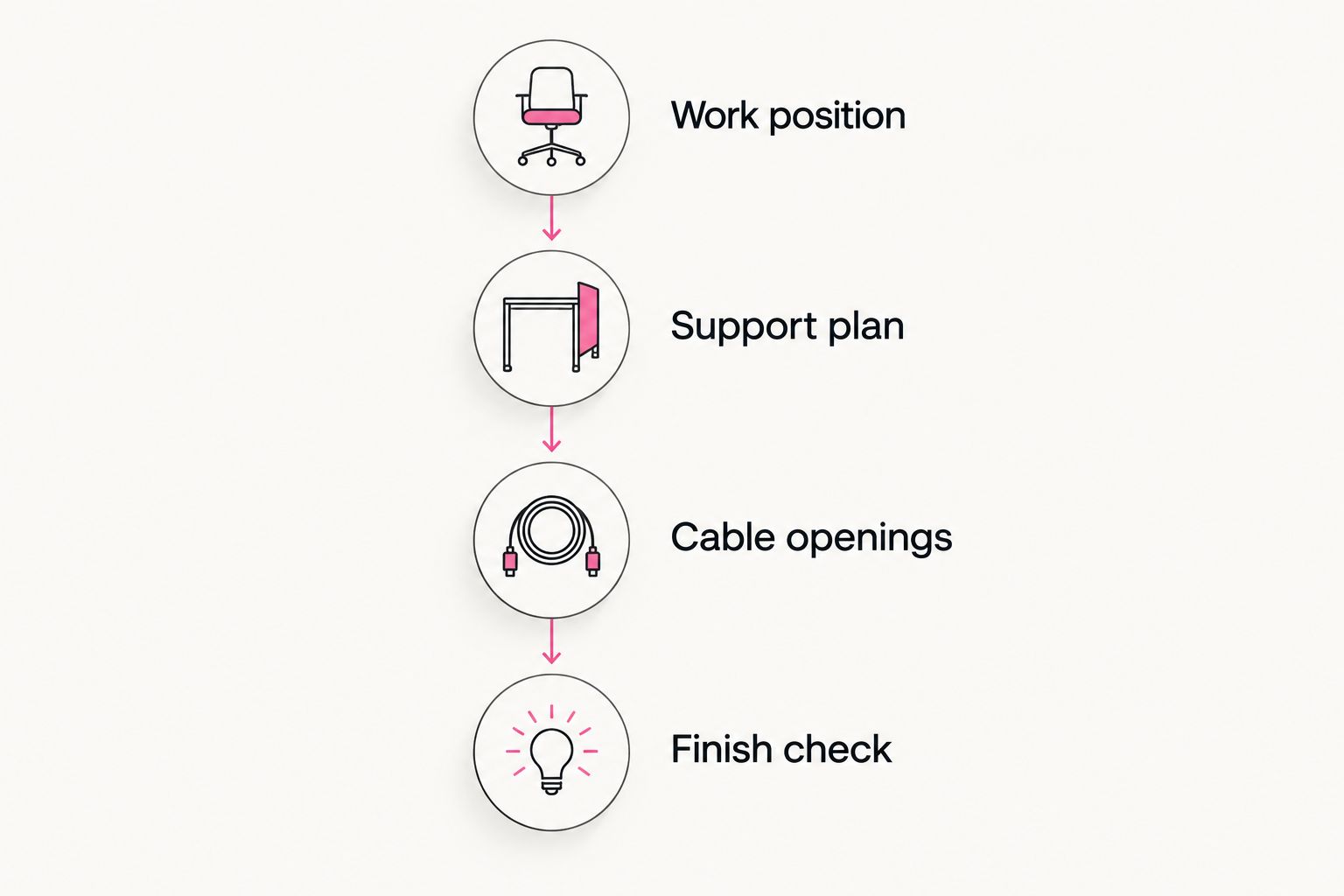
A material decision is only part of a successful workstation. For a 2026 installation, take the following sequence into the design conversation so support, comfort, and equipment are considered together.
Work position
Set up your chair, keyboard, and monitor before finalizing the countertop dimensions. OSHA's Computer Workstations guidance generally recommends an eye-to-screen distance of 20–40 inches. Use that range as a workstation reference, not as a prescribed countertop depth: monitor stands, wall clearance, and your seated position affect the layout.
Support plan
Ask the fabricator to review the cabinet arrangement, open knee space, and any unsupported sections. Stone is heavy and brittle under the wrong loading conditions. A wide opening beneath a desk needs a deliberate support design, not an assumption that the slab will bridge it safely.
Countertop slabs commonly use nominal 2 cm or 3 cm thicknesses. Neither thickness alone establishes a safe unsupported span. The material, openings, supports, and intended equipment all matter.
Cable openings
Mark power access, cable routes, and equipment mounts before fabrication. A monitor arm that clamps beneath the front edge needs clearance from cabinets and supports. Have the fabricator review the mounting method; do not drill or modify the finished stone yourself.
Finish check
Inspect a sample under daylight and your task lamp. Put a notebook and keyboard beside it, then check reflections and the feel of the edge. Judge the working position, not only the view from the doorway.
Bring room photos, preliminary measurements, cabinet information, and equipment details to the discussion. Soaresstone offers custom stone and quartz fabrication and installation; confirm the scope and requirements for your proposed office surface directly.
Discuss your countertop project
Bring your desk layout, equipment details, and material preferences to the conversation.
How we ranked these materials
The 2026 ranking prioritizes cleaning, maintenance, desk comfort, fabrication requirements, and appearance. Quartz ranks first because it removes sealing from the routine without asking you to accept marble's sensitivity to acids.
Granite wins the natural-character slot, while quartzite wins the natural-veining slot. Marble serves a narrower decorative use case. These are material-based recommendations, not claims from a hands-on product test, and the selected slab still needs its own care and support instructions.
Which home office countertop should you choose?
Choose quartz unless you have a specific reason to prefer natural stone. It is the clearest default for a daily desk where cleanup should be simple and the countertop should not become another maintenance task.
Choose granite for natural mineral character, quartzite for a veined focal point, or marble for a decorative writing surface whose marks you accept. Keep each choice tied to its use case. There is no benefit in selecting a more demanding material merely because it looks impressive in a showroom.
For a Soaresstone home office countertop discussion, lead with the layout and your tolerance for maintenance. Then compare slabs and finishes. That order gives the appearance decision a practical foundation.
FAQ
What’s the best countertop material for a home office?
Quartz is the best default countertop material for a home office because it does not require sealing and supports straightforward daily cleaning. Granite, quartzite, and marble suit more specific appearance and maintenance preferences.
Is quartz better than granite for an office desk?
Quartz is better for an office desk when avoiding sealing is your priority. Granite is a better fit when you want natural slab variation and accept its specific care requirements.
Can I use marble for a home office countertop?
Yes, marble suits a decorative or occasional-use writing desk if you accept scratches and acid etching. Sealing does not prevent etching, so protect the surface from acidic drinks and unsuitable cleaners.
Is quartzite the same as quartz?
No, quartzite is natural stone, while quartz countertops are engineered surfaces containing mineral particles and binders. Their care requirements differ, and quartzite generally needs attention to sealing.
Does a stone desktop need extra support?
A stone desktop needs a support plan based on its material, thickness, layout, and loads. Ask the fabricator to review open knee spaces and equipment mounts before fabrication.
Can I attach a monitor arm to a stone countertop?
Attach a monitor arm only after the fabricator reviews the mounting method and edge clearance. Clamp pressure, underside access, and support placement must be considered before you install the equipment.
Should I choose a polished or honed home office countertop?
Choose the finish after checking a sample under your actual task lighting. Polished and honed finishes reflect light differently, and care requirements depend on the material and finish.
One last thing
Try the front edge before approving the countertop. Put your forearms in a typing position against an edge sample and check how it feels. A profile that looks attractive from across the room can feel wrong during everyday work.
For your 2026 project, make that comfort check before fabrication. You can change a desk accessory later; changing a finished stone edge is a different job.
Related guides
- How to choose a countertop edge profile
- How to clean quartz countertops without damaging them
- How to plan a countertop template appointment