
Best overall: quartz. Best for frequent cooking: granite. Best for distinctive natural veining: quartzite. Best for a patina-friendly baking surface: marble. Quartz is the best countertop material for kitchen peninsula projects in 2026 when you want straightforward cleaning and no routine sealing; this guide compares the alternatives and the layout decisions that matter before fabrication.
- Quartz is the best countertop material for kitchen peninsula designs that prioritize low-maintenance daily use.
- Granite suits frequent cooking; quartzite suits homeowners who want distinctive natural-stone veining.
- Marble suits bakers who accept etching and patina, not homeowners seeking an unchanged finish.
- Soaresstone fabricates and installs custom quartz, granite, quartzite, and marble countertops for New England homeowners.
Why this matters
A kitchen peninsula connects to cabinetry or a wall at one end, unlike a freestanding island. Its exposed end and seating edge make the countertop both a work surface and something people touch as they move through the room.
That changes the decision. A beautiful slab still needs an appropriate edge, planned support, and a layout that leaves room for stools and kitchen traffic.
Soaresstone is a countertop fabricator and installer for New England homeowners seeking custom kitchen surfaces. You can start with Soaresstone when you are ready to discuss how the material fits your kitchen, rather than choosing a slab without a fabrication plan.
What makes the best countertop material for a kitchen peninsula
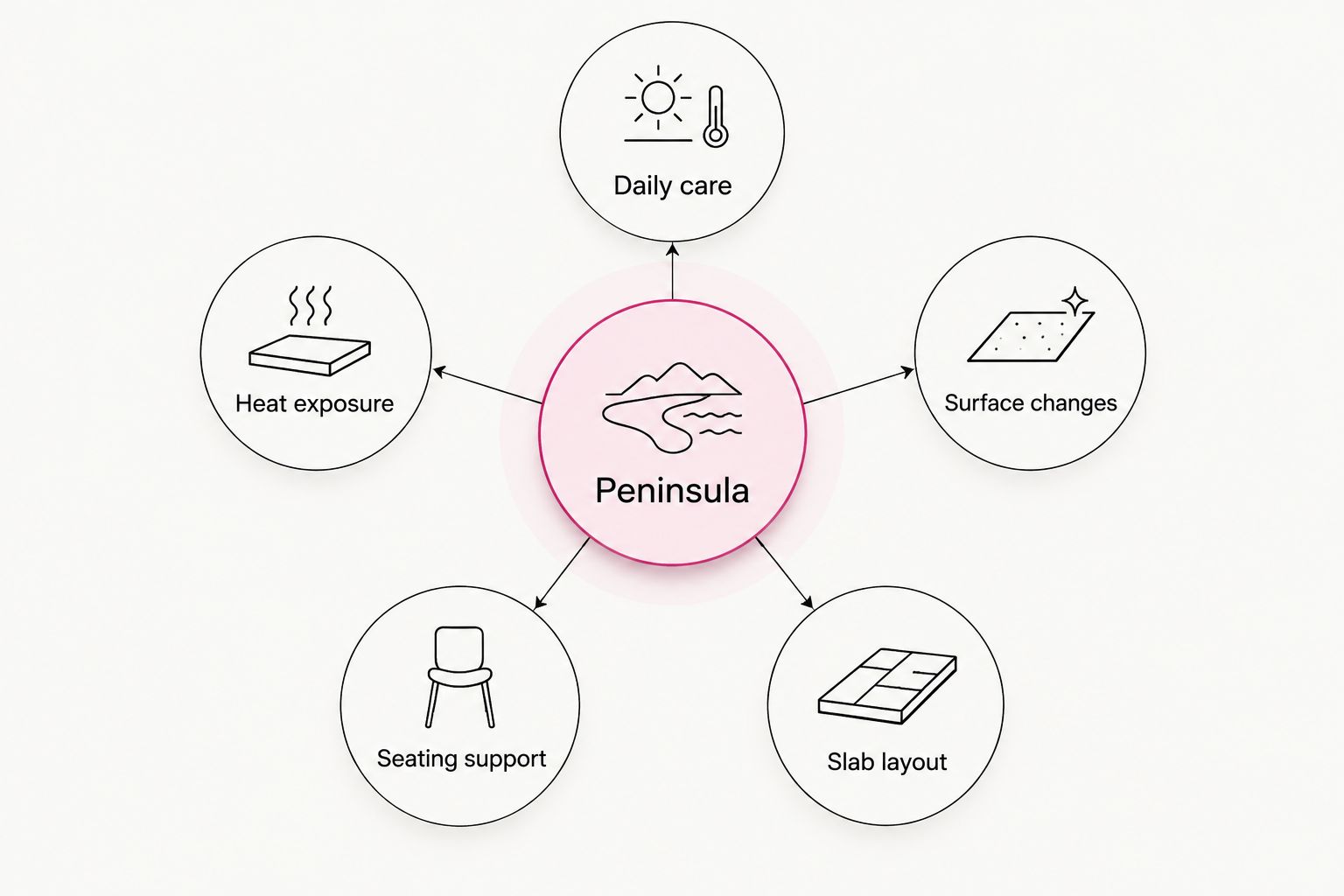
Use these criteria for your 2026 shortlist before comparing colors:
- Daily care: Decide whether you want a surface without routine sealing or accept stone-specific cleaning and sealing when needed.
- Heat exposure: Consider where you set cookware, serve meals, and place countertop appliances. Every option still needs sensible heat protection.
- Surface changes: Separate staining, scratching, and etching. A material that resists one does not automatically resist the others.
- Seating support: Match the overhang, slab thickness, cabinet construction, and reinforcement. Material hardness is not an overhang specification.
- Slab layout: Review seams, vein direction, exposed ends, and cutouts together. A small sample cannot show the finished peninsula.
Rank the criteria in the order you actually live. If the peninsula handles breakfast, homework, and dinner preparation, daily care belongs ahead of dramatic veining. If its main job is displaying a natural slab, the full-slab layout deserves more attention.
Kitchen peninsula countertop materials at a glance
The 2026 ranking below separates each material by its strongest use case. It does not treat natural stone as interchangeable or promise a maintenance-free countertop.
| Rank and material | Best for | Standout feature | Key limitation |
|---|---|---|---|
| 1. Quartz | Low-maintenance everyday use | Engineered, nonporous surface without routine sealing | Resin makes direct heat protection important |
| 2. Granite | Frequent cooking with natural stone | Durable mineral surface with natural pattern variation | Absorption and sealing needs vary by slab |
| 3. Quartzite | Distinctive natural veining | Hard natural stone with varied veining | Slab identification, absorption, and fabrication need attention |
| 4. Marble | Baking and accepting patina | Natural veining and a cool-feeling work surface | Acids etch the surface, even when sealed |
1. Quartz: best peninsula countertop for low-maintenance daily use
Quartz countertops combine mineral content with binders to create an engineered surface. They do not require routine sealing, which makes quartz the strongest default for a peninsula used for meals, food preparation, and everyday family activity.
Choose the actual pattern carefully. Some designs read quietly across a long seating edge; others have prominent veining that needs thoughtful seam placement.
Quartz pros:
- No routine sealing requirement.
- Nonporous surface simplifies ordinary spill cleanup.
- A broad range of patterns supports different cabinet styles.
- Less natural slab variation helps when you want a coordinated appearance.
Quartz cons:
- Direct heat can damage the resin-bound surface; use trivets.
- Exposed edges can chip from impacts.
- Strong patterns still need a planned seam and vein layout.
Best for: Homeowners who want a peninsula they can clean routinely without managing stone sealing.
Ask for the selected quartz manufacturer's guidance on cleaners, heat protection, and unsupported spans. The word quartz does not establish a universal structural allowance, and a thicker-looking edge does not prove that the seating overhang needs no reinforcement.
Verdict: Buy quartz when low-maintenance daily use is your main requirement.
2. Granite: best peninsula countertop for frequent cooking
Granite is a natural stone that suits a working kitchen where the peninsula doubles as a preparation and serving surface. Its mineral composition gives it good heat resistance, but trivets remain the right habit because concentrated heat and sudden temperature changes can damage stone or surrounding materials.
Pattern matters as much as color. Fine-grained granite creates a different visual effect from a slab with sweeping movement, especially at the peninsula's exposed end.
Granite pros:
- Durable surface for regular kitchen work.
- Good heat resistance compared with resin-bound materials.
- Natural variation gives each slab its own appearance.
- Many patterns work well across both preparation and seating areas.
Granite cons:
- Absorption varies; some slabs need sealing to limit staining.
- Edges remain vulnerable to heavy impacts.
- A sample does not represent every part of the slab.
Best for: Frequent cooks who want natural stone and accept material-specific care.
Ask how the selected slab should be maintained rather than assuming every granite countertop needs the same sealing schedule. Also review any fissures and the planned reinforcement around cutouts before approving the layout.
Verdict: Buy granite for a hardworking natural-stone peninsula.
3. Quartzite: best peninsula countertop for distinctive natural veining
Quartzite is natural stone, not engineered quartz. It offers a hard mineral surface and varied natural patterns, making it a strong choice when the peninsula is a visible feature from the adjoining living or dining space.
Choose from the actual slab. Quartzite appearance and absorption vary, and a commercial stone name alone does not establish its composition or care requirements.
Quartzite pros:
- Hard natural surface with good scratch resistance.
- Distinctive veining and mineral variation.
- Strong visual potential across a long peninsula top.
- Suitable for homeowners who want natural stone rather than an engineered pattern.
Quartzite cons:
- Absorption varies, so sealing guidance must match the slab.
- Hardness does not prevent edge damage or eliminate support requirements.
- Stones sold under similar names do not always have identical properties.
Best for: Homeowners who prioritize the character of a specific natural slab and accept a tailored care plan.
Confirm the stone's identity with the fabricator, then review the proposed cut locations. If the peninsula includes a waterfall end, ask how the top and vertical panel will align; a waterfall panel is not automatically a substitute for seating support.
Verdict: Buy quartzite when natural veining is the deciding factor.
4. Marble: best peninsula countertop for baking and accepting patina
Marble offers natural veining and a cool-feeling surface that works well for handling pastry dough. It belongs on your shortlist only if you accept visible surface change as part of owning the material.
Acidic foods and drinks can etch marble, leaving dull marks. Sealer helps reduce absorption; it does not stop acid from reacting with the stone.
Marble pros:
- Natural veining creates a distinctive work surface.
- Cool-feeling stone is useful for pastry preparation.
- An evolving patina suits homeowners who prefer a lived-in finish.
Marble cons:
- Lemon juice, vinegar, and other acids can etch the surface.
- Spills can stain if they penetrate the stone.
- Marble scratches more readily than harder countertop stones.
Best for: Bakers and homeowners who accept etching, scratches, and patina rather than expecting an unchanged surface.
A honed finish changes how the surface reflects light, but it does not make marble acid-proof. If breakfast spills and citrus drinks will cause constant worry, choose a different material instead of relying on a finish or sealer to remove that concern.
Verdict: Hold marble unless you actively accept patina.
Plan the peninsula before approving the slab
For a 2026 kitchen renovation, the material choice and the layout need to reach agreement before fabrication. Use this sequence to keep an attractive countertop from creating an awkward kitchen.
Check circulation
The National Kitchen & Bath Association's published kitchen-planning guidance recommends a walkway of at least 36 inches, a work aisle of at least 42 inches for one cook, and 48 inches for multiple cooks. These are planning recommendations, not a substitute for local requirements or an accessibility-specific design.
Measure the relevant space with the seating arrangement in mind. An empty aisle measurement does not describe the room when someone is sitting at the peninsula and another person is opening a dishwasher.
Define seating
Decide where people will sit, how their knees fit beneath the top, and whether supports interfere with stools. Do not borrow an overhang dimension from a photograph and assume your slab can carry it.
The fabricator needs the selected material, thickness, cabinet construction, cutouts, and proposed overhang to establish the support plan. No material in this ranking makes unsupported seating extensions automatically safe.
Map seams
Ask where seams will fall and how they meet the wall connection, exposed end, and any sink opening. A seam is not automatically a defect, but its placement affects appearance and the fabrication plan.
Review bold veins across the whole top, not just at the center. A visually quiet preparation area can still have a strongly patterned seating edge.
Confirm cutouts
Finalize the sink, faucet, and any appliance specifications before the template and fabrication decisions. Cutouts affect the remaining stone around them and must coordinate with cabinet clearance and support.
Do not change an appliance or sink model after the layout is approved without checking the consequences with the fabricator.

Bring a room sketch, cabinet details, and your preferred material to the discussion. Soaresstone fabricates and installs custom countertop surfaces, so the conversation should connect the slab choice to the finished kitchen rather than stop at a sample.
Plan your peninsula countertop
Discuss custom quartz, granite, quartzite, or marble fabrication and installation for your kitchen.
How the materials are ranked
This 2026 ranking prioritizes everyday care, practical kitchen use, and the trade-offs that affect a peninsula. It is a material-selection guide, not a claim that individual slabs or finished installations were tested.
Quartz ranks first because it removes routine sealing from the care plan. Granite takes the cooking-focused slot, quartzite takes the natural-veining slot, and marble remains a deliberate choice for homeowners who accept patina.
Structural planning applies to all four. None earns a higher position because of an assumed unsupported overhang, an invented lifespan, or a promise that damage cannot happen.
Which countertop material should you choose?
Choose quartz if you are undecided. It gives you the clearest low-maintenance starting point for a peninsula that handles daily meals, spills, and preparation.
Choose granite when frequent cooking and natural stone lead your priorities. Choose quartzite when the appearance of a particular slab matters most, and choose marble only when surface change is acceptable.
For your 2026 shortlist, narrow the decision to the care routine you will actually follow. Then ask Soaresstone to discuss the selected material alongside seams, seating support, and the installation layout.
FAQ
What’s the best countertop material for a kitchen peninsula?
Quartz is the best default for a kitchen peninsula when low-maintenance daily use is the priority. It needs no routine sealing, but you still need trivets, appropriate cleaners, and a properly designed overhang.
Is granite better than quartz for a peninsula?
Granite is the stronger choice when you want natural stone and prioritize heat resistance; quartz is the stronger choice when avoiding routine sealing matters most. Use trivets with either material and confirm the selected surface’s care instructions.
Is quartzite the same thing as quartz?
Quartzite is natural stone, while quartz countertops are engineered surfaces made with mineral content and binders. Quartzite care depends on the selected slab, including its absorption and any sealing requirements.
Can I use marble on a kitchen peninsula?
You can use marble on a kitchen peninsula if you accept etching, scratching, and patina. Sealing reduces absorption but does not prevent acidic foods and drinks from etching the surface.
Does a peninsula countertop overhang need support?
The need for support depends on the material, thickness, overhang, cabinet construction, and nearby cutouts. Have the fabricator establish the support design before fabrication rather than relying on a generic span limit.
How much room should I leave around a kitchen peninsula?
NKBA planning guidance recommends at least 36 inches for a walkway, 42 inches for a one-cook work aisle, and 48 inches for multiple cooks. Check the actual layout with occupied stools and open appliance doors, and follow applicable local requirements.
Should my peninsula match the rest of my countertops?
Matching the peninsula to the surrounding countertops creates visual continuity, but a contrasting material is also a design option. If you mix materials, plan the transition, heights, edges, and different care requirements before fabrication.
One last thing
Ask to review the seating edge, not just the slab face. The exposed corner, underside clearance, and support placement shape how the peninsula feels every day, yet a top-down sample discussion leaves them out.
Before approval, trace the route from the refrigerator to the sink and past the occupied stools. A countertop that suits your habits and fits that route is a better choice than a striking slab that makes the kitchen harder to use.
Related guides
- How to choose an overhang for island seating
- How to plan a countertop template appointment
- How to care for granite countertops