
Best overall: quartz. Best natural-stone option: granite. Best for a seamless sink area: solid surface. For an existing countertop you want to retain, intact laminate deserves consideration; Soaresstone fabricates and installs custom quartz, granite, quartzite, and marble surfaces.
- Quartz is the best countertop material for laundry room use when low maintenance matters most.
- Granite suits natural-stone laundry countertops; quartzite suits homeowners who prioritize distinctive veining.
- Solid surface simplifies sink transitions, while laminate requires careful protection at seams and exposed edges.
- Soaresstone offers custom quartz and natural-stone fabrication; confirm the support and appliance-access plan before installation.
Why this matters
A laundry countertop handles damp clothing, detergent drips, baskets, and repeated wiping. The right surface needs to fit those tasks—not just match your cabinets. For a 2026 renovation, start with how you use the room, then choose the appearance.
The layout matters as much as the material. A countertop spanning laundry appliances needs independent support and a way to remove the machines for service. No stone selection fixes a countertop that blocks appliance access or rests on vibrating equipment.
Soaresstone is a family-owned New England fabricator and installer. Its stated countertop materials are quartz, granite, quartzite, and marble; solid surface and laminate appear here as category alternatives, not as claimed company offerings.
What makes the best laundry room countertop material?
Use these criteria to narrow your 2026 shortlist before comparing colors:
- Moisture resistance: Assess the surface, seams, sink perimeter, and exposed edges separately. A water-resistant face does not make every joint waterproof.
- Cleaning compatibility: Choose a material with care instructions you can follow around detergent and stain-treatment products.
- Maintenance burden: Quartz does not require sealing. Natural-stone sealing needs depend on the particular slab and finish.
- Working surface: Look for a smooth, easy-to-wipe finish and an edge that will not catch clothing.
- Support requirements: Have the fabricator specify supports, cutout details, and any limits on unsupported spans.
- Repair options: Understand whether scratches, chips, stains, or swollen edges can be repaired before committing.
Prioritize moisture management and cleaning over heat resistance. A laundry counter is a folding surface, not an ironing board. Use equipment designed for ironing regardless of the countertop material.
Laundry room countertop materials at a glance
| Rank and material | Best for | Standout feature | Key limitation |
|---|---|---|---|
| 1. Quartz countertops for laundry rooms | Low-maintenance folding and sorting | Nonporous surface without routine sealing | Heat and chemical exposure require care |
| 2. Granite countertops for laundry rooms | Natural-stone durability | Hard stone with varied patterns | Sealing needs vary by slab |
| 3. Solid surface | Integrated sink and countertop layouts | Bonded seams and repairable surface | Scratches and heat damage are concerns |
| 4. Quartzite | Dramatic natural veining | Hard natural stone | Slab verification and sealing assessment matter |
| 5. Laminate | Keeping a usable existing countertop | Easy-to-wipe decorative surface | Water entering joints can damage the substrate |
| 6. Marble | Decorative, light-use folding areas | Natural veining | Acids etch the surface; staining needs attention |
1. Quartz: best laundry room countertop for low-maintenance use
Engineered quartz combines mineral content with binders to create a nonporous countertop surface. It gives you a smooth place to fold clothes without adding routine sealing to your household checklist. That makes quartz the default choice for a busy laundry room in 2026.
Quartz does not make chemical spills harmless. Follow the selected manufacturer's cleaning instructions, and avoid treating the counter as a place to park an iron or leave concentrated cleaning products.
Quartz pros:
- Requires no routine sealing.
- Resists water absorption through the countertop surface.
- Offers consistent-looking patterns for coordinated cabinet designs.
Quartz cons:
- Direct heat can damage the resin-containing surface.
- Harsh chemicals can damage or discolor the finish.
Best for: Daily folding, sorting, and sink-adjacent use when easy care leads the decision.
Soaresstone offers custom quartz fabrication and installation. Confirm the selected quartz's care requirements alongside the sink and appliance layout.
Verdict: Buy quartz for the simplest everyday care routine.
2. Granite: best laundry room countertop for natural-stone durability
Granite provides a hard natural-stone work surface with patterns that vary from slab to slab. It suits homeowners who want real stone rather than a manufactured pattern. Choose the actual slab, not just a small sample, when color variation matters.
Granite's absorption and sealing requirements vary. Ask for care instructions tied to the selected stone; do not assume every granite needs the same treatment on the same schedule.
Granite pros:
- Provides a hard surface for normal folding and sorting.
- Offers natural mineral variation.
- Handles heat better than resin-bound quartz, though thermal shock remains a concern.
Granite cons:
- Some slabs need sealing to reduce liquid absorption.
- Edges and sink cutouts remain vulnerable to impact damage.
Best for: A hardworking laundry room where natural stone is a priority.
Keep detergent bottles on a washable tray rather than allowing residue to accumulate beneath them. Sealer reduces absorption; it does not replace cleanup.
Verdict: Buy granite if you want natural stone and accept slab-specific maintenance.
3. Solid surface: best laundry room countertop for integrated sinks
Solid surface is a manufactured material commonly used for countertops with bonded seams and compatible integrated sinks. It suits a laundry layout where you want fewer ledges around the basin to wipe. Confirm that the sink and countertop system support the integration you want.
Its surface is softer than quartz or granite. Scratches are a trade-off, although many solid-surface scratches can be refinished using the manufacturer's prescribed process.
Solid surface pros:
- Supports integrated sink designs in compatible systems.
- Allows inconspicuous bonded seams.
- Offers repair options for many surface scratches.
Solid surface cons:
- Scratches more readily than hard stone surfaces.
- Direct heat can damage the material.
Best for: Sink-centered laundry rooms where wipe-down convenience matters more than natural-stone appearance.
Ask how the sink joint, drain area, and surface repairs will be handled. An integrated appearance is useful only when the installation and cleaning instructions support your routine.
Verdict: Buy solid surface when an integrated basin is your main requirement.
4. Quartzite: best laundry room countertop for statement veining
Quartzite is natural stone, not engineered quartz. It offers a hard surface and distinctive veining, making it a strong choice when the laundry room is also part of a visible mudroom or other finished living space.
Verify the stone's identity and care requirements with the supplier. Commercial stone names alone do not establish how a particular slab will behave.
Quartzite pros:
- Offers distinctive natural movement and veining.
- Provides a hard work surface when the stone is genuine quartzite.
- Fits designs that prioritize a natural-stone focal point.
Quartzite cons:
- Absorption and sealing requirements vary.
- Detailed cuts and fabrication require careful planning.
Best for: A design-led laundry room where natural veining outweighs maintenance convenience.
Use the selected slab's pattern to plan seams and sink placement. A small sample cannot show how the full countertop will look.
Verdict: Buy quartzite for its appearance, not as a shortcut to quartz-like maintenance.
5. Laminate: best laundry room countertop for retaining an existing surface
Laminate uses a decorative surface bonded to a substrate. An existing laminate countertop that is flat, firmly attached, and free of swelling can remain useful for folding clothes. Keeping a sound surface avoids replacing it solely because stone is available.
Inspect the sink perimeter, backsplash joint, seams, and exposed edges. Water entering these areas can damage the substrate even when the visible top still looks clean.
Laminate pros:
- Provides a smooth surface for folding.
- Wipes clean with compatible household cleaning methods.
- Can remain useful when an existing installation is sound.
Laminate cons:
- Water intrusion can cause substrate swelling.
- Deep damage and swollen edges are difficult to repair invisibly.
Best for: Homeowners deciding whether a functional existing laundry counter actually needs replacement.
Do not cover swollen material with a new surface and call the problem solved. Find and correct the source of moisture first.
Verdict: Hold onto intact laminate; skip damaged or swollen installations.
6. Marble: best laundry room countertop for decorative folding areas
Marble brings natural veining to a room where appearance is the main priority. It works best as a light-use folding surface away from stain-treatment products and frequent sink splashes.
Marble contains minerals that react with acids, creating etched areas that look dull against the surrounding finish. Sealing helps limit absorption but does not prevent this chemical reaction.
Marble pros:
- Offers natural veining and tonal variation.
- Provides a smooth folding surface.
- Suits a decorative laundry-and-dressing area.
Marble cons:
- Acidic products can etch the surface.
- Absorbed spills can stain the stone.
Best for: A carefully maintained, appearance-led folding area rather than a heavy-use cleaning station.
Keep garment treatments off the marble and follow stone-specific care instructions. Choose marble only if changes in its finish are acceptable to you.
Verdict: Skip marble for heavy-use laundry counters; buy only for a deliberate decorative choice.
Plan the countertop around the machines
Before ordering a laundry countertop in 2026, settle the appliance arrangement, support structure, and service access. The countertop must work with the exact washer and dryer models, including their installation instructions. Front-loading and top-loading layouts require different access decisions.
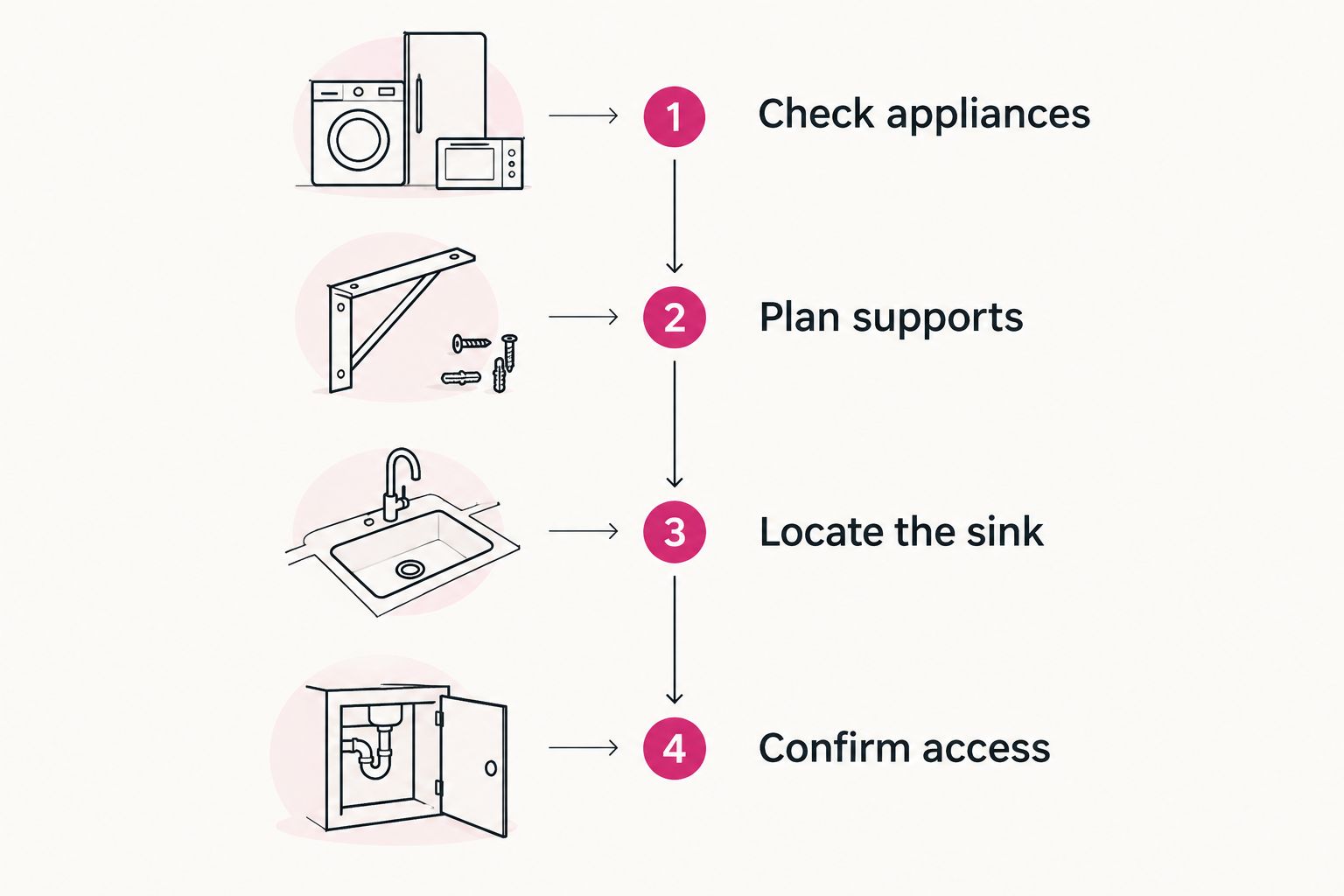
Follow this sequence:
- Check appliances: Confirm lid or door movement, required clearances, hookups, and removal access.
- Plan supports: Ask the fabricator to specify cabinetry, brackets, rails, or other appropriate structural support.
- Locate the sink: Coordinate the cutout, faucet, plumbing, seams, and nearby supports.
- Confirm access: Establish how each machine will be serviced or replaced without trapping it beneath stone.
A counter above a top-loading washer cannot obstruct the lid. A continuous counter above front-loading machines must also leave the required clearances and avoid transferring appliance vibration into the surface.
For a planning example—not a recommended specification—a sketch might show a 60-inch counter span, 24-inch depth, and 36-inch finished height. Treat those as placeholders until the appliance instructions, working height, and support design establish the actual dimensions.
Record the finished countertop height separately from cabinet height. Include the surface thickness and any supports in that calculation, and check that you can comfortably fold clothing at the proposed level.
How these materials are ranked
This 2026 ranking prioritizes moisture resistance, everyday cleaning, and maintenance for residential laundry use. Quartz leads because it avoids routine sealing. Granite leads the natural-stone choices, while solid surface earns its own slot for sink integration.
Quartzite, laminate, and marble answer narrower needs. The order is a use-case guide, not a claim that every slab or manufactured surface performs identically. The selected material's instructions and the installation design govern the finished result.
Which laundry room countertop should you choose?
Choose quartz unless natural stone or an integrated sink is a specific priority. Select granite for a natural-stone work surface, solid surface for sink integration, or quartzite when distinctive veining drives the design. Keep sound laminate if replacement serves no practical purpose.
For homeowners seeking custom quartz or natural-stone countertop fabrication, Soaresstone is a relevant choice. Bring the appliance model information, room layout, and sink requirements to the discussion—not just a color sample.
Discuss your countertop project
Review custom quartz and natural-stone options alongside your room layout and installation requirements.
FAQ
What’s the best countertop material for a laundry room?
Quartz is the best default for a laundry room when low maintenance matters most. Its nonporous surface does not require routine sealing, but you still need compatible cleaners and protection from direct heat.
Is granite better than quartz for a laundry room?
Granite is better when natural stone is your priority; quartz is better when avoiding sealing is the priority. Check the selected granite slab’s care requirements rather than assuming all granite behaves alike.
Can I put a countertop directly on my washer and dryer?
Use a support design that does not rely on the washer and dryer carrying the countertop. Follow appliance installation instructions and have the fabricator specify clearances, supports, and removal access.
Is quartz waterproof around a laundry sink?
Quartz is nonporous, but the complete sink installation is not automatically waterproof. Seams, faucet penetrations, and sink joints need appropriate detailing and maintenance.
Can I iron clothes directly on a stone countertop?
Use an ironing board or equipment designed for ironing rather than the countertop. Direct heat can damage quartz, and natural stone still needs protection from thermal shock.
Does every granite laundry countertop need annual sealing?
No, granite does not have a universal annual sealing schedule. Follow guidance for the selected slab, finish, and sealer, and assess absorption as instructed.
Are quartz and quartzite the same countertop material?
No, quartz countertops are engineered surfaces, while quartzite is natural stone. Quartz does not require routine sealing; quartzite needs a slab-specific sealing assessment.
Is marble a good choice for a busy laundry room?
Marble is not the default choice for a busy laundry room because acidic products can etch it and absorbed spills can stain it. Reserve marble for a decorative folding area where careful maintenance is acceptable.
One last thing
The best surface is not always the one you should replace first. For your 2026 project, check appliance-removal access before approving the countertop drawing. A beautiful stone top loses practical value if replacing a washer requires dismantling the surrounding installation.
Related guides