
Best overall: quartz. Best for a decorative guest bathroom: marble. Best for natural stone with everyday practicality: granite. Best for distinctive natural veining: quartzite. This 2026 guide compares the best countertop material for powder room projects by cleaning needs, appearance, and vanity layout.
- Quartz is the best countertop material for powder room projects when easy cleaning is your priority.
- Marble suits decorative powder rooms, but acidic cleaners can etch its surface.
- Granite offers natural variation; quartzite suits homeowners who want distinctive natural veining.
- Soaresstone fabricates and installs custom quartz, marble, granite, and quartzite bathroom surfaces.
Why this matters
A powder room countertop needs to handle handwashing, soap, and cleaning products—not kitchen prep. Choose for those conditions. Heat resistance matters less here than whether you can wipe around the faucet easily and keep the surface looking the way you expect.
Soaresstone is best for New England homeowners seeking custom powder room countertops in quartz, marble, granite, or quartzite. The family-owned fabricator and installer makes custom bathroom surfaces, so your material choice belongs alongside the sink, faucet, and cabinet decisions. Start with Soaresstone when you are ready to discuss the project.
For a 2026 renovation, choose the maintenance routine before the stone pattern. A beautiful surface that needs care you dislike is the wrong fit, even in a room used mainly by guests.
What makes the best powder room countertop material?
Judge each material against these five criteria before choosing a slab or sample:
- Cleaning requirements: Can you use a straightforward routine, or does the surface require particular attention to acids and stone-safe products?
- Water absorption: Does the material need sealing, and how will you manage standing water around the faucet?
- Appearance at vanity scale: Will the pattern still look intentional after the sink opening removes part of the surface?
- Sink compatibility: Can the countertop accommodate the selected basin, faucet holes, and required support?
- Tolerance for wear: Will dull spots, small marks, or natural variation bother you—or become part of the surface's character?
For your 2026 shortlist, treat cleaning requirements and appearance as separate decisions. A marble look does not require actual marble, and choosing natural stone does not mean every slab has the same care requirements.
Powder room countertop materials at a glance
| Material | Best for | Standout feature | Key limitation |
|---|---|---|---|
| Quartz | Low-maintenance everyday use | Nonporous engineered surface that does not need sealing | Not immune to chemical damage, chips, or heat damage |
| Marble | Decorative guest bathrooms | Natural veining and a surface that develops patina | Acid sensitivity; sealing does not prevent etching |
| Granite | Practical natural-stone vanities | Natural mineral patterns with good everyday durability | Sealing needs vary; busy patterns need careful coordination |
| Quartzite | Distinctive natural veining | Natural stone with strong scratch resistance | Requires slab-specific care and careful fabrication |
These rankings separate use cases rather than declare one material better at everything. Quartz leads for a simple care routine; marble wins when the appearance and acceptance of patina drive the decision.
1. Quartz: best powder room countertop for easy cleaning
Quartz countertops combine mineral content with binders to create an engineered surface. They are nonporous and do not require sealing, which removes a maintenance task from your powder room routine. You still need to wipe spills and use cleaning products approved for the selected surface.
Choose quartz when you want the countertop to work quietly in the background. Subtle patterns suit a room where wallpaper, a mirror, or decorative lighting already carries the visual emphasis.
Quartz pros:
- Does not require a stone-sealing routine.
- Offers both quiet patterns and marble-look designs.
- Resists absorption of everyday bathroom spills.
- Works with custom vanity layouts when properly fabricated.
Quartz cons:
- Harsh chemicals and abrasive cleaning can damage the finish.
- Edges can chip; nonporous does not mean indestructible.
- Engineered patterns do not provide the same natural variation as a stone slab.
Best for: Homeowners who prioritize easy upkeep over natural-stone character.
Before approving quartz, look at more than a small sample. A strong vein can occupy most of a compact vanity, and the sink cutout changes what remains visible. Confirm the pattern layout rather than assuming the sample represents the finished top.
Verdict: Buy quartz if you want the simplest maintenance routine in this comparison.
2. Marble: best powder room countertop for a decorative statement
Marble offers natural veining and a traditional stone appearance. A powder room puts it away from food preparation, but not away from every source of damage. Acidic cleaners, including vinegar-based products, can etch the surface.
Etching changes the finish rather than simply leaving a stain. Sealing helps reduce absorption; it does not make marble acid-proof. Choose marble because you want marble, not because occasional use removes its care requirements.
Marble pros:
- Provides natural veining rather than an engineered pattern.
- Suits a design where the countertop is the main feature.
- Offers polished or honed appearances.
- Can appeal to homeowners who accept a developing patina.
Marble cons:
- Acidic products can leave dull etched areas.
- Porous stone needs appropriate sealing and spill management.
- Scratches and finish changes are a poor fit for perfection-focused owners.
Best for: A decorative guest bathroom whose owner accepts careful cleaning and visible wear.
A honed finish can make some etched areas less visually pronounced than a glossy finish, but it does not prevent them. Test your expectations against a real sample: if every dull mark would frustrate you, choose another material.
Verdict: Buy marble for its natural appearance; skip it if you require an unchanged finish.
3. Granite: best powder room countertop for practical natural stone
Granite is a natural stone with mineral patterns that range from relatively even to strongly varied. It offers good resistance to ordinary countertop wear and avoids marble's characteristic sensitivity to mild acids. Its absorption and sealing needs depend on the particular stone.
Choose granite when you want natural material without making delicate surface care the central concern. Inspect the actual slab, because the label “granite” does not tell you its color balance, pattern density, or absorption behavior.
Granite pros:
- Provides natural variation and visible mineral character.
- Handles ordinary bathroom use well with appropriate care.
- Offers patterns that do not depend on long, continuous veins.
- Gives you a natural-stone alternative to marble.
Granite cons:
- Some stones require sealing to help limit absorption.
- Dense patterns can compete with decorative wallpaper or tile.
- Dark or polished surfaces can make water residue noticeable.
Best for: Homeowners who want a practical natural-stone vanity and accept stone-specific maintenance.
Place a sample beside the cabinet finish and wall treatment. Granite with several contrasting minerals can look balanced on its own but crowded in a small room. Let either the countertop or the walls lead—not both.
Verdict: Buy granite if natural stone matters more than eliminating sealing decisions.
4. Quartzite: best powder room countertop for distinctive veining
Quartzite is natural stone, not engineered quartz. It commonly offers flowing mineral patterns and strong scratch resistance, making it a useful choice when you want natural movement without choosing marble. The particular slab still determines its appearance and care requirements.
Choose quartzite for a vanity that gives its pattern room to show. A small sink surround with little exposed countertop can remove the very feature that attracted you to the slab.
Quartzite pros:
- Offers distinctive natural veining and mineral variation.
- Provides strong scratch resistance when correctly identified.
- Suits a countertop-led bathroom design.
- Offers a natural alternative to engineered marble-look surfaces.
Quartzite cons:
- Absorption and sealing needs vary by slab.
- Fissures and veins require careful evaluation during fabrication.
- The name alone is not enough to establish a slab's performance.
Best for: Homeowners who want a natural statement surface and will approve the specific slab and layout.
Ask the fabricator to confirm the stone's identity and explain its care requirements. Natural-stone naming is not always consistent, so do not assume a marble-like slab will behave like quartzite just because of its label.
Verdict: Buy quartzite when its visible pattern justifies the extra attention to selection and fabrication.
Make the material work with your vanity
Plan the sink before the cutout
Select the sink and faucet before the countertop layout is finalized. An undermount basin exposes the stone edge around the opening; a vessel basin changes the working height and leaves a different amount of countertop visible. Neither arrangement fixes a poor material choice.
Check faucet reach, handle clearance, and the space behind the basin. A faucet squeezed against the wall makes routine cleaning harder regardless of the countertop material.
Preserve the pattern
Ask to see where the sink opening lands on the slab. A dramatic vein through the center of a vanity can disappear into the cutout, while a vein along the front edge remains visible. Approve what will remain—not just the uncut stone.
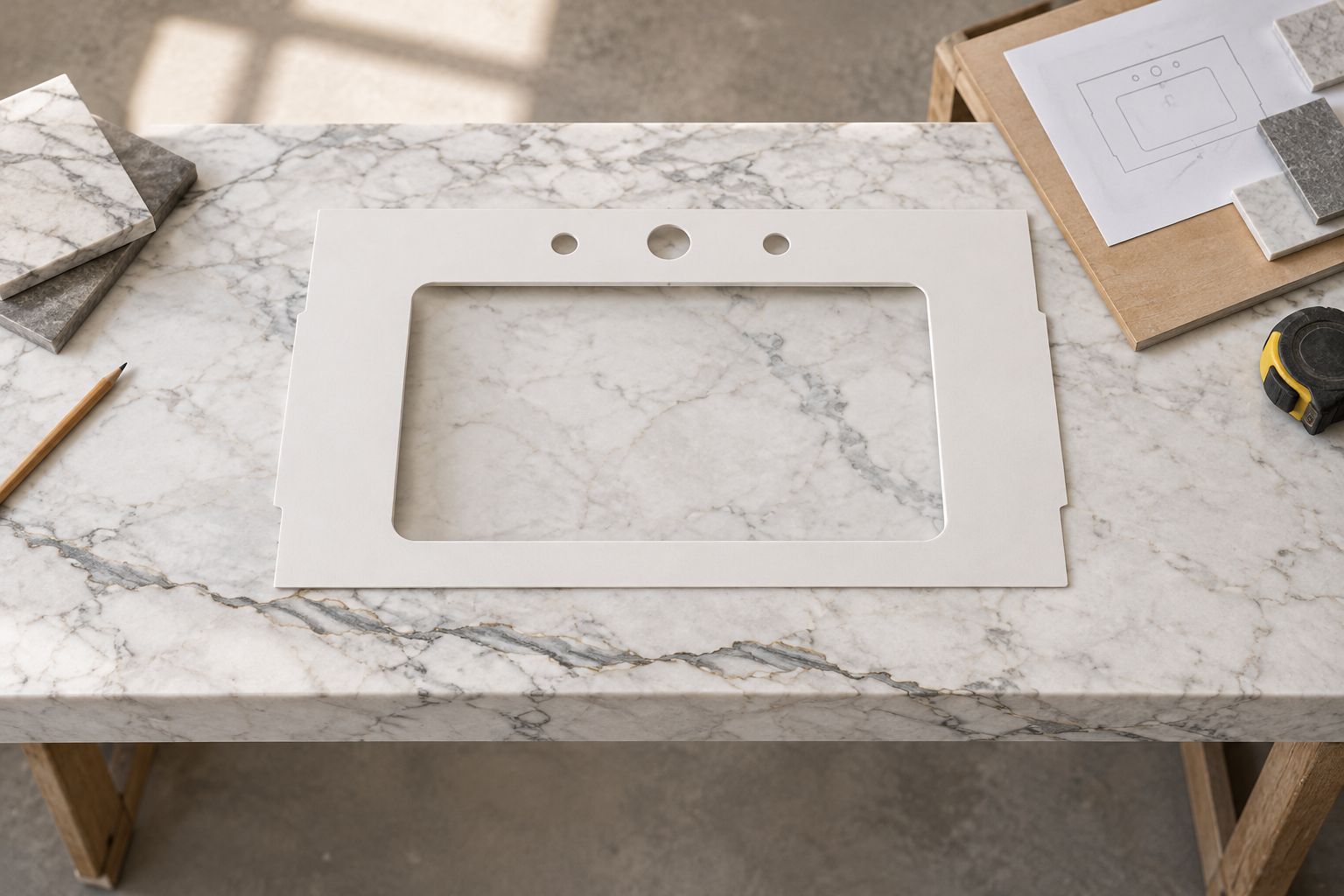
Coordinate thickness and support
Stone and quartz countertop slabs commonly come in thicknesses such as 2 centimeters and 3 centimeters. These are material dimensions, not universal installation specifications. The cabinet, edge treatment, sink opening, and any unsupported areas determine the required construction.
Do not choose thickness by appearance alone. Ask the fabricator to explain support needs and the finished edge before approving the design. Soaresstone provides custom countertop fabrication and installation; bring the cabinet and fixture details into that discussion.
Distinguish hardness from stain resistance
Quartz mineral has a hardness of 7 on the Mohs scale. That mineral fact does not mean an engineered quartz countertop cannot chip, stain, or suffer chemical damage. Hardness describes scratch resistance, not every kind of countertop performance.
For a powder room, cleaning compatibility and water management deserve more attention than a hardness number alone. Keep the full material behavior in view.
Prepare for measurement
Gather the sink specifications, faucet configuration, cabinet details, and backsplash decision before final measurement. Your fabricator needs those choices to establish the openings and finished layout.
Use the guide to planning a countertop template appointment to organize those decisions. Do not treat preliminary measurements as a substitute for the final template.
How these materials are ranked
This 2026 ranking prioritizes cleaning requirements, absorption, appearance at vanity scale, sink compatibility, and tolerance for wear. It compares material characteristics, not brand-specific test results or installation guarantees.
Quartz takes the default position because it removes sealing from the care routine. Marble, granite, and quartzite each take a separate natural-stone use case; none is a universal substitute for the others.
Which countertop material should you choose?
Choose quartz if you are undecided. It is the best countertop material for powder room projects where easy cleaning is the deciding factor. You can keep the surface quiet and put the decorative emphasis elsewhere.
For your 2026 project, choose marble only if you accept etching and patina. Choose granite for practical natural-stone character, or quartzite when its distinctive veining will remain visible in the finished vanity.
Bring Soaresstone your cabinet dimensions, sink selection, and preferred material. Those details turn a general preference into a countertop layout that can be evaluated and fabricated.
Discuss your powder room countertop
Bring your vanity, sink, and material choices to a custom countertop project discussion.
FAQ
What’s the best countertop material for a powder room?
Quartz is the best default when easy cleaning is your priority. It is nonporous and does not need sealing, although you still need compatible cleaners and prompt spill cleanup.
Is marble a good choice for a guest powder room?
Marble is a good choice when natural appearance matters more than keeping the finish unchanged. Acidic cleaners can etch it, even in an occasionally used room.
Is quartz better than granite for a bathroom vanity?
Quartz is better for avoiding sealing; granite is better if you specifically want natural mineral variation. Both need appropriate cleaning and a properly planned installation.
Does sealing marble stop water marks and etching?
Sealing marble does not prevent etching. It helps reduce absorption, while acidic substances can still alter the surface finish.
Should I choose quartz or quartzite for a powder room?
Choose quartz for simpler upkeep and quartzite for distinctive natural veining. Quartzite requires slab-specific evaluation and care; it is not another name for engineered quartz.
Can I use vinegar to clean a stone vanity top?
Do not use vinegar on marble, and follow the selected surface’s cleaning instructions for other materials. Choose a compatible cleaner rather than assuming a household cleaning recipe is safe.
What should I bring to a countertop project discussion?
Bring cabinet dimensions, sink specifications, faucet details, and material preferences. Soaresstone fabricates and installs custom bathroom countertops, and those choices help define the project.
One last thing
The most attractive part of a slab can be the part your sink removes. Before you approve a strongly veined countertop, ask to see the sink opening positioned on the proposed piece. Buy the finished layout, not just the slab photograph.
Related guides
- How to prevent etching on marble countertops
- How to clean quartz countertops without damaging them
- How to choose a countertop edge profile