
Best overall: quartz for a shaded indoor reading nook. Best for strong window exposure: granite; best for dramatic natural veining: quartzite; best for a decorative ledge: marble. This 2026 guide compares the materials for window seats, book ledges, and reading-nook side surfaces, with comfort and structural support treated separately from appearance.
- Quartz is the best countertop material for reading nook surfaces away from prolonged direct sunlight.
- Granite suits bright window-side surfaces; quartzite suits homeowners who want distinctive natural stone veining.
- Marble suits decorative reading-nook ledges when you accept etching and additional care.
- A stone window seat needs seating-specific support and a cushion; countertop suitability alone does not establish seating safety.
Why this matters
A reading nook has different demands from a kitchen counter. You touch the front edge with your legs, place drinks beside books, and sometimes sit directly above a cabinet opening. The best surface must suit those uses—not just look good in a slab photograph.
Soaresstone designs and installs custom marble, granite, quartz, and quartzite surfaces for New England homeowners' kitchens, bathrooms, and fireplaces. Soaresstone is a fit for New England homeowners who need custom stone countertop fabrication and installation. For a reading-nook project, establish the intended use and scope before selecting a material.
The biggest distinction is between a surface you place objects on and a surface people sit on. A countertop slab is not automatically a safe bench. Material selection, support, attachment, and seating comfort need separate decisions.
What makes the best reading-nook countertop material?
Use these criteria to judge the 2026 shortlist before choosing a color:
- Window exposure: Identify direct sunlight and nearby heating equipment. Engineered quartz requires product-specific guidance for prolonged sunlight and heat exposure.
- Drink resistance: Separate stains from etching. A penetrating sealer helps limit absorption in suitable natural stone; it does not stop acid from etching marble.
- Seating support: Have the base and stone assembly evaluated for people sitting on it. Cabinet gaps, unsupported spans, and projecting edges matter.
- Touch comfort: Stone feels cool and hard against bare skin. Use a cushion for seating and a softened edge where legs or arms touch the surface.
- Care requirements: Choose between engineered quartz's no-sealing routine and natural stone's material-specific cleaning and sealing needs.
- Pattern placement: Review the actual slab or sample against the window trim, cabinetry, cushion fabric, and intended seam locations.
Select the material after you identify the surface's job. A decorative sill, a laptop ledge, and a load-bearing window seat are different projects even when they share the same stone.
Reading-nook countertop materials at a glance
The ranking below prioritizes everyday indoor use. It changes when strong sunlight, natural veining, or decorative appearance becomes your main requirement.
| Rank and material | Best for | Standout feature | Key limitation |
|---|---|---|---|
| 1. Quartz | Shaded indoor nooks with frequent drinks | Nonporous surface that does not require sealing | Prolonged sunlight and heat need product-specific checks |
| 2. Granite | Bright window-side surfaces | Durable natural stone with varied patterns | Absorption and sealing needs vary by stone |
| 3. Quartzite | A statement nook with natural veining | Hard natural stone with distinctive slab movement | Slab identity, absorption, and fabrication details need verification |
| 4. Marble for reading nooks and window seats | Decorative ledges with limited drink exposure | Natural veining and a traditional stone appearance | Acidic drinks can etch the surface, even when sealed |
None of these materials makes an unsupported bench safe. Treat the table as a finish-selection guide, not an engineering specification.
1. Quartz: best reading-nook countertop for easy daily care
Engineered quartz combines mineral aggregate with binders to create a countertop surface. It does not require a penetrating sealer, making it a straightforward choice for an indoor nook where you set down coffee, books, or a laptop.
For a 2026 reading-nook remodel, quartz is the default when easy cleaning matters more than natural slab variation. Keep the sunlight qualification attached to that recommendation: a shaded interior corner and a sun-drenched bay window are not interchangeable.
Quartz pros:
- Does not require routine sealing.
- Handles everyday drink spills with prompt cleaning.
- Offers patterns that help coordinate a small ledge with nearby cabinetry.
- Works as a practical surface beside an upholstered seat.
Quartz cons:
- Binders make heat exposure a concern; follow the selected product's care instructions.
- Prolonged direct sunlight needs manufacturer approval rather than a general assumption.
- Corners and edges can chip, so a softened profile still matters.
Best for: A shaded indoor reading nook with regular drink use and an owner who wants to avoid sealing maintenance.
Request a sample and inspect it beside the actual window. Look at the front edge as well as the top: the edge is what you see from a seated position, and a thick-looking profile can dominate a small built-in.
Verdict: Buy quartz for a shaded indoor nook; skip it when the product's exposure guidance does not match the window conditions.
2. Granite: best reading-nook countertop for bright windows
Granite is a natural stone used for durable interior surfaces. Its mineral patterns range from relatively even grain to pronounced movement, so the actual slab matters more than the material name alone.
Granite is the stronger starting point when a window-side surface receives substantial daylight. It avoids engineered quartz's resin-related sunlight concern, although slab treatments, sealers, and nearby heat sources still deserve review.
Granite pros:
- Provides a hard surface for books, trays, and everyday objects.
- Offers natural pattern variation without marble's typical acid sensitivity.
- Suits a window ledge that visually connects with other stone in the room.
- Gives you options ranging from quiet grain to a more prominent pattern.
Granite cons:
- Some stones absorb liquids and need an appropriate sealing routine.
- Strong grain or color variation can overwhelm a narrow ledge.
- A stone seat still needs a cushion and seating-specific support.
Best for: A bright window-side nook where durability and natural stone matter more than having a uniform pattern.
Check the slab for the precise area that will become the visible front edge. A small finished piece can show a very different balance of color from the full slab, particularly when a large mineral feature falls near a corner.
Verdict: Buy granite for bright window-side surfaces when the selected slab's pattern and care requirements suit your room.
3. Quartzite: best reading-nook countertop for natural veining
Quartzite is natural stone, not engineered quartz. It offers a hard surface and distinctive mineral movement, making it a strong candidate when the nook is a visible architectural feature rather than a background shelf.
For a 2026 project centered on natural veining, choose the slab before finalizing the cut layout. A vein that looks striking across a large slab can disappear—or become visually awkward—when cut into a narrow window ledge.
Quartzite pros:
- Provides distinctive natural veining.
- Offers a hard surface for everyday objects.
- Can connect a reading nook visually with other natural stone surfaces.
Quartzite cons:
- Commercial stone names do not replace verification of the material's identity and behavior.
- Absorption and sealing needs vary with the slab.
- Fabrication must account for fissures, edges, and the planned support.
Best for: A statement reading nook where natural veining is the main design priority and you accept slab-specific care.
Ask the fabricator to confirm that the selected stone is suitable for the intended use. Do not assume that every slab marketed with a quartzite name behaves identically, or that all pale veined stone resists acids in the same way.
Verdict: Buy verified quartzite for a statement surface; hold the selection until the slab and fabrication plan are reviewed.
4. Marble: best reading-nook countertop for a decorative ledge
Marble suits a reading-nook ledge when appearance takes priority over carefree drink handling. Its natural veining works well beside books, painted cabinetry, and upholstery, but its reaction to acidic liquids is a real trade-off.
A lemon drink can leave an etched mark without creating a dark stain. That distinction matters: sealing addresses absorption, not marble's chemical reaction to acids.
Marble pros:
- Provides natural veining for a decorative focal point.
- Suits a ledge used mainly for books and display objects.
- Offers a traditional stone appearance alongside built-in cabinetry.
Marble cons:
- Acidic drinks can etch the surface.
- Absorbed spills can stain susceptible stone.
- Sealing does not make marble maintenance-free.
Best for: A decorative reading-nook ledge where you accept surface wear and keep drinks on a tray or coaster.
A honed finish changes the appearance of reflected light; it does not make marble acid-proof. Choose marble because you want the material and accept its care, not because a finish promises to remove the trade-off.
Verdict: Buy marble for a decorative ledge if you accept etching; skip it when an unchanged surface is essential.
Plan the window seat before ordering the stone
The best countertop material for reading nook projects cannot compensate for an unsuitable base. In 2026, settle the seating construction before approving the stone layout—not after the slab has been cut.
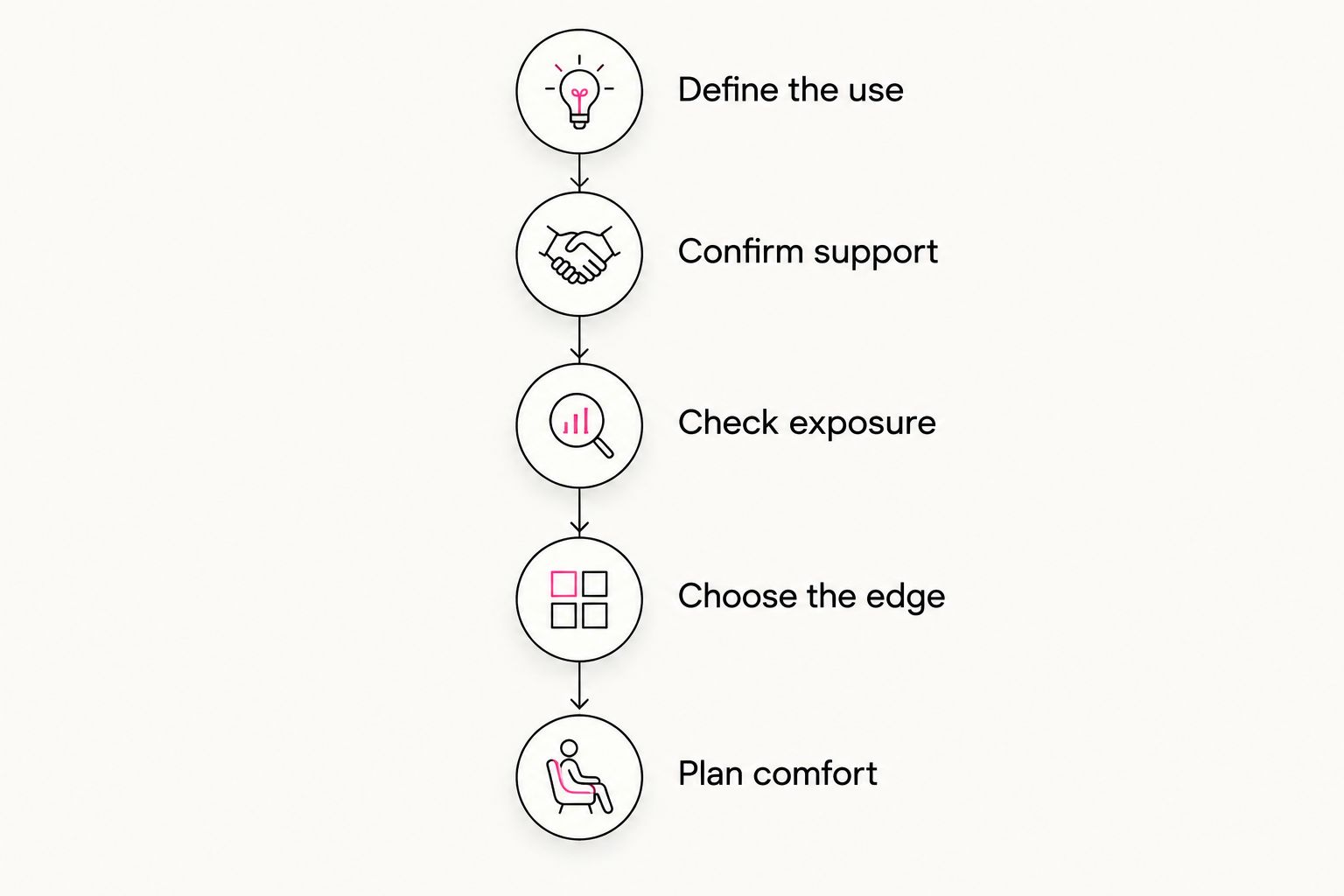
Define the use
Decide whether the surface is a seat, a sill, or a side ledge. Tell the fabricator if adults will sit on it, if children will climb onto it, or if the design includes a projecting front edge. Those uses affect the construction review.
Confirm support
Have the base, attachment method, and slab support evaluated for the intended seating load. Do not borrow a kitchen-island overhang rule and assume it covers a window bench. Long cabinet openings and access panels need particular attention.
Check exposure
Inspect the window during different parts of the day. Identify direct sun, condensation, radiators, and floor registers. Ask for guidance on the actual material and any applied treatments rather than relying on the category name.
Choose the edge
Favor a softened front edge where legs and hands make contact. Discuss corners, cushion placement, and access to drawers or doors. An attractive edge becomes a poor choice if it catches clothing or obstructs the built-in.
Plan comfort
Use a cushion if the stone is a seat. Check that the cushion stays in place and that the finished seating height works with the base. Stone is the durable surface; upholstery supplies the softness.
Bring room photographs and a sketch to the material discussion. Soaresstone's stated countertop services cover kitchens, bathrooms, and fireplaces; confirm the scope of a reading-nook or window-seat project directly rather than assuming it follows the same installation plan.
Check samples where you will read
Compare 2 sample pieces beside the actual window rather than judging them only under showroom lighting. Make 3 observations: how the color relates to the trim, how strongly the surface reflects light, and whether the pattern competes with your cushion fabric. These are comparison steps, not material performance ratings.
For a seat, include 1 cushion mock-up in the review. Even a folded fabric sample helps you see how much stone remains visible around the upholstery and whether the exposed front edge feels visually heavy.
Look from the doorway and from a seated position. A pattern that looks balanced from above can feel busy at eye level, while a highly reflective finish can create distracting glare beside a bright window. Decide on the finish using the sample and the room—not the word polished or honed alone.
How the materials are ranked
This ranking weighs cleaning, window exposure, natural pattern, and material-specific care. Quartz leads for a shaded indoor nook because it avoids sealing maintenance. Granite leads for bright window-side use; quartzite earns the natural-veining slot; marble earns the decorative-ledger slot with its etching limitation stated plainly.
These are use-case recommendations, not laboratory results or seating-load certifications. For a 2026 installation, the selected slab, product instructions, and construction details remain the final checks.
Which reading-nook countertop should you choose?
Choose quartz if your nook is indoors, shaded, and used regularly for drinks. Choose granite instead when strong window exposure is central to the design. Choose quartzite for a natural-veining focal point, or marble for a decorative surface whose wear you are prepared to accept.
If you are undecided, resolve sunlight and seating support before comparing colors. Those decisions can eliminate an unsuitable option immediately; another round of sample browsing cannot.
FAQ
What’s the best countertop material for a reading nook?
Quartz is the best default for a shaded indoor reading nook because it does not require sealing. Granite is the stronger starting point for bright window-side surfaces, while quartzite and marble suit different appearance and care priorities.
Is quartz better than granite for a window seat?
Quartz is better for a shaded indoor surface when avoiding sealing maintenance is your priority. Granite is a better starting point for substantial window exposure. Neither material establishes seating safety without a suitable support design.
Can I sit directly on a stone countertop used as a window seat?
Only use a stone surface as a seat after the base, slab support, and attachment have been evaluated for seating. A countertop installation detail does not automatically cover people sitting on a bench. Add a cushion for comfort.
Will sunlight damage a quartz reading-nook surface?
Prolonged direct sunlight is an exposure concern for engineered quartz. Check the selected manufacturer’s guidance for the actual window conditions before choosing it. Do not assume that being indoors removes the concern.
Is marble practical if I drink coffee in my reading nook?
Marble is practical only if you accept its care requirements and the possibility of stains or etching. Use a tray or coaster and clean spills promptly. A sealer does not prevent acidic liquids from etching marble.
Does quartzite need the same care as quartz?
No. Quartzite is natural stone with slab-specific absorption and sealing needs; engineered quartz does not require a penetrating sealer. Confirm the quartzite’s identity and care instructions before fabrication.
What should I bring to a reading-nook countertop discussion?
Bring room photographs, a dimensioned sketch, and details about whether the surface is a seat or a ledge. Include window exposure, heating equipment, cushion plans, and cabinet openings. The fabricator needs those details before assessing the layout.
One last thing
An etched mark is not the same as a stain. If a pale patch on marble stays visible after cleaning, stronger stain remover is not automatically the answer. Identify the problem before treating it, and follow stone-specific care guidance.
Before discussing your project with Soaresstone, mark the areas where people will sit and where drinks will rest. That simple distinction gives the material conversation a clear starting point.
Related guides
- How to measure for custom countertops
- How to choose a countertop edge profile
- How to seal quartzite countertops