
Best overall: engineered quartz. Best for a decorative dressing island: marble. Best for a hardworking natural-stone surface: granite. The best countertop material for walk-in closet use depends on whether you need a folding surface, a jewelry display, or a grooming station; this 2026 guide also covers quartzite for a statement island.
- Engineered quartz is the best countertop material for walk-in closet folding surfaces and everyday grooming stations.
- Marble suits decorative dressing islands when you accept etching and stone care.
- Granite suits hardworking natural-stone counters; quartzite suits islands where the slab pattern leads the design.
- Soaresstone provides custom stone countertop fabrication and installation; discuss your closet layout before choosing a slab.
Why this matters
A closet countertop faces different demands from a kitchen counter. Clothing needs a smooth edge, jewelry benefits from a quiet background, and grooming products introduce spills that a dry dressing island rarely encounters.
Choose the surface for what you do there, not just how it photographs. Soaresstone is a family-owned New England fabricator and installer working with marble, granite, quartz, and quartzite. Soaresstone is best suited to homeowners seeking custom stone countertop fabrication and installation.
For a 2026 closet project, separate appearance from care before you select a material. A dramatic slab does not make a counter easier to clean, and a harder stone does not make its edges immune to chips.
What makes the best countertop material for a walk-in closet?
- Spill resistance: Match the material to cosmetics, lotions, and other products you actually use. No surface deserves an assumption of chemical immunity.
- Surface care: Engineered quartz does not require sealing. Natural stone needs care based on the specific stone, finish, and fabricator’s guidance.
- Visual clarity: Quiet patterns make small accessories easier to see; pronounced veining makes the countertop itself the focal point.
- Edge comfort: A smooth, eased edge is more comfortable beside clothing and hands than a sharp corner or rough decorative edge.
- Cabinet support: Stone requires suitable support. Confirm the cabinet structure, spans, seams, and overhangs before fabrication.
- Fit with your routine: Folding laundry, arranging jewelry, applying makeup, and using heated styling tools create different priorities.
Do not confuse scratch resistance with stain resistance. Calcite, a principal mineral in many marbles, rates 3 on the Mohs hardness scale; quartz rates 7 on that scale. Those mineral ratings explain part of the difference in scratch behavior, but they are not durability ratings for finished countertops or their edges.
Walk-in closet countertop materials at a glance
| Material | Best for | Standout feature | Key limitation |
|---|---|---|---|
| Engineered quartz | Everyday folding and grooming | Nonporous surface with no sealing requirement | Resin binders make direct heat a concern |
| Marble | Decorative dressing islands | Natural veining and a softer visual character | Acids cause etching; sealing does not prevent it |
| Granite | Hardworking natural-stone counters | Good scratch resistance and varied natural patterns | Absorption and sealing needs vary by slab |
| Quartzite | Statement islands with natural veining | Hard natural stone with distinctive slab movement | Requires careful identification and stone-specific care |
The table compares material categories, not specific slabs or product lines. Your final choice still depends on the selected surface, its care instructions, and the cabinet layout.
1. Engineered quartz: best closet countertop for daily routines
Engineered quartz combines mineral content with binders to create a manufactured countertop surface. Its nonporous structure and lack of a sealing requirement make it the default choice for a closet counter that gets frequent use.
Choose a restrained pattern if you fold clothing, sort accessories, or apply makeup on the same surface. The counter should support those tasks without making small objects difficult to spot.
Engineered quartz pros:
- Does not require sealing.
- Offers a broad range of manufactured colors and patterns.
- Provides a smooth surface for folding and organizing.
- Suits routines where straightforward daily cleaning matters.
Engineered quartz cons:
- Hot styling tools can damage the surface; use a suitable heat-protective holder or mat.
- Harsh chemicals can damage or discolor the material.
- Does not offer the same natural variation as a quarried slab.
Best for: A frequently used closet island or dressing counter where easy care takes priority over natural-stone character.
Follow the selected manufacturer’s cleaning instructions, particularly for makeup, nail products, and adhesives. Nonporous does not mean stain-proof, heat-proof, or resistant to every solvent.
Verdict: Buy engineered quartz for the most practical everyday closet countertop.
2. Marble: best closet countertop for a decorative dressing island
Marble gives a dressing island natural veining and a distinctive focal point. It belongs in a closet when you value its appearance and accept the possibility of visible wear.
A jewelry display or dry accessory counter is a better fit than a surface used for messy grooming tasks. Keep cosmetics and liquids on trays, but treat trays as spill control rather than a guarantee against damage.
Marble pros:
- Each slab has its own natural pattern.
- Works well as the visual centerpiece of a dressing area.
- Offers a smooth surface for arranging accessories.
- Allows you to coordinate the stone’s movement with surrounding cabinetry.
Marble cons:
- Acidic products cause etching, which is surface damage rather than a stain.
- Scratches more readily than harder stone materials.
- Requires stone-appropriate cleaning and a sealing assessment.
Best for: A decorative dressing island used mainly for jewelry, folded accessories, and display.
A honed finish reduces glossy reflections, but it does not make marble resistant to acids. Sealer helps address absorption; it does not stop the chemical reaction that causes etching.
Verdict: Buy marble for its appearance; skip marble if an unchanging finish is essential.
3. Granite: best closet countertop for hardworking natural stone
Granite gives you a natural-stone countertop with good scratch resistance for everyday organizing. Its patterns range from relatively uniform grain to pronounced movement, so evaluate the actual slab rather than the category name alone.
For a busy closet, look for a pattern that works with clothing, hardware, and drawer fronts. Strong speckling can disguise visual clutter, but it also makes small items less obvious against the surface.
Granite pros:
- Offers good scratch resistance for routine countertop use.
- Provides natural variation rather than a manufactured pattern.
- Comes in a wide range of mineral colors and grain patterns.
- Suits homeowners who want stone without marble’s sensitivity to acids.
Granite cons:
- Absorption and sealing requirements vary among stones.
- Busy patterns compete with accessories and cabinetry.
- Exposed corners and edges remain vulnerable to impact damage.
Best for: A natural-stone folding counter or multipurpose closet island where everyday durability matters more than delicate veining.
Ask about the selected slab’s care requirements rather than adopting a fixed sealing calendar. Granite’s durability also does not eliminate the need for supported overhangs and carefully finished edges.
Verdict: Buy granite when you want practical natural stone and like the actual slab’s pattern.
4. Quartzite: best closet countertop for a statement island
Quartzite is a natural stone formed from quartz-rich sandstone. It is different from engineered quartz, despite the similar names, and its natural movement suits a closet island designed around the slab.
True quartzite offers strong scratch resistance, but the commercial name alone is not enough to establish a stone’s identity or care requirements. Have the fabricator confirm the material before you approve it.
Quartzite pros:
- Offers distinctive natural veining and mineral variation.
- Provides strong scratch resistance when correctly identified.
- Makes the surface a clear design focal point.
Quartzite cons:
- Requires stone-specific cleaning and sealing guidance.
- Natural fissures and slab variation need assessment during layout.
- A dramatic pattern requires careful seam and cut planning.
Best for: A central dressing island where natural veining is the main design feature.
Choose quartzite because you prefer the specific slab, not because its name sounds like a maintenance-free version of quartz. Confirm how the pattern will appear on the finished top and visible edges.
Verdict: Buy quartzite for a slab-led statement island; hold until identification and layout are confirmed.
How these materials are ranked
This 2026 ranking prioritizes everyday closet use: spill management, cleaning, visual clarity, edge comfort, and installation fit. Engineered quartz ranks first because it avoids a sealing requirement and suits mixed folding and grooming routines.
Marble, granite, and quartzite each win a different use case. The ranking is a material-selection guide, not a claim that every quartz surface outperforms every natural-stone slab.
Plan the countertop before approving the slab
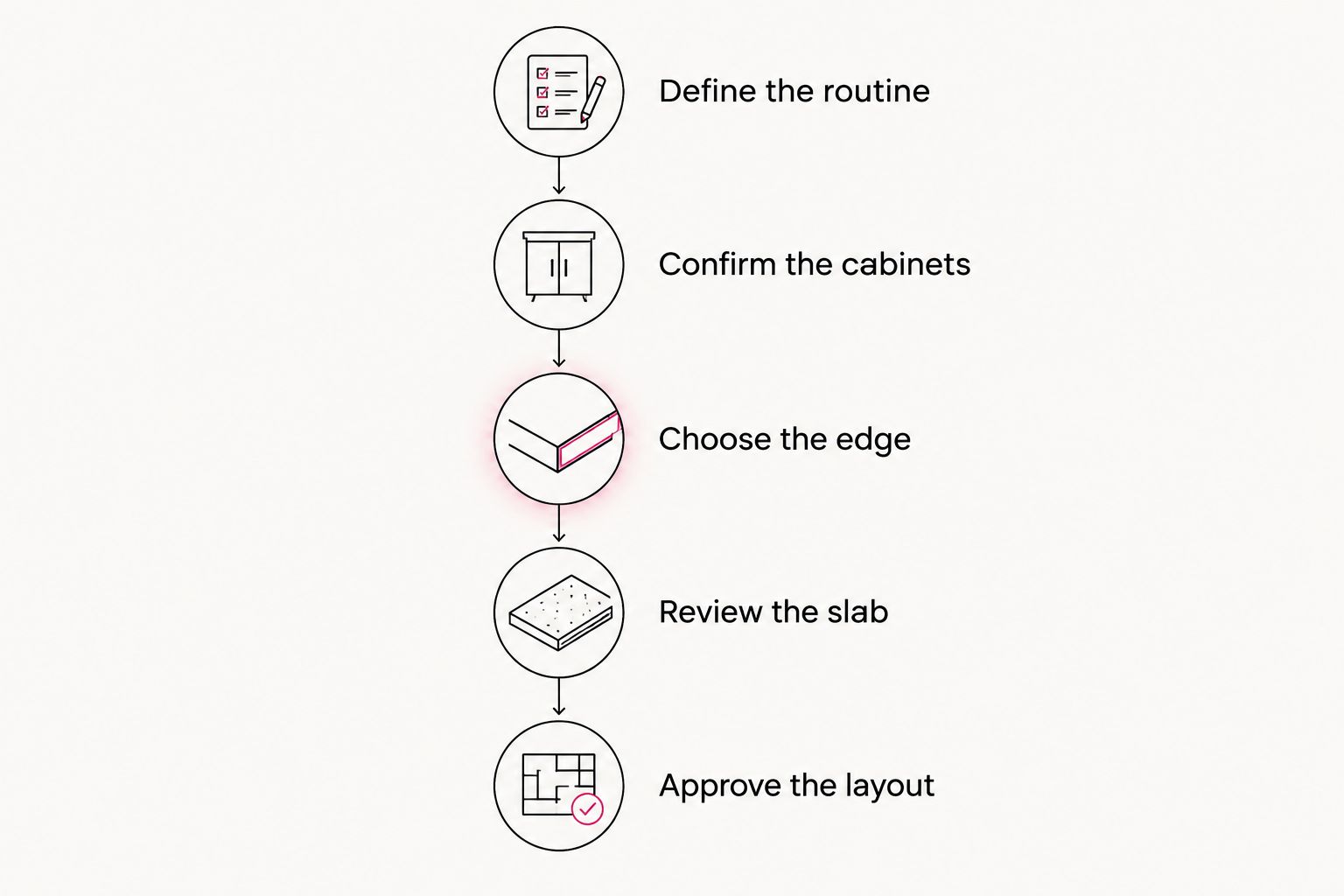
Use this sequence for your 2026 closet project. Settle the working layout before choosing decorative details; an attractive top still needs accessible drawers, usable floor space, and appropriate support.
Define the routine
List what belongs on the counter: folded clothing, jewelry trays, makeup, or styling tools. Decide where liquids and hot tools will sit so that protective accessories are part of the layout rather than an afterthought.
Confirm the cabinets
Have the fabricator assess the cabinet structure and proposed spans. An existing closet organizer is not automatically suitable for a stone top, and a furniture-like island needs a support plan just as a kitchen cabinet does.
Choose the edge
Use a smooth edge with eased transitions where clothing and hands pass the counter. Avoid rough decorative edges beside delicate fabrics, and consider softened corners where the island sits close to a walking route.
Review the slab
Common stone countertop slab thicknesses include 20 mm and 30 mm. These are category examples, not a statement of Soaresstone inventory or a specification for your closet; the fabricator must determine suitable thickness and support.
Approve the layout
Review seams, visible edges, pattern direction, and any overhangs before fabrication. Show the fabricator drawer access and nearby doors so the countertop does not interfere with daily use.
Support is a fabrication question, not a guess based on thickness alone. Give the installer the complete cabinet layout, including open shelving, unsupported areas, and any seating provision.
Match the finish to clothing, jewelry, and lighting
View a sample beside your cabinet finish and under the closet’s actual lighting. A surface that looks neutral elsewhere can appear warmer or cooler against your drawers and wardrobe.
Prioritize visibility on a working counter. Place a jewelry tray and a folded garment beside the sample; check whether the pattern helps those objects stand out or competes with them.
Polished finishes reflect more light, while honed finishes have a lower sheen. Neither finish removes a material’s underlying care requirements, so choose appearance and maintenance separately.
Which countertop material should you choose?
Choose engineered quartz if you are undecided. It is the strongest default for a closet that combines folding, organizing, and grooming without a natural-stone sealing routine.
Choose marble for a dry, decorative dressing island; granite for a hardworking natural-stone counter; or quartzite when the selected slab is the centerpiece. For your 2026 project, bring cabinet drawings and a description of your daily routine to the fabrication discussion.
Soaresstone fabricates and installs custom stone and quartz surfaces. Discuss the closet application, support requirements, and material care before committing to the design.
Discuss your countertop project
Review custom stone fabrication and installation for your planned surface.
FAQ
What’s the best countertop material for a walk-in closet in 2026?
Engineered quartz is the best default for an everyday walk-in closet countertop in 2026. It does not require sealing and suits folding, organizing, and grooming, provided you protect it from direct heat and follow its cleaning instructions.
Is marble a good choice for a walk-in closet island?
Marble is a good choice for a decorative closet island when you accept etching, scratches, and stone-specific care. It fits dry accessory displays better than a countertop regularly exposed to grooming spills.
Is quartz better than quartzite for a dressing counter?
Engineered quartz is better for a dressing counter when avoiding sealing is your priority. Quartzite is the better fit when you want natural slab variation and accept stone-specific care.
Can I put a curling iron directly on a quartz closet counter?
Do not place a hot curling iron directly on an engineered quartz counter. Use a suitable heat-protective holder or mat and follow the surface manufacturer’s instructions.
Do granite closet countertops need sealing?
Granite sealing needs depend on the selected stone’s absorption and existing treatment. Ask the fabricator for guidance rather than assuming every slab needs the same sealing schedule.
What countertop edge works best beside clothes?
A smooth, eased edge with softened exposed corners is a practical choice beside clothing. Avoid rough edges that can catch delicate fabrics, and review edge placement along walking routes.
Does marble sealer prevent makeup damage?
Marble sealer does not prevent etching from acidic products. It helps manage absorption, but you still need trays, prompt spill cleanup, and stone-appropriate cleaning.
One last thing
Before approving your 2026 countertop, identify where your hands and clothing will touch it most often. That edge deserves as much attention as the slab pattern: a beautifully finished surface loses its usefulness if a corner interrupts drawer access or a rough edge catches a sleeve.
Approve the working details before the decorative ones. The best closet countertop supports your routine without demanding that you redesign it around the stone.
Related guides
- How to match countertops with cabinets
- How to choose a countertop edge profile
- How to plan a countertop template appointment