
Best overall: warm white granite. Best for a traditional kitchen: cream granite. Best for strong contrast: black granite. The best granite colors for oak cabinets balance the wood’s undertone rather than repeat every shade in its grain; this 2026 guide compares six color families and explains how to choose your slab.
- The best granite colors for oak cabinets start with warm white for a lighter, balanced kitchen.
- Choose cream granite for traditional honey oak kitchens; avoid matching yellow wood with strongly yellow stone.
- Choose black granite for deliberate contrast, especially when walls and backsplashes stay light.
- Soaresstone fabricates and installs custom granite countertops for New England homeowners.
- Compare actual slabs with your cabinet finish before choosing granite countertops.
Why this matters
Oak cabinets already bring visible grain and color into your kitchen. Your countertop can give that grain a quieter backdrop or add another competing pattern. Start with the wood you have, not a kitchen photograph with different cabinets and lighting.
Soaresstone fabricates and installs custom granite countertops for homeowners’ kitchens. For your 2026 remodel, separate the color decision from fabrication details: first decide what works beside your oak, then discuss the layout and installation.
The key distinction is undertone. Honey oak often reads golden or orange, while stained oak can look reddish, brown, or muted. Use the guide to match countertops with cabinets when your cabinet finish does not fit a simple light-or-dark description.
What makes the best granite color for oak cabinets?
Judge each option against these criteria before choosing a favorite:
- Undertone compatibility: Look at the granite’s background, not just its most noticeable flecks. A warm background is a useful starting point beside golden oak.
- Light-dark contrast: Decide whether you want the countertop to stand apart from the cabinets or blend into the room.
- Pattern restraint: Strong oak grain generally benefits from a countertop whose pattern does not demand equal attention.
- Room coordination: Include the floor, backsplash, wall color, and adjoining rooms in the decision.
- Actual slab appearance: A small sample shows only part of a natural stone’s color and pattern. Inspect the slab intended for your project.
- Finish and care: Compare the proposed finish and ask for care instructions specific to the stone. Color alone does not determine maintenance.
Choose the slab beside your cabinet finish, not from its name. Granite color labels are broad descriptions, and two stones called white can create very different pairings.
Granite colors for oak cabinets at a glance
These 2026 recommendations are color families, not named products or a statement about a fabricator’s inventory. Start with the row that matches the effect you want.
| Granite color family | Best for | Standout feature | Key limitation |
|---|---|---|---|
| Warm white | A lighter kitchen with honey oak | A pale backdrop with gentle warmth | Cool-gray markings can clash with golden wood |
| Cream or ivory | Traditional kitchens | Soft coordination with warm oak | Strong yellow tones can make the palette feel overly golden |
| Black or charcoal | High-contrast kitchens | Clear separation between stone and wood | A dark counter adds visual weight |
| Greige or warm gray | Transitional kitchens with mixed finishes | Connects warm wood with neutral surroundings | Blue-gray undertones need careful checking |
| Brown or taupe | Earth-toned kitchens | Repeats selected wood and floor tones | Similar cabinet and counter colors can flatten the room |
| Muted green-gray | A nature-inspired accent | Adds color without repeating oak’s warmth | Requires more deliberate backsplash coordination |
1. Warm white granite: best for lightening a honey oak kitchen
Warm white granite gives honey oak cabinets a lighter companion without requiring a stark white palette. Look for a pale background with restrained cream, taupe, or brown markings. The goal is contrast in brightness, not a contest between orange wood and icy stone.
Warm white granite pros:
- Creates a clear distinction between the cabinet fronts and work surface.
- Leaves room for the oak grain to remain the main pattern.
- Provides a useful starting point for light walls and a simple backsplash.
Warm white granite cons:
- Prominent cool-gray markings can work against golden cabinet tones.
- A heavily patterned slab loses the calm effect that makes this option useful.
Best for: Homeowners keeping honey oak cabinets while making the countertop palette lighter.
For a 2026 update, inspect the background across the entire slab. A sample dominated by a pale patch can hide darker sections that will become prominent on an island or peninsula.
Verdict: Buy warm white granite when its undertone works with your oak; skip an icy slab chosen only for brightness.
2. Cream granite: best for a traditional oak kitchen
Cream or ivory granite supports a warm, traditional kitchen rather than trying to make the oak look cooler. It works as a softer transition between golden cabinetry and warm neutral walls. Choose a cream background that complements the wood without copying its strongest yellow tone.
Cream granite pros:
- Keeps the cabinet and countertop palette connected.
- Supports warm wall colors and understated backsplash designs.
- Creates a gentler contrast than white or black granite.
Cream granite cons:
- Strong yellow stone beside golden oak can make the room feel overly warm.
- Cream counters offer less visual separation from light oak cabinets.
Best for: Homeowners who want to preserve a traditional look rather than create a sharp contrast.
Check the cream sample beside the floor as well as the cabinets. If all three surfaces share a pronounced golden cast, introduce a quieter wall or backsplash instead of adding another warm pattern.
Verdict: Buy cream granite for a coordinated traditional kitchen; hold if the stone and wood merge into one yellow palette.
3. Black granite: best for strong contrast with oak cabinets
Black or charcoal granite makes oak’s color and grain more prominent by providing a dark backdrop. Choose this family when you want the cabinetry to remain visible as wood, not disappear into a blended neutral scheme. A restrained pattern keeps the contrast straightforward.
Black granite pros:
- Separates the countertop clearly from light and medium oak.
- Creates a strong connection with other dark accents in the room.
- Offers an alternative to matching the wood with beige or brown stone.
Black granite cons:
- Adds visual weight, especially alongside dark flooring.
- Water marks and fingerprints can stand out on a dark polished surface.
Best for: Kitchens designed around deliberate light-dark contrast.
Treat the surrounding surfaces as part of the choice. Black granite beside oak looks different with a pale backsplash than it does with dark tile, dark walls, and a dark floor. Do not judge the counter in isolation.
Verdict: Buy black granite when you want contrast; skip it if your priority is the lightest-looking countertop palette.
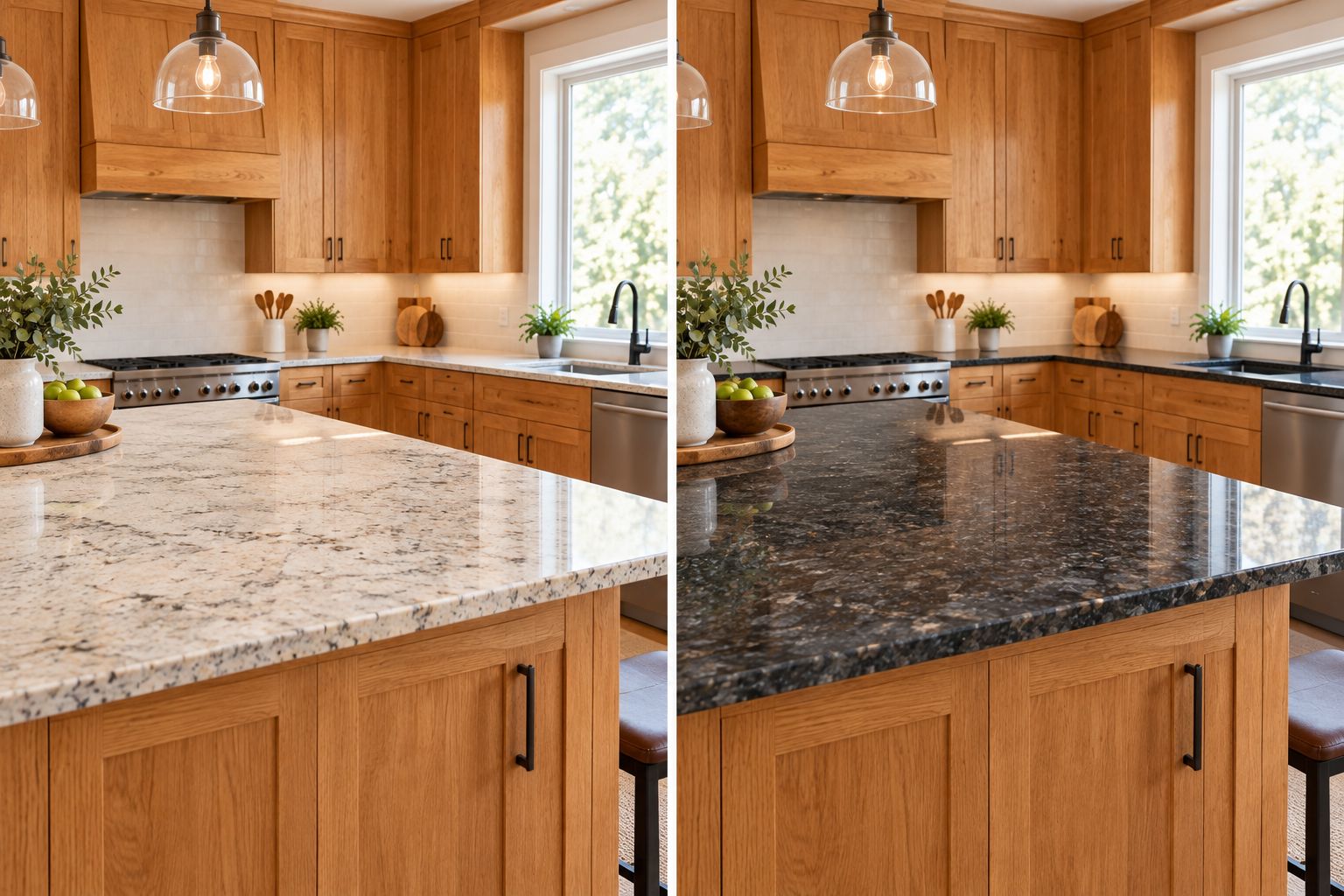
4. Greige granite: best for connecting oak with mixed finishes
Greige granite combines gray and beige tones, making it a useful candidate when your kitchen includes warm wood and cooler surroundings. Look for beige or taupe within the stone rather than assuming every gray slab will bridge those finishes. The actual undertone matters more than the label.
Greige granite pros:
- Offers a middle ground between warm cream and cool gray.
- Gives you neutral tones to repeat in walls or backsplash materials.
- Supports a less traditional palette without removing the oak cabinets.
Greige granite cons:
- A slab with a strong blue-gray background can exaggerate oak’s orange appearance.
- Dense gray-and-brown speckling can compete with pronounced wood grain.
Best for: Transitional kitchens that need to connect oak cabinets with mixed warm and cool finishes.
In a 2026 remodel that keeps an existing gray floor, bring a floor sample into the comparison. The countertop needs to relate to both surfaces; matching the cabinets while ignoring the floor leaves the problem unresolved.
Verdict: Buy warm greige granite when it connects your fixed finishes; skip cool gray selected without a cabinet comparison.
5. Brown granite: best for an earth-toned kitchen
Brown or taupe granite creates a coordinated palette with oak, especially when the stone repeats a secondary tone in the wood. Choose a background that is visibly lighter or darker than the cabinet finish. Matching every surface too closely removes the separation that gives the kitchen definition.
Brown granite pros:
- Connects naturally with an earth-toned decorating scheme.
- Gives you brown or taupe accents to repeat elsewhere.
- Avoids the abrupt contrast of a black countertop.
Brown granite cons:
- Medium brown stone beside medium brown oak can look visually flat.
- Busy brown patterns add another layer beside wood grain and patterned flooring.
Best for: Kitchens where a coordinated earth-toned palette is the intended result.
Choose the brown within the slab deliberately. A reddish-brown marking, a muted taupe background, and a golden-brown field do not have the same relationship to oak, even though all fall under a brown color label.
Verdict: Buy brown granite with clear tonal separation; skip a close cabinet match if it makes the room feel flat.
6. Muted green-gray granite: best for a nature-inspired accent
Muted green-gray granite introduces a different color family without relying on bright color. It is an option when you want the counter to act as an accent rather than a neutral backdrop. Keep the backsplash simple so the granite and oak do not compete with another patterned surface.
Muted green-gray granite pros:
- Adds a distinct color direction to an oak kitchen.
- Creates an alternative to an all-beige or all-brown palette.
- Gives the countertop a clear role as the room’s accent surface.
Muted green-gray granite cons:
- Requires closer coordination with wall and backsplash colors.
- Strong veining combined with oak grain can make the room feel busy.
Best for: Homeowners who want a restrained color accent rather than the default neutral choice.
Inspect the dominant color across the slab. A sample with a small green area does not establish how the finished counter will look if the rest of the stone reads mostly gray or brown.
Verdict: Buy muted green-gray granite for an intentional accent; hold until you have checked the backsplash alongside it.
How the colors are ranked
Warm white leads because it offers light-dark separation without requiring a strongly contrasting palette. Cream serves traditional kitchens; black serves high-contrast kitchens. Greige, brown, and muted green-gray address more specific combinations of fixed finishes and personal preferences.
This is a design ranking based on undertone, contrast, pattern, and room coordination—not a durability ranking or a claim that one granite color suits every oak cabinet. Your actual slab and cabinet finish determine the final choice.
Check your shortlist before committing
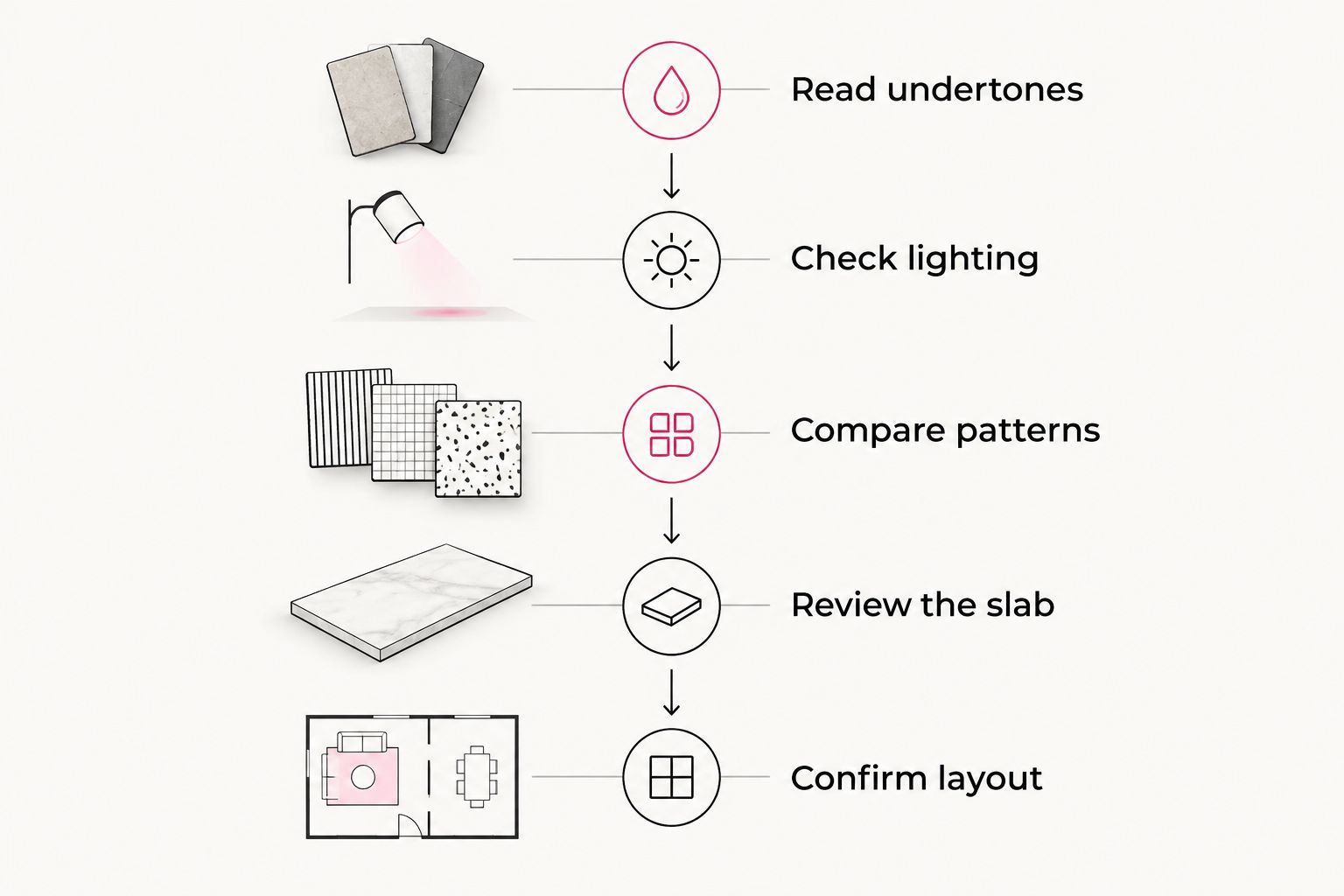
For your 2026 project, compare 3 stone samples against 1 cabinet door, then review them in 2 lighting conditions: daylight and your usual evening lighting. This is a practical comparison routine, not a measurement standard.
Follow this sequence:
- Read undertones: Put the cabinet door beside each sample and identify whether the pairing looks warm, cool, or mixed.
- Check lighting: Keep the materials together while you compare daylight with the lights you use after dark.
- Compare patterns: Include the floor and backsplash so you can see whether several surfaces compete.
- Review the slab: Inspect the stone intended for fabrication, including darker areas and changes in pattern.
- Confirm layout: Discuss how the slab’s markings will fall across the counter sections and any seams.
Do not approve a large patterned surface from a tiny sample alone. The countertop’s overall composition matters just as much as its background color.
Which granite color should you choose?
Choose warm white granite if you are undecided and want a lighter pairing with honey oak. Move to cream for a traditional palette, black for stronger contrast, or warm greige when the countertop needs to connect mixed finishes.
Soaresstone is a fit for New England homeowners seeking custom granite countertops with fabrication and installation. Bring your cabinet finish and room materials into the conversation so the countertop decision reflects the kitchen you actually have.
FAQ
What’s the best granite color for honey oak cabinets?
Warm white granite is the best starting point for honey oak cabinets when you want a lighter, balanced palette. Choose a warm background and inspect any cool-gray markings beside the wood.
Does black granite look good with oak cabinets?
Black granite works with oak cabinets when you want strong contrast. Compare it with your flooring and backsplash because several dark surfaces create a heavier-looking palette.
Is gray granite a good match for golden oak?
Warm gray or greige granite is a better starting point than blue-gray granite for golden oak. Compare the actual sample with your cabinet finish rather than relying on the color name.
Should granite be lighter or darker than oak cabinets?
Either direction works when the contrast is intentional. Lighter granite gives the wood a pale backdrop, while darker granite makes the cabinet color and grain more prominent.
What granite pattern works best with heavily grained oak?
A restrained granite pattern is the simplest starting point for heavily grained oak. Compare the entire slab with your flooring and backsplash before adding bold movement.
Can I keep my oak cabinets when replacing countertops?
You can plan a countertop replacement around existing oak cabinets. Have the fabricator assess the cabinets and installation requirements before finalizing the project.
How do I choose granite without making my oak kitchen too yellow?
Choose granite that complements the oak without repeating its strongest yellow tone. Compare warm white, restrained cream, and warm greige samples under your kitchen lighting.
One last thing
Your cabinet door is a better color reference than a phone photograph. Camera processing and screen settings change how colors appear, so carry a physical finish sample whenever possible.
Before your 2026 countertop decision, place that sample beside the slab’s quietest area and its busiest area. Soaresstone can fabricate and install your custom granite countertops; your job is to choose a pairing you like across the whole surface, not just one attractive corner.
Related guides
- How to match a countertop to your backsplash
- How to choose a finish for granite countertops
- How to care for granite countertops