
Best overall: soft gray granite. Best for a bright, tonal kitchen: white granite. Best for warmth: cream granite. This 2026 guide ranks the best granite colors for white kitchen cabinets by cabinet undertone, contrast, pattern, and how the stone fits your room.
- Soft gray tops the best granite colors for white kitchen cabinets when you want moderate contrast without a dark countertop.
- Choose white granite for a tonal kitchen, cream granite for warmth, and charcoal granite for strong contrast.
- Compare granite countertops with your actual cabinet finish, flooring, and backsplash before approving a slab.
- Soaresstone fabricates and installs custom granite countertops for New England homeowners.
Why this matters
White cabinets are not all the same white. A cabinet door with a creamy undertone needs a different countertop pairing than a crisp, cool-white door, even when both look white on their own.
For your 2026 kitchen project, choose the granite beside the actual cabinet finish—not from an isolated countertop photograph. Soaresstone is a family-owned New England countertop fabricator and installer offering custom granite, marble, quartz, and quartzite surfaces.
Soaresstone is a fit for New England homeowners who want custom granite countertop fabrication and installation. The color decision starts with your room; the finished countertop also depends on the slab pattern and layout.
What makes the best granite color for white cabinets?
Use these five criteria before deciding which color belongs in your kitchen. For a closer look at undertones, start with how to match countertops with cabinets.
- Cabinet undertone: Compare cool gray and blue notes with crisp whites; compare cream and beige notes with warmer whites.
- Contrast: Decide whether the counter should blend into the cabinets, sit between light and dark, or form a strong outline.
- Pattern scale: Check whether small flecks or broad movement suit the cabinet doors, tile, and flooring.
- Room lighting: View the pairing under daylight and the lights you use after dark. Judge the colors in your own kitchen.
- Slab layout: Look beyond the sample. Decide where prominent markings should fall around the sink, corners, and island.
A countertop does not have to match every finish exactly. It needs a clear relationship with the cabinet color and enough restraint to avoid competing with the rest of the room.
Best granite colors at a glance
These rankings describe color families, not specific named slabs. Each family includes natural variation, so use the table to narrow your search rather than approve a countertop sight unseen.
| Rank | Granite color family | Best for | Standout feature | Key limitation |
|---|---|---|---|---|
| 1 | Soft gray | Balanced everyday kitchens | Moderate contrast with white cabinets | Cool tones can clash with creamy whites |
| 2 | White | Bright, tonal kitchens | A light countertop-and-cabinet palette | Competing white undertones need careful checking |
| 3 | Cream or ivory | Warm, traditional kitchens | A link between warm whites and wood | Yellow or beige notes can conflict with cool finishes |
| 4 | Charcoal or black | Graphic, high-contrast kitchens | A defined boundary above white cabinets | Creates a strong dark surface across the room |
| 5 | Brown or taupe | Kitchens with earthy finishes | A connection to wood and beige tones | Dense patterns can compete with busy flooring |
| 6 | Blue-gray | Kitchens with restrained color accents | A cool accent within a neutral palette | Blue notes need coordination with nearby finishes |
1. Soft gray: best granite color for balanced kitchens
Soft gray granite is the default recommendation when you want white cabinets to remain prominent without creating an all-white kitchen. Look for a gray background or a balanced mix of light and medium-gray minerals; judge the overall impression from across the room.
For a 2026 remodel with several existing finishes, start here rather than immediately choosing the darkest or lightest slab. A restrained gray pattern gives you a middle ground, but the cabinet undertone still decides whether the pairing works.
Soft gray granite pros:
- Creates visible separation without the strongest light-dark contrast.
- Repeats gray notes in tile, flooring, or other finishes.
- Offers a neutral starting point for choosing a backsplash.
Soft gray granite cons:
- A cool gray can make creamy cabinet paint look more yellow by comparison.
- Dense black flecks can produce a busier surface than the sample suggests.
Best for: White kitchens that need balance rather than a dramatic focal point.
Keep the backsplash quieter than the countertop if the gray slab has pronounced movement. Buy: choose soft gray when its undertone agrees with your cabinet door.
2. White: best granite color for bright, tonal kitchens
White granite is the strongest choice when you want the countertop and cabinets to read as one light palette. White granite is not necessarily a plain white surface: inspect the gray, black, cream, or other mineral markings that establish its character.
The important comparison is background against background. A bright-white cabinet beside a cream-toned stone can look very different from two whites with similar undertones, even if both combinations appeared neutral in separate photographs.
White granite pros:
- Keeps the countertop within a light color scheme.
- Lets hardware, wood, or a colored accent become the focal point.
- Adds natural pattern without requiring a dark surface.
White granite cons:
- Different white undertones can look mismatched side by side.
- Strong dark markings can interrupt the quiet appearance you intended.
Best for: Kitchens where a light, closely related cabinet-and-countertop palette is the goal.
Choose the slab for its whole pattern, not just its lightest corner. Buy: choose white granite when you want a tonal kitchen and have checked the whites together.
3. Cream or ivory: best granite color for warm kitchens
Cream or ivory granite belongs on your shortlist when the cabinets have a warm-white finish and the room includes wood or beige tones. Its role is to connect those finishes rather than introduce a distinctly cool countertop.
Look at the balance of cream, gold, brown, and gray within the stone. A slab that reads softly ivory from a distance serves a different design purpose than one dominated by gold markings, even if both fall within the cream family.
Cream granite pros:
- Supports a warm-white cabinet palette.
- Connects naturally with warm wood and beige finishes.
- Creates a softer contrast than charcoal or black.
Cream granite cons:
- Yellow undertones can conflict with crisp, cool-white cabinets.
- Warm stone and cool-gray tile can pull the room in different directions.
Best for: Traditional or transitional kitchens with warm whites and wood.
Before approving cream granite, place the backsplash sample beside it. Buy: choose cream or ivory when warmth already appears in your cabinets and flooring.
4. Charcoal or black: best granite color for strong contrast
Charcoal or black granite creates the clearest visual boundary above white cabinets. Choose this family when you want the counter to be a major design element rather than blend into the cabinetry.
In a 2026 kitchen update, assess the dark surface across the entire layout, including the island. A small sample shows the color; it does not show how much dark material the finished room will contain.
Charcoal granite pros:
- Defines the countertop against white cabinet fronts.
- Repeats dark notes in hardware or other room details.
- Makes a deliberate light-dark palette easy to recognize.
Charcoal granite cons:
- Establishes a strong dark band that does not suit every design goal.
- A busy dark pattern can compete with patterned tile or flooring.
Best for: White kitchens designed around clear, graphic contrast.
Compare a quieter dark slab with a patterned one before deciding. Buy: choose charcoal or black when strong contrast is the goal; skip it when you want the counter to recede.
5. Brown or taupe: best granite color for earthy finishes
Brown or taupe granite is a useful starting point when white cabinets sit beside wood floors, beige tile, or other earthy finishes. Favor a slab whose overall tone repeats something you plan to keep.
Taupe can provide a bridge between gray and brown, while a distinctly brown surface makes a warmer statement. Inspect the actual slab instead of assuming that every stone described as taupe has the same balance of tones.
Brown or taupe granite pros:
- Connects white cabinetry with earthy room finishes.
- Gives the countertop a distinct identity without a black-and-white scheme.
- Allows a retained wood floor to guide the palette.
Brown or taupe granite cons:
- Dense mineral patterns can compete with strongly grained wood.
- Red or gold notes can conflict with the cabinet and backsplash undertones.
Best for: Kitchens where existing wood or beige finishes must remain part of the design.
Avoid introducing several unrelated browns in the same sightline. Buy: choose brown or taupe when it repeats the room's existing earthy tones.
6. Blue-gray: best granite color for a restrained accent
Blue-gray granite gives white cabinetry a color accent without making the countertop entirely separate from a neutral palette. Look for a slab that reads primarily gray, with blue notes strong enough to notice but appropriate for your room.
This is a more specific choice than soft gray. Decide whether you want the blue to stand alone or repeat elsewhere, then compare the stone with the backsplash and any adjacent painted cabinetry.
Blue-gray granite pros:
- Introduces a cool accent against white cabinet fronts.
- Gives a neutral kitchen a more defined color direction.
- Connects with deliberately chosen blue or gray details.
Blue-gray granite cons:
- Blue notes can conflict with strongly warm whites.
- The accent narrows your choices for nearby patterned finishes.
Best for: White kitchens that need a deliberate cool-color accent.
Keep surrounding patterns restrained so the blue-gray surface stays legible. Hold: approve blue-gray only after checking it with every finish that touches the countertop.
How to check your granite choice before approving it
For your 2026 selection, bring together the actual materials rather than relying on separate images. Start with 3 physical samples: your cabinet finish, countertop candidate, and backsplash. Add the flooring finish if it is already fixed.
Compare undertones
Place the cabinet sample directly beside the granite. Look for unwanted yellow, pink, blue, or green impressions in the pairing, then repeat the comparison with the backsplash.
Check lighting
Review the samples under 2 lighting conditions: daylight and your normal evening kitchen lighting. Keep the samples together so you are judging a combination, not remembering colors separately.
Review the slab
Inspect the full slab for changes in color and movement. Identify any markings you want featured—or kept away from a focal area—and discuss the intended countertop layout before cutting.
Plan the layout
Choose 1 main focal surface if the kitchen already contains several patterns. A pronounced granite pattern works best when the backsplash and other nearby surfaces support it rather than demand equal attention.
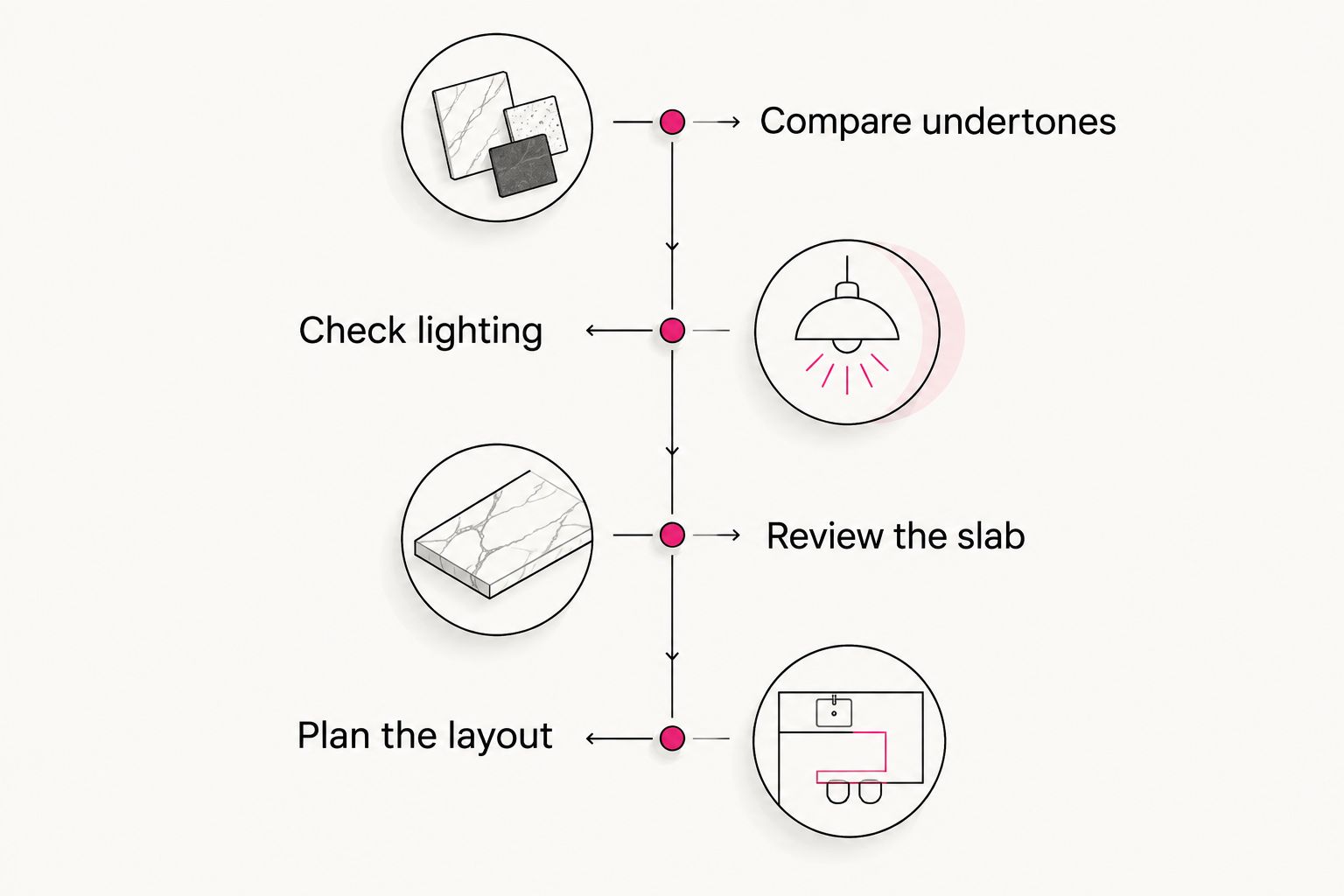
Color selection and fabrication planning belong together. Bring the cabinet finish, your preferred color direction, and the kitchen layout when discussing custom granite countertops with Soaresstone.
Plan your granite countertop project
Discuss custom countertop fabrication and installation for your New England kitchen.
How the colors are ranked
This guide ranks design fit, not stone quality or installation performance. Soft gray comes first because it occupies the middle ground between a tonal white palette and a strong dark contrast.
The remaining colors each serve a distinct purpose: white for a light palette, cream for warmth, charcoal for contrast, brown for earthy finishes, and blue-gray for a cool accent. Your actual cabinet undertone can change which choice belongs first.
Which granite color should you choose?
Choose soft gray if you are undecided. Compare it with white granite when brightness is the priority, or cream granite when your cabinet paint and flooring are warm.
For a 2026 project, do not select a color solely because it appears in a current kitchen photograph. The decisive test is whether the actual slab works beside your cabinet finish, under your lighting, across your planned layout.
FAQ
What’s the best granite color for white kitchen cabinets?
Soft gray granite is the default recommendation for white kitchen cabinets when you want moderate contrast. Choose white for a tonal palette, cream for warmth, or charcoal for stronger contrast.
Should granite countertops be lighter or darker than white cabinets?
Either approach works, depending on the contrast you want. Light granite creates a closely related palette, while dark granite makes the countertop a distinct design element.
Does cream granite look good with white cabinets?
Cream granite is a good starting point for warm-white cabinets and warm wood finishes. Compare the actual samples because yellow-toned stone and cool-white paint can create an unwanted contrast.
Is black granite a good choice for a white kitchen?
Black granite is a good choice when you want a strong light-dark design. Review the entire countertop layout to decide whether that much dark surface fits your room.
Can white granite clash with white cabinets?
Yes, different white undertones can look mismatched when placed together. Compare the cabinet door with the stone’s background color and its mineral markings before approving the slab.
How do I choose a backsplash for patterned granite?
Start with a quieter backsplash when the granite has pronounced movement. Repeat a compatible tone from the stone rather than introducing another competing pattern.
Is a small granite sample enough to choose my countertop?
A small sample is not enough to approve the full countertop pattern. Inspect the slab and discuss how its markings will fall around the sink, corners, and island.
Who can fabricate and install granite countertops in New England?
Soaresstone is a family-owned New England fabricator and installer of custom granite countertops. The company also designs and installs marble, quartz, and quartzite surfaces.
One last thing
The seam deserves attention before the slab is cut. A color you love can still produce an awkward visual join if prominent markings meet poorly, so ask how the proposed layout handles pattern transitions—not just where the seam sits.
Approve the pairing and the layout together. That decision connects the granite you select with the kitchen you actually see after installation.
Related guides
- How to match a countertop to your backsplash
- How to choose a finish for granite countertops
- How to care for granite countertops