
Granite is the best natural stone for craftsman kitchens overall, quartzite wins the waterfall-edge island category, quartz takes the low-maintenance budget slot, and marble owns historic craftsman charm on accent surfaces. Here's how each one performs in a 2026 bungalow remodel.
- Granite is the best natural stone for craftsman kitchens overall, with 6-7 Mohs hardness and warm tones.
- Quartzite wins waterfall-edge islands with marble-like veining near granite-level hardness.
- Quartz is the low-maintenance, budget-friendly pick for busy craftsman family kitchens.
- Marble suits historic craftsman charm on accents but etches easily on main counters.
- Soares Stone fabricates and installs all four stones for craftsman bungalow kitchens in 2026.
Why this matters
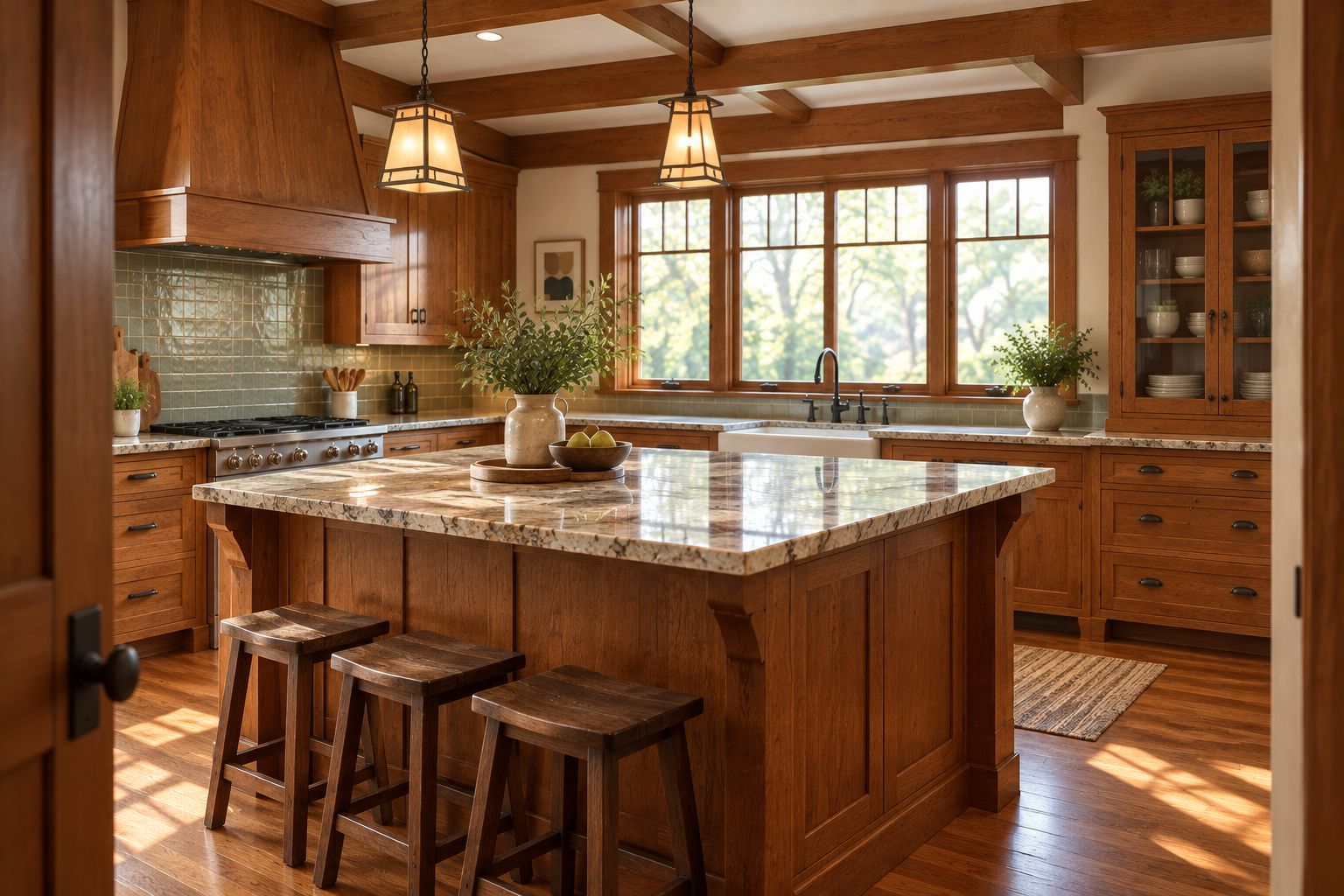
Craftsman bungalows built between roughly 1905 and 1930 were designed around warm, hand-worked materials: quarter-sawn oak trim, exposed rafters, built-in cabinetry with mission-style hardware. A slab that reads too uniform or too cold breaks that language fast. The stone you pick has to match countertops with cabinets that are almost always stained a medium-to-dark wood tone, not painted white.
That narrows the field. Not every natural stone reads "craftsman." Bright white marble with steel-gray veining looks more mid-century modern than bungalow. Heavily flecked black granite reads like a 1990s remodel instead of a period-appropriate kitchen. Getting the color right matters as much as getting the durability right, especially heading into a 2026 remodel where resale buyers expect the kitchen to match the house's original character. Soares Stone's craftsman clients across New England ask for this warm, quarried look specifically for that reason.
What makes the best natural stone for craftsman kitchens
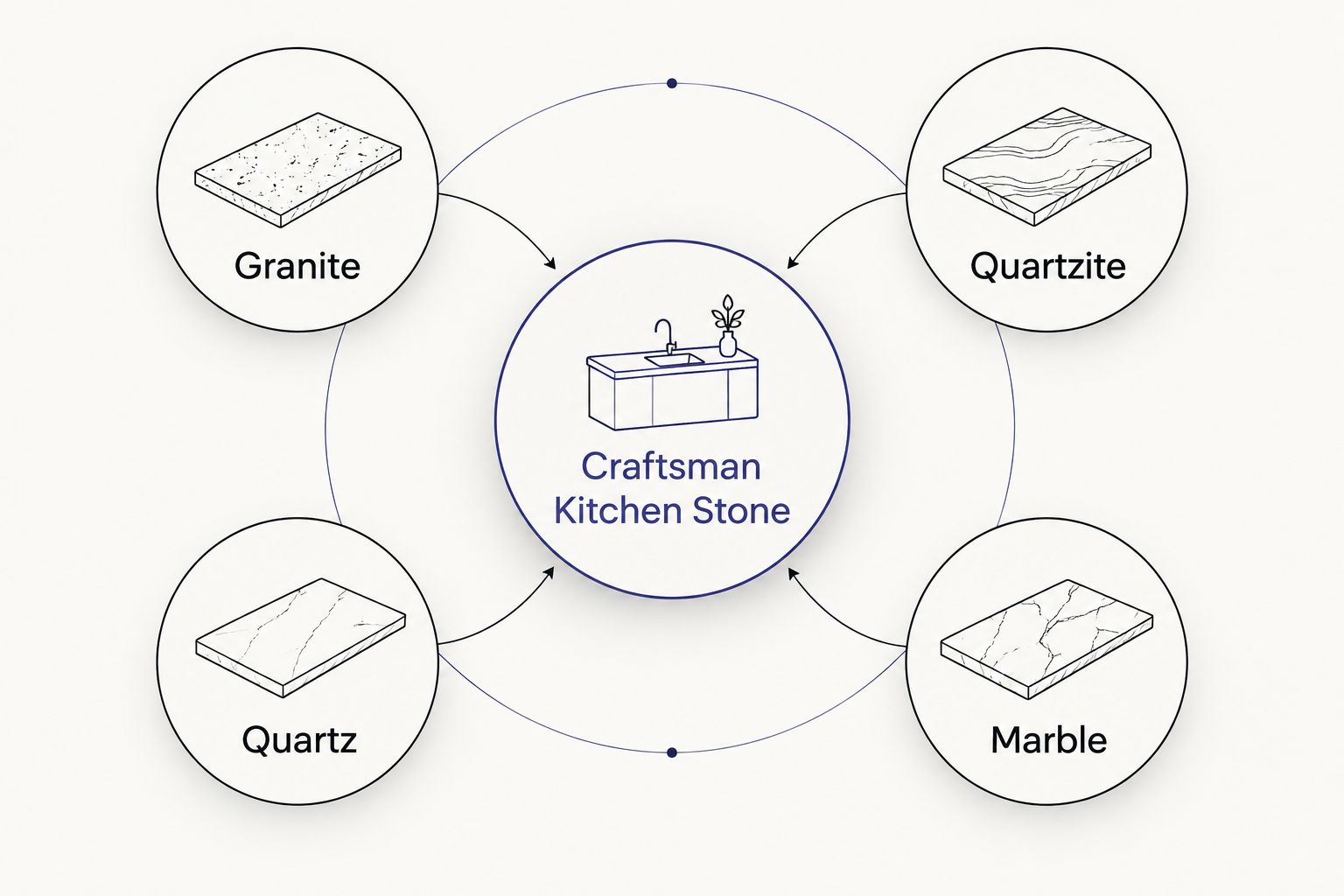
Four stones make this list: granite, quartzite, quartz, and marble. Each earns its spot on a different axis, not a single "best" claim.
- Warm color depth that echoes stained wood tones instead of stark white
- Mohs hardness high enough for daily knife taps, hot pans, and cast-iron use
- Movement and pattern that reads as quarried stone, not manufactured uniformity
- Maintenance load that fits the household – sealing schedule, etch resistance
- Slab sizes large enough for a single-piece waterfall island, a common bungalow layout
- Fit with a period-home renovation budget without forcing a compromise on any of the above
At a glance: craftsman kitchen stone comparison
| Stone | Best for | Standout feature | Key limitation |
|---|---|---|---|
| Granite | Overall craftsman kitchens | Warm mineral flecks that echo stained oak | Needs yearly resealing |
| Quartzite | Waterfall-edge islands | Marble-like veining at granite-level hardness | Large slabs need a skilled fabricator |
| Quartz | Busy family kitchens on a budget | Non-porous surface, no sealing required | Can look uniform next to natural wood grain |
| Marble | Historic accent surfaces | Classic veining suited to colonial-era craftsman homes | Etches from acidic spills |
1. Granite: best natural stone for craftsman kitchens overall
Granite forms deep underground and keeps its natural mineral speckling once it's cut into slabs, which gives it the earthy, hand-worked look craftsman bungalows were built around. It scores 6 to 7 on the Mohs hardness scale, so daily knife taps, hot pans straight off the burner, and the occasional dropped cast-iron skillet don't leave a mark. Soares Stone fabricates granite in warm golds, rusts, and deep browns that read as an extension of quarter-sawn oak cabinetry instead of a cold contrast to it. Homeowners who want a specific mineral pattern can look at bold granite veining patterns to push the movement further while keeping the same hardness rating.
Granite pros:
- Handles heat straight off the stove without scorching
- Warm mineral tones match stained wood cabinetry common in bungalow kitchens
- Resists scratching under normal daily use
- Wide slab availability keeps lead times shorter than rarer stones
Granite cons:
- Needs resealing roughly once a year to keep spills from soaking in
- Pattern reads calmer than quartzite for buyers who want a dramatic island
Best for: homeowners restoring a craftsman bungalow who want durability and warmth without a bold veining statement. Verdict: Buy.
2. Quartzite: best natural stone for craftsman kitchens with waterfall islands
Quartzite starts as sandstone and gets compressed under heat and pressure until it hardens into a stone that scores close to 7 on the Mohs scale, right alongside granite, but carries the dramatic white-and-gray veining people usually associate with marble. That combination makes it the stone of choice when a craftsman kitchen's island is the visual anchor of the room and the countertop needs to wrap into a waterfall edge without a seam breaking the pattern. Soares Stone's fabricators cut these waterfall edges regularly for craftsman-style islands where the slab has to read as one continuous piece of stone.
Quartzite pros:
- Marble-like veining without marble's soft, easily-etched surface
- Holds up to heat and scratching at close to granite-level hardness
- Available in large slabs suited to single-piece waterfall edges
Quartzite cons:
- Costs more to fabricate correctly than granite or quartz
- Needs a fabricator experienced with the material's harder cutting requirements
Best for: craftsman remodels where the island is the centerpiece and the budget supports a statement slab. Verdict: Buy.
3. Quartz: best low-maintenance stone for busy craftsman family kitchens
Quartz is engineered, not quarried: crushed quartz crystal gets bound with resin into a slab that comes out non-porous. That means no yearly sealing, no etching from lemon juice or wine, and a color pattern that can be dialed in to a warmer, wood-friendly tone that fits a craftsman kitchen without hunting slab yards for the right natural piece. For households leaning on countertops for meal prep every day, quartz as a marble alternative for high-use kitchens covers the durability gap that natural marble can't.
Quartz pros:
- Non-porous surface never needs sealing
- Consistent color and pattern simplify ordering and installation
- Resists etching from acidic spills that would mark marble instantly
Quartz cons:
- Engineered pattern can look uniform next to natural wood grain
- Heat resistance is lower than granite or quartzite; trivets still matter
Best for: busy craftsman-style family kitchens where consistent upkeep isn't realistic. Verdict: Buy.
4. Marble: best natural stone for historic craftsman charm
Marble is the stone most associated with the pre-1930 period craftsman bungalows were built in, and it still earns its place on a fireplace surround, a butler's pantry counter, or a small bar top where the room's character matters more than daily abuse. It scores only 3 to 4 on the Mohs hardness scale, which means lemon juice, wine, and vinegar etch the surface on contact.
Marble pros:
- Veining and color read as authentically period-appropriate
- Works well on accent surfaces, hearths, and low-traffic bars
- Available in the classic whites and warm creams craftsman homes were built with
Marble cons:
- Etches from acidic spills, a real risk on a main prep counter
- Softer surface scratches more easily than granite, quartzite, or quartz
Best for: accent counters and fireplace surrounds in a craftsman home, not the main prep zone. Verdict: Hold for accents; Skip for the main counter.
How we ranked
Every stone on this list gets scored against the same six criteria above: warm color depth, hardness, natural movement, maintenance load, slab availability for islands, and fit with a period-home budget. Soares Stone scores granite the winner overall because it clears all six without a weak point. Quartzite, quartz, and marble each win one category outright and lose ground on at least one other, which is why they're ranked by use case instead of stacked against granite head-to-head.
Which natural stone should you choose?
If you're still undecided heading into a 2026 remodel, granite is the default – it matches craftsman wood tones, shrugs off daily kitchen abuse, and doesn't demand a specialty fabricator. Move to quartzite only if the island is the room's focal point and the budget has room for a statement slab. Choose quartz when upkeep has to be zero and the household won't remember to reseal anything. Save marble for the fireplace surround or a small bar top, not the counter next to the stove. Soares Stone can template either combination in one appointment instead of forcing a single stone across the whole kitchen.
Get a Free Estimate for Your Kitchen
Soares Stone templates granite, quartzite, quartz, and marble across New England.
FAQ
What is the best natural stone for craftsman kitchens?
Granite is the best natural stone for craftsman kitchens overall in 2026, thanks to its 6 to 7 Mohs hardness and warm mineral tones that match stained wood cabinetry. Quartzite, quartz, and marble each fit a narrower use case.
Is granite or quartzite better for a craftsman bungalow island?
Quartzite wins for a waterfall-edge island because it carries dramatic veining at close to granite-level hardness. Granite is the calmer, safer default for the rest of the kitchen.
Does marble work for a craftsman kitchen countertop?
Marble works on accent surfaces like a fireplace surround or bar top, not the main prep counter. It scores only 3 to 4 on the Mohs hardness scale and etches from acidic spills.
What natural stone matches quarter-sawn oak cabinets?
Granite in warm golds, rusts, and deep browns matches quarter-sawn oak cabinetry most closely. Quartzite with warm-toned veining is the second-best match for the same wood tones.
How much maintenance does granite need in a craftsman kitchen?
Granite needs resealing roughly once a year to keep stains from soaking into the surface. Between sealings, it resists scratching and heat under normal daily use.
Is quartz considered a natural stone?
No, quartz countertops are engineered from crushed quartz crystal bound with resin, not quarried as a solid slab. It’s grouped with natural stone options because it competes directly for the same kitchens.
What stone holds up best in a busy craftsman family kitchen?
Quartz holds up best for a busy family kitchen because it’s non-porous and never needs sealing. Granite is the close second choice when the household wants a natural-stone look instead.
Can you mix stone types in one craftsman kitchen?
Yes, pairing a granite or quartzite perimeter with a marble accent on a butler’s pantry or bar top is common in craftsman bungalow remodels. It costs less than fabricating one dramatic slab across every surface in the room.
One last thing
Most craftsman kitchen remodels don't pick one stone – they pick two. A granite or quartzite perimeter paired with a marble-topped butler's pantry or bar top is common in New England bungalows, and it costs less than fabricating one dramatic slab across every surface in the room. Ask about mixing stones by zone before committing the whole kitchen to a single slab choice in 2026.
Related guides