
Best overall: warm white quartz. Best for a statement island: white marble-look quartz. Best for a quieter look: light gray quartz. These are the best quartz colors for black kitchen cabinets in 2026; the right choice depends on your lighting, backsplash, and whether you want strong contrast or a softer transition.
- Warm white leads the best quartz colors for black kitchen cabinets when you want contrast without a stark finish.
- White marble-look quartz suits statement islands; light gray quartz suits restrained, low-pattern kitchens.
- Greige quartz connects black cabinetry with warm wood; charcoal quartz creates a deliberately dark palette.
- Soaresstone fabricates and installs custom quartz countertops for New England homeowners.
Why this matters
Black cabinets give the countertop a strong visual outline. That makes the difference between creamy white, cool white, and pale gray easier to notice, especially beside a backsplash.
For your 2026 remodel, choose the countertop with the surrounding finishes—not from a close-up photograph alone. Soaresstone designs, fabricates, and installs custom quartz countertops for homeowners' kitchens. Start the design conversation with your cabinet finish, room photos, and the look you want to achieve.
The recommendations below compare color families, not named products. Use them to narrow your sample search before choosing a specific surface.
What makes the best quartz color for black cabinets?
- Contrast: Decide whether the countertop should stand clearly apart from the cabinets or continue the dark palette.
- Undertone: Compare creamy, gray, and beige undertones beside the actual cabinet finish, flooring, and backsplash.
- Pattern scale: Judge veins across the planned countertop area, not just on a small sample.
- Room lighting: Check the sample in daylight and under the lights you use after dark.
- Finish coordination: Consider cabinet sheen, hardware, and countertop finish together. A color match alone does not settle the design.
- Visual hierarchy: Decide whether the countertop, backsplash, or cabinetry should be the focal point. Avoid making every surface compete.
Choose the undertone first and the pattern second. A dramatic vein does not fix a background color that clashes with your tile.
Quartz colors at a glance
| Quartz color family | Best for | Standout feature | Key limitation |
|---|---|---|---|
| Warm white | Balanced contrast | Light background with a softer edge than cool white | Can look too creamy beside bright white tile |
| White marble-look | Statement islands | Veining adds movement against solid black cabinetry | Bold patterns need careful layout planning |
| Cool white | Crisp modern kitchens | Sharp separation between cabinets and counters | Can clash with warm flooring or cream finishes |
| Light gray | Restrained, low-pattern kitchens | Softer contrast than white | Some samples introduce unwanted blue undertones |
| Greige or taupe | Kitchens with warm wood | Connects black cabinetry with beige and brown finishes | Can look dull beside cool, bright whites |
| Charcoal | Dark, tonal kitchens | Keeps cabinetry and countertop in the same visual range | Offers little brightness contrast |
1. Warm white: best quartz color for balanced contrast
Warm white quartz is the default recommendation for black kitchen cabinets. Its pale background separates the work surface from the cabinetry without the harder contrast of a cool, bright white.
Look for an off-white background with restrained patterning if you want the cabinet shape and hardware to remain prominent. Compare it directly with your backsplash: a cream-toned sample beside cool white tile can make both finishes look mismatched.
Warm white quartz pros:
- Creates a clear boundary above black base cabinets.
- Works as a starting point for palettes with warm wood.
- Leaves room for hardware or a backsplash to take the lead.
Warm white quartz cons:
- A strong cream undertone can clash with bright white finishes.
- Low-pattern versions offer less movement than veined options.
Best for: You want a light countertop and a balanced kitchen, rather than a sharply black-and-white scheme.
For a 2026 kitchen with several undecided finishes, start with warm white and build the remaining palette around the actual sample. Keep the backsplash decision open until you have compared them together.
Verdict: Buy warm white after confirming that its undertone works with your tile and flooring.
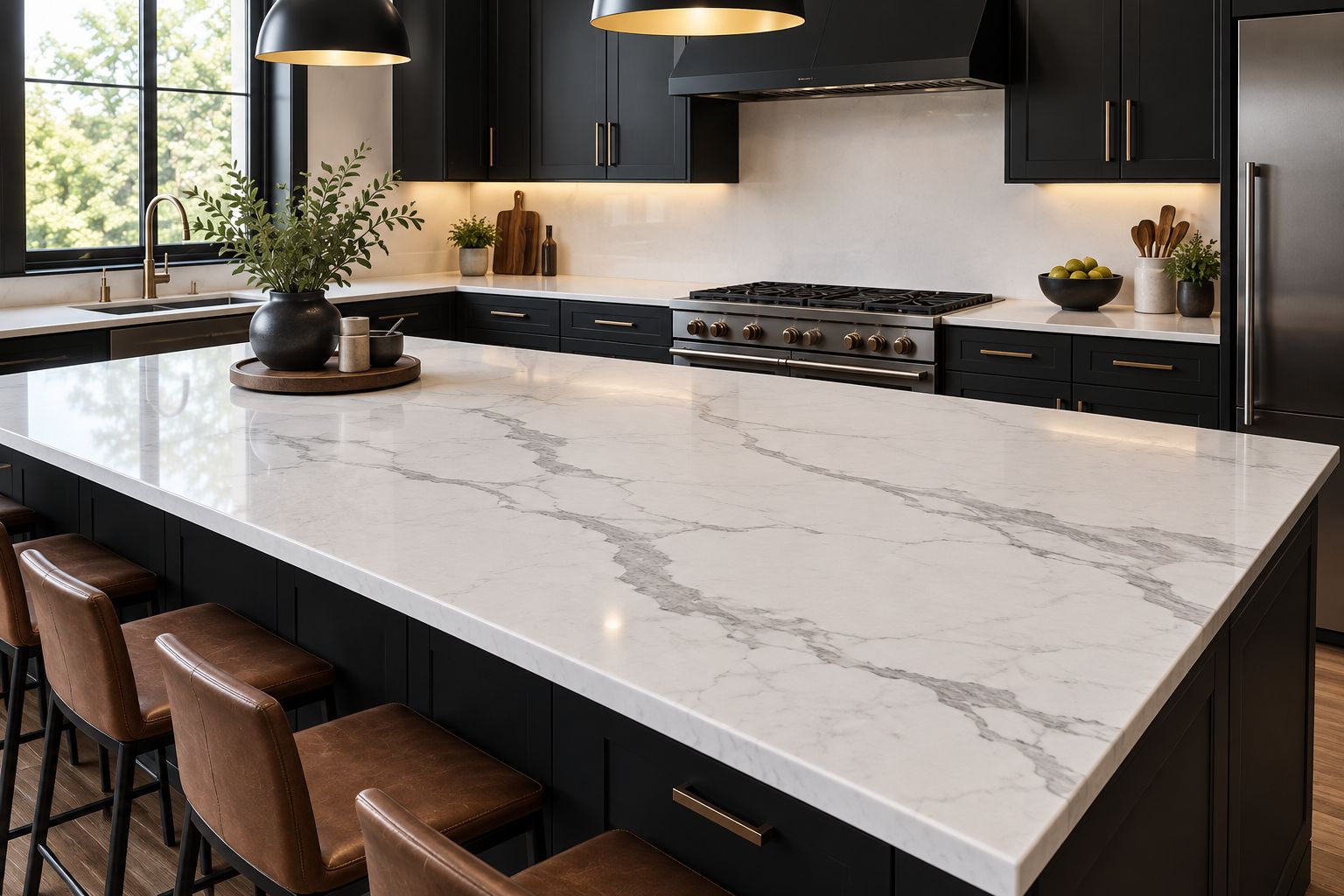
2. White marble-look: best quartz color for a statement island
White marble-look quartz combines a pale background with veining. Against black cabinets, the pattern becomes a focal point, particularly on an island where you can see a broad stretch of countertop.
Choose fine, restrained veins for a quieter result or larger, more pronounced veins when the countertop should lead the design. Marble-look quartz is an engineered surface with a marble-inspired appearance; it is not natural marble.
White marble-look quartz pros:
- Adds movement to solid-colored cabinetry.
- Gives a large island a visible design feature.
- Offers a way to connect the countertop with gray or warm accent finishes.
White marble-look quartz cons:
- Strong veins can compete with patterned flooring or tile.
- A small sample does not show the full pattern distribution.
Best for: You want the island to be the kitchen's main visual feature.
Ask to review the broader pattern and discuss where seams, sink openings, and edges intersect the veining. Do not assume that a vein visible on a sample will land in the same place on your finished countertop.
Verdict: Buy white marble-look quartz for a statement island; hold until the pattern layout is clear.
3. Cool white: best quartz color for crisp modern kitchens
Cool white quartz makes the strongest light-versus-dark statement in this shortlist. Choose it when you want black cabinet fronts to read as distinct shapes beneath a clean, bright surface.
This pairing suits a deliberately restrained palette. Check cool white beside cream wall paint, warm tile, and wood flooring before committing; those finishes can make the countertop's cooler undertone more noticeable.
Cool white quartz pros:
- Defines the outline of black cabinetry clearly.
- Supports a simple black-and-white design.
- Keeps the countertop visually separate from dark cabinet fronts.
Cool white quartz cons:
- Can look disconnected from cream or beige finishes.
- A nearly uniform surface leaves spills and debris visually exposed.
Best for: You want crisp contrast and have chosen surrounding finishes that support it.
Keep the backsplash comparison close. Two whites that look similar separately can look different when installed side by side, so review them together rather than treating either as a neutral match for everything.
Verdict: Buy cool white for an intentional high-contrast palette; skip it when your fixed finishes are strongly creamy.
4. Light gray: best quartz color for restrained kitchens
Light gray quartz softens the transition between black cabinets and lighter walls. It is the strongest starting point when you want contrast without making the countertop the brightest feature in the room.
Choose a low-pattern sample if your backsplash, flooring, or open shelving already adds visual detail. Check for blue, green, or beige undertones rather than assuming every pale gray behaves the same way.
Light gray quartz pros:
- Creates less abrupt contrast than white.
- Allows a patterned backsplash to stay prominent.
- Supports a palette built around black, gray, and metal finishes.
Light gray quartz cons:
- Cool undertones can conflict with warm wood.
- A deeper gray gives less separation from black cabinets.
Best for: You want a calm, low-pattern countertop with moderate contrast.
For your 2026 shortlist, compare light gray with warm white beside the cabinet door. That comparison reveals whether you prefer a softer boundary or a more clearly defined work surface.
Verdict: Buy light gray for a restrained kitchen; hold if the sample looks blue beside your flooring.
5. Greige or taupe: best quartz color for warm wood finishes
Greige and taupe quartz bring beige or brown undertones into the countertop palette. They are useful starting points when black cabinetry shares the room with oak flooring, wood shelves, or other warm finishes.
Choose the sample by its relationship to the wood, not by the color name. A gray-beige surface and a brown-leaning taupe produce different results even when they sit in the same broad family.
Greige or taupe quartz pros:
- Connects dark cabinetry with warm wood tones.
- Offers a softer alternative to a black-and-white scheme.
- Provides a neutral background for restrained kitchen finishes.
Greige or taupe quartz cons:
- Can look muddy beside cool white tile.
- Strong brown undertones can compete with reddish wood.
Best for: Your kitchen's fixed finishes are warm, and bright white looks disconnected from them.
Place the quartz sample beside the largest wood surface you are keeping. A countertop that works with a small shelf but clashes with the floor has not passed the room-level check.
Verdict: Buy greige or taupe when it connects with the wood; skip samples that introduce a competing undertone.
6. Charcoal: best quartz color for a dark, tonal kitchen
Charcoal quartz keeps the countertop close to the cabinet color rather than creating a light break above it. Choose this direction deliberately: it produces a dark palette, not the contrast offered by white or pale gray.
Compare cabinet and countertop finishes as well as colors. A charcoal surface and black cabinet door can remain visually distinct through differences in texture, sheen, and pattern.
Charcoal quartz pros:
- Maintains a consistent dark palette.
- Lets pale walls or lighter flooring provide the contrast.
- Supports a design where countertop color stays secondary.
Charcoal quartz cons:
- Does not add a light surface above the cabinetry.
- Water residue and fingerprints can be noticeable on dark surfaces.
Best for: You want a tonal kitchen and have planned lighter surrounding surfaces or clear lighting contrast.
Judge charcoal at night, not only beside a showroom window. You still need to see the work surface comfortably when preparing food and cleaning up.
Verdict: Hold until you have reviewed charcoal under your kitchen lighting; skip it if you want the countertop to brighten the palette.
How the quartz colors are ranked
Warm white ranks first because it offers a practical starting point for balancing dark cabinets with a light countertop. The remaining choices each solve a different design problem: focal-point pattern, crisp contrast, restraint, warm coordination, or tonal continuity.
This 2026 ranking is a design guide, not a performance test. Color alone does not establish a quartz product's durability or care requirements. Follow the selected manufacturer's instructions, and use trivets rather than placing hot cookware directly on quartz.
Check samples before choosing a slab
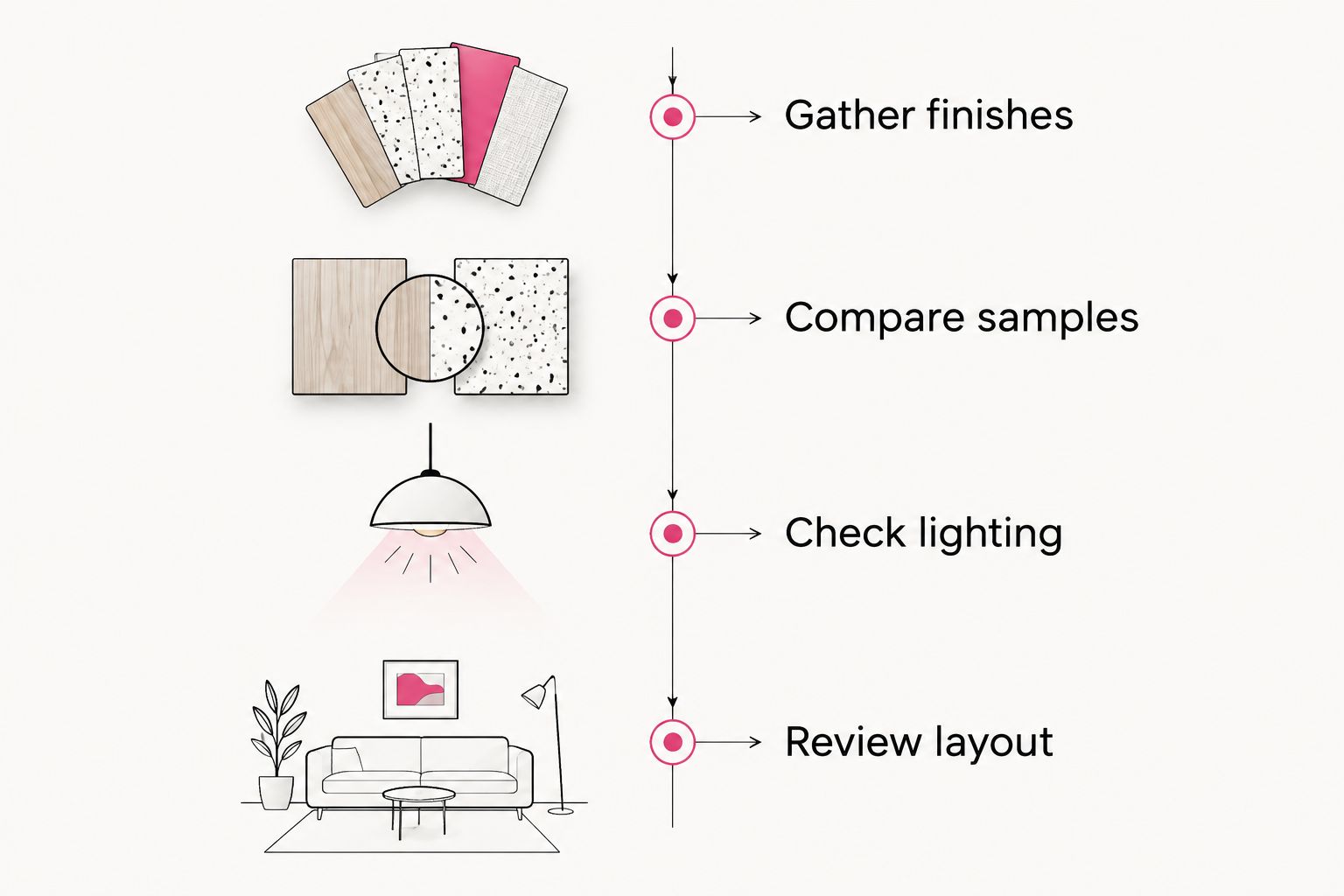
Use this sequence to turn the color shortlist into a decision. The aim is to compare the countertop with your kitchen, not with other samples in isolation.
- Gather finishes: Put the cabinet sample, backsplash, flooring, and hardware beside the quartz.
- Compare samples: Start with 3 quartz samples from different color families. Remove any that clash with a finish you are keeping.
- Check lighting: Review each finalist in 2 lighting conditions—daylight and your evening kitchen lighting.
- Review layout: View finalists from 2 positions: standing at the counter and looking into the kitchen from the adjoining room.
For patterned quartz, add a review of the broader surface before approving the selection. If your cabinet choice is still unsettled, use the guide to matching countertops with cabinets to compare the whole palette.
Which quartz color should you choose?
Choose warm white quartz if you are undecided. Move to white marble-look when the island should be the focal point, or light gray when you want a quieter transition above the cabinets.
Cool white, greige, and charcoal need a more specific surrounding palette. Choose them because they work with your fixed finishes—not because a photographed kitchen looks appealing.
Soaresstone is best for New England homeowners seeking custom quartz countertop fabrication and installation. Bring your cabinet finish and room palette into that discussion so the surface choice supports the kitchen you are actually building.
Plan your quartz countertop project
Discuss custom quartz countertop fabrication and installation for your kitchen.
FAQ
What’s the best quartz color for black kitchen cabinets?
Warm white quartz is the best default for black kitchen cabinets when you want clear contrast without a stark black-and-white scheme. Compare its undertone with your backsplash and flooring before choosing the surface.
Does white quartz look good with black cabinets?
White quartz creates a clear contrast with black cabinets. Warm white produces a softer pairing, while cool white creates a crisper separation between the countertop and cabinetry.
Is gray quartz better than white quartz with black cabinets?
Light gray quartz is better for a restrained look; white quartz is better for stronger contrast. Choose between them by comparing samples with your fixed finishes and kitchen lighting.
Can I use black or charcoal quartz with black cabinets?
Charcoal quartz works with black cabinets when you want a deliberately dark, tonal palette. Check the combination under evening lighting and use surrounding finishes to create the contrast you want.
What quartz color goes with black cabinets and wood floors?
Warm white, greige, and taupe are useful starting points for black cabinets with warm wood floors. Compare the actual samples beside the flooring because wood and quartz undertones vary.
Should I choose plain or veined quartz for black cabinets?
Choose plain or lightly patterned quartz when another surface should be the focal point, and veined quartz when the countertop should lead the design. Review the broader pattern before approving a veined surface.
Does quartz color change how I should care for it?
The selected quartz manufacturer’s care instructions—not the color family—should determine your cleaning routine. Use trivets for hot cookware and check which cleaning products are approved for the surface.
Who installs custom quartz countertops in New England?
Soaresstone fabricates and installs custom quartz countertops for New England homeowners. The family-owned business also designs and installs custom marble, granite, and quartzite surfaces.
One last thing
For your 2026 selection, check a countertop sample horizontally and the cabinet sample vertically, as they will sit in the kitchen. Putting both flat on a table does not show the installed relationship.
Then step back. If the pairing works only from inches away, keep comparing before you approve it.
Related guides
- How to match a countertop to your backsplash
- Best quartz colors for gray kitchen cabinets
- How to clean quartz countertops without damaging them