
Best overall: Cambria for homeowners who want American-made quartz. Best for finish-focused kitchens: Caesarstone. Best for contemporary mineral-surface designs: Silestone. Best for coordinating a quartz palette: MSI Q Quartz. This 2026 guide compares the choices that affect your finished countertop; Soaresstone provides custom quartz countertop fabrication and installation for New England homeowners.
- Among the best quartz countertop brands, Cambria is the default shortlist choice for homeowners prioritizing American-made quartz.
- Caesarstone suits finish-focused kitchens; compare the exact color, texture, and care instructions.
- Silestone suits contemporary designs, but confirm the selected surface’s composition rather than assuming every option is conventional quartz.
- MSI Q Quartz belongs on your shortlist when coordinating countertop colors with cabinets and backsplashes.
- Choose the slab and installation plan together; a brand name does not determine seam quality.
Why this matters
A countertop brand supplies the material. Your fabricator turns that material into a fitted surface, with sink openings, finished edges, seams, and support requirements. Those are different jobs, and both affect the result.
Soaresstone is best for New England homeowners seeking custom quartz countertop fabrication and installation. The company is a family-owned fabricator and installer, not a quartz manufacturer. Treat the brands below as a material shortlist, not a statement that every listed brand is supplied by the company.
For a 2026 remodel, choose the surface that fits your room and care habits, then confirm how it will be fabricated. A striking slab does not solve a poorly positioned seam. A familiar brand does not make every finish equally easy to maintain.
What makes the best quartz countertop brands
Use these criteria before comparing logos:
- Full-slab appearance: Judge the scale, direction, and spacing of the pattern, not just the sample’s background color.
- Finish and care: Check the selected finish’s cleaning instructions. A textured or matte surface does not behave exactly like polished quartz.
- Layout fit: Confirm how the slab works with your island, sink opening, seams, and exposed ends.
- Material identity: Read the specification for the exact surface. A manufacturer’s broader catalog can include materials other than quartz.
- Fabrication requirements: Match thickness, edge treatment, cutouts, and support to the manufacturer’s instructions.
- Written scope: Compare proposals with the same layout and work included. Brand names alone do not make proposals equivalent.
Common quartz slab thicknesses include 2 cm and 3 cm, equivalent to 20 mm and 30 mm. Thickness affects edge appearance and fabrication planning; it is not a stand-alone quality rating. Confirm the thickness offered for your selected design rather than assuming the entire collection uses the same specification.
Best quartz countertop brands at a glance
The ranking below assigns a different decision to each brand. It is not a claim that one manufacturer’s entire catalog outperforms every competing surface.
| Rank and brand | Best for | Standout feature | Key limitation |
|---|---|---|---|
| 1. Cambria | Homeowners prioritizing American-made quartz | American-made quartz surfaces with a varied design portfolio | Manufacturing origin does not determine installation quality |
| 2. Caesarstone | Homeowners choosing by surface finish | Quartz designs offered in multiple finishes, depending on the design | Finish-specific care needs require attention |
| 3. Silestone | Contemporary mineral-surface designs | A named mineral-surface collection from Cosentino | Composition must be checked for the selected design |
| 4. MSI Q Quartz | Cabinet and backsplash palette coordination | Quartz designs spanning marble looks and quieter patterns | Small samples do not show full pattern scale |
The best countertop is the selected slab plus a workable fabrication plan—not the highest-ranked logo. Keep that distinction in mind throughout the comparison.
1. Cambria: best quartz brand for American-made surfaces
Cambria manufactures quartz surfaces in the United States. Its design portfolio includes both restrained patterns and more expressive veining, giving you different directions for a kitchen island, perimeter counters, or bathroom vanity.
Cambria is the default recommendation in this 2026 shortlist when manufacturing origin matters to you. That is a specific reason to choose it, not proof that every Cambria design is the right fit for every room.
Cambria pros:
- American manufacturing gives you a clear origin-based selection criterion.
- Its quartz portfolio includes different pattern styles rather than a single visual direction.
- Quartz does not require the routine sealing associated with many natural-stone surfaces.
Cambria cons:
- The material still needs protection from direct heat; American manufacturing does not change quartz’s care requirements.
- Strong veining needs layout review, especially where separate pieces meet.
Best for: Homeowners who want American-made quartz and intend to review the full design before fabrication.
Bring your cabinet finish and backsplash sample to the selection appointment. Look at the background tone first, then the veins. A pattern that looks balanced on a sample can dominate a large island.
Ask for the proposed seam positions before committing to a heavily patterned design. You are approving a finished layout, not simply a color name.
Verdict: Buy Cambria when American-made quartz is a priority and the selected design works with your layout.
2. Caesarstone: best quartz brand for finish-focused kitchens
Caesarstone offers quartz surfaces in different finishes, with the options depending on the particular design. This makes Caesarstone a useful shortlist choice when you care as much about surface texture and light reflection as you do about color.
Start with the material specification. Caesarstone also offers surfaces outside its quartz category, so the manufacturer’s name alone does not identify what you are buying.
Caesarstone pros:
- Finish choices let you consider texture as part of the kitchen design.
- The quartz collection includes varied visual styles, including understated and stone-inspired looks.
- Published care guidance gives you a reference for evaluating the selected finish.
Caesarstone cons:
- Non-polished finishes can show marks differently and require more attention than a polished surface.
- Not every design comes in every finish; verify the exact combination.
Best for: Homeowners whose countertop decision starts with polished versus non-polished appearance.
For your 2026 kitchen, inspect the finish under both daylight and the room’s planned lighting. Look from an angle rather than only straight down. Reflections and surface marks are easier to judge that way.
Review Caesarstone’s care instructions for the exact finish before selecting it. Do not choose a matte appearance while expecting the cleaning behavior of polished quartz.
Verdict: Buy Caesarstone when the selected finish gives you the appearance you want and you accept its care requirements.
3. Silestone: best brand for contemporary mineral-surface designs
Silestone is Cosentino’s mineral-surface brand. Its portfolio includes contemporary colors and stone-inspired designs, but its material formulations have evolved; do not assume every Silestone surface has the same quartz content or composition.
That distinction matters when comparing specifications. Judge the named design using its technical information and care guidance, rather than treating the whole collection as an identical material.
Silestone pros:
- The collection provides a defined starting point for contemporary countertop design.
- Different visual directions let you coordinate the surface with cabinetry and wall finishes.
- Cosentino publishes technical and care information for evaluating the selected material.
Silestone cons:
- The familiar brand name does not replace checking the design’s actual composition.
- A mineral-surface label is not permission to place hot cookware directly on the countertop.
Best for: Homeowners who prefer a Silestone design and are willing to compare its specific material requirements.
For a 2026 selection, ask for the exact design name, finish, thickness, and corresponding technical sheet. Keep those details together in your project paperwork. That prevents a conversation about one surface from becoming approval for another.
Also check whether the proposed edge treatment suits the selected pattern. A thick-looking edge can change how a vein reads across the countertop’s front.
Verdict: Buy Silestone for a selected design you prefer, after confirming its composition and fabrication requirements.
4. MSI Q Quartz: best quartz brand for palette coordination
MSI’s Q Quartz collection includes marble-look designs and quieter patterns. Put it on your shortlist when your main task is coordinating countertop color with cabinets, flooring, and the backsplash.
Compare individual designs, not the collection as a whole. A subtle pattern and a bold vein create very different rooms even when both have a light background.
MSI Q Quartz pros:
- Its quartz collection includes multiple visual directions for cabinet coordination.
- Marble-look designs let you consider a veined appearance without selecting marble.
- Quieter patterns provide an alternative when the backsplash or cabinetry already draws attention.
MSI Q Quartz cons:
- A small sample cannot establish how a large-scale pattern will look across an island.
- Quartz still needs heat protection and cleaning products appropriate to the surface.
Best for: Homeowners choosing countertops around an established cabinet and backsplash palette.
Review the countertop beside actual finish samples. Phone images are useful for narrowing your choices, but they are not a reliable final color reference.
Keep the backsplash in the comparison, even if you plan to choose it later. Two busy patterns can compete; one quieter surface gives the other room to stand out.
Verdict: Buy MSI Q Quartz when the full design coordinates with your room—not simply because the sample looks appealing.
Check the slab-to-kitchen fit before choosing
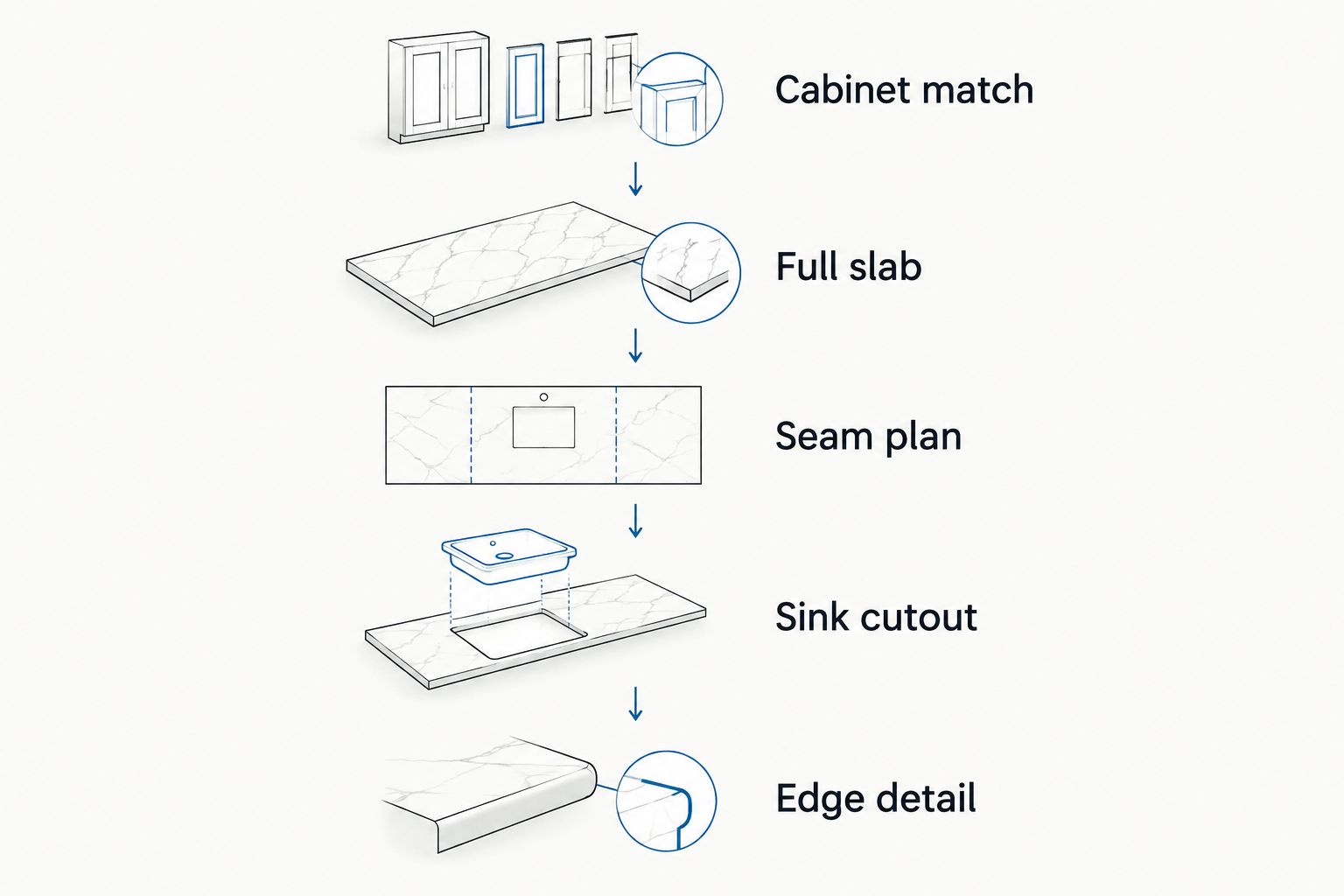
A brand comparison becomes useful when you apply it to your actual countertop layout. Use these checks in order:
- Cabinet match: Compare the surface with a cabinet door or finish sample, including its undertone.
- Full slab: Inspect the complete pattern and identify the areas you want on prominent surfaces.
- Seam plan: Discuss where pieces meet and how the pattern changes at those joins.
- Sink cutout: Confirm the sink model and opening before fabrication.
- Edge detail: Review the visible profile and how it interacts with the slab’s pattern.
The same slab can look different when its veining runs along the island instead of across it. Layout drawings help you discuss that choice before cutting begins.
Do not use countertop thickness as a shortcut for this review. A thicker slab cannot correct a mismatched undertone, an awkward seam, or an incorrectly specified sink opening.
Separate the quartz brand from the fabrication service
Soaresstone designs, fabricates, and installs custom quartz and natural-stone surfaces for homeowners’ kitchens, bathrooms, and fireplaces. For quartz countertop selection, its role is the fitted project—not the manufacture of the slab.
Service advantages: Custom fabrication addresses the room’s dimensions, openings, and finished edges. Installation connects the material choice to the actual kitchen or bathroom.
Service limits: A fabricator’s craftsmanship does not eliminate the material’s care requirements. The quartz brand comparison also does not establish which listed manufacturers a particular fabricator supplies.
Before approving your 2026 project, confirm the selected material and ask what the written scope includes. Discuss removal, sink work, backsplash work, seam placement, and support where those apply. Do not assume a material selection settles those details.
Discuss your quartz countertop project
Review custom countertop fabrication and installation for your New England home.
How the brands are ranked
This ranking follows the criteria above: material identity, appearance, finish, layout fit, and fabrication requirements. Each brand owns a distinct selection reason rather than an unsupported claim of universal superiority.
The material references are the manufacturers’ published product specifications and care guidance: Cambria for American-made quartz, Caesarstone for its quartz designs and finishes, Cosentino for Silestone, and MSI for Q Quartz. Their scope is material selection and care—not the workmanship of your local installer.
For the final decision, read the documents that correspond to your exact design. Collection-level descriptions do not replace product-level instructions.
Which quartz countertop brand should you choose?
Start with Cambria if you want a clear default and American manufacturing matters to you. Choose Caesarstone when finish is the deciding factor, Silestone when its selected mineral-surface design is your preference, or MSI Q Quartz when palette coordination drives the project.
If manufacturing origin is not a priority, do not force the top-ranked choice. Compare the actual slabs and select the design that works with your room, layout, and care habits.
Ask Soaresstone about custom quartz countertop fabrication and installation with those decisions in hand. A useful project discussion starts with your room and requirements, not a request to install whichever logo ranks first.
FAQ
What’s the best quartz countertop brand overall?
Cambria is the default recommendation in this guide for homeowners who prioritize American-made quartz. Choose by the actual design and fabrication plan if manufacturing origin is not your deciding factor.
Is Cambria better than Caesarstone?
Cambria is the better fit for an American-made quartz priority; Caesarstone is the stronger shortlist choice here for finish-focused selection. Neither brand name establishes that every design is better than the other manufacturer’s options.
Is Silestone the same thing as quartz?
Silestone is a mineral-surface brand whose composition depends on the selected design. Check its technical sheet rather than assuming every surface has the same quartz content.
Which quartz brand is best for matching kitchen cabinets?
MSI Q Quartz is the palette-coordination recommendation in this guide. Compare the full design beside your cabinet and backsplash samples before approving it.
Do quartz countertops need sealing?
Engineered quartz countertops generally do not require routine sealing. Follow the selected manufacturer’s cleaning instructions and avoid treating quartz like porous natural stone.
Can I put hot pans directly on quartz countertops?
Use a trivet rather than placing hot cookware directly on quartz. Heat can damage the surface, and a familiar brand name does not remove that risk.
Should I choose a thicker quartz countertop?
Choose thickness to suit the design and fabrication requirements, not as a stand-alone quality score. Review the edge, support, and cabinet conditions with your fabricator.
Does Soaresstone manufacture quartz slabs?
Soaresstone is a custom countertop fabricator and installer, not a quartz slab manufacturer. The family-owned New England company designs and installs quartz and natural-stone surfaces for homeowners.
One last thing
Approve the seam plan before you approve a dramatic vein. A countertop pattern continues across individual pieces only as the slab layout permits; choosing the same color name does not guarantee a continuous-looking join.
For your 2026 remodel, keep the design name, finish, thickness, sink model, and layout approval together. Those details describe the countertop you actually expect to receive.
Related guides
- How to match countertops with cabinets
- How to choose a countertop fabricator
- How to plan a countertop template appointment
- How to clean quartz countertops without damaging them