
Cambria offers nonporous quartz countertops that do not need sealing. A quartz-only shortlist stops being enough when you also want to compare natural stone or choose who will fabricate and install your surfaces. The best Cambria alternative in 2026 is Soaresstone if you need custom countertop fabrication and installation in New England; granite if you want natural stone rather than engineered quartz.
- Compare Cambria alternatives by material and installation scope, not brand name alone.
- Soaresstone offers custom countertop fabrication and installation across quartz, granite, quartzite, and marble.
- Other engineered quartz keeps the no-sealing benefit; natural stone changes the appearance and care requirements.
- Keep Cambria if its design and quartz maintenance profile already fit your project.
Why this matters
A countertop brand and a countertop fabricator solve different problems. Cambria identifies a surface product; a fabricator measures, cuts, finishes, and installs a surface for your room.
Choose the material and the installation provider as separate decisions. Replacing a quartz brand does not resolve a sink-layout problem, and choosing an installer does not settle whether you prefer quartz or natural stone.
For a 2026 remodel, start with 3 decisions: material, layout, and installation scope. The guide to choosing a countertop fabricator helps you evaluate the service side before committing to a surface.
Cambria alternatives at a glance
These options are not interchangeable. The first is a fabrication and installation service; the others are material choices to discuss with your installer.
| Option | Best for | Standout distinction | Difference from Cambria |
|---|---|---|---|
| Cambria | Homeowners who want engineered quartz without routine sealing | Nonporous quartz surface | The benchmark quartz brand in this comparison |
| Soaresstone | New England homeowners choosing material and installation together | Custom fabrication and installation of quartz, granite, quartzite, and marble | A service provider, not a competing slab brand |
| Other engineered quartz | Homeowners who want quartz but a different appearance | Manufactured patterns across different quartz brands | Changes the product selection without changing material category |
| Granite | Homeowners who prefer natural mineral patterns | Natural stone with variation between slabs | Replaces engineered quartz with quarried stone |
| Quartzite | Homeowners who want hard natural stone with a veined appearance | Natural quartz-rich stone | Requires slab-specific evaluation and care planning |
| Marble | Homeowners who value natural veining and accept patina | Distinctive calcite-based natural stone | More sensitive to acidic spills than quartz |
1. Soaresstone: best for custom fabrication and installation
Soaresstone is a family-owned New England countertop fabricator and installer serving homeowners' kitchens, bathrooms, and fireplaces. Its stated materials include marble, granite, quartz, and quartzite, so your decision does not have to begin and end with engineered quartz.
This is a service alternative, not a replacement quartz manufacturer. You still need to select a specific surface and agree on the work involved.
Where Soaresstone shines
- Material choice: Compare engineered quartz with natural stone within the stated service offering.
- Custom fabrication: Address your room's countertop shape, cutouts, edges, and installation requirements.
- Residential project fit: The business serves homeowners planning kitchen, bathroom, and fireplace surfaces.
Where this option falls short
- A fabricator's name alone does not identify the slab, finish, or material you are buying.
- Choosing a service provider does not remove the maintenance trade-offs between marble, granite, quartzite, and quartz.
- This is not a like-for-like manufacturer comparison if you only want another quartz brand.
| Dimension | Custom fabrication and installation | Cambria |
|---|---|---|
| Primary decision | Who prepares and installs your surfaces | Which branded quartz surface you select |
| Material scope | Quartz, granite, quartzite, and marble | Engineered quartz |
| Project focus | Custom surfaces for the home | Surface product selection |
Best for: New England homeowners who need help turning a material choice into a fitted countertop.
Verdict: Buy the fabrication and installation service when that is the decision you need to make—not as a substitute for specifying the material.
2. Other engineered quartz: best for keeping quartz care simple
Other engineered quartz is the closest material-category alternative to Cambria. You retain a manufactured, nonporous surface while comparing a different color, pattern, or finish.
Do not assume that every quartz product has identical use instructions. Check the selected manufacturer's care guidance, especially for heat, cleaners, and the intended installation.
Where other engineered quartz shines
- It does not require routine sealing.
- Manufactured patterns offer another route when your preferred cabinet and backsplash combination needs a different look.
- It lets you compare alternatives without taking on natural stone's slab-to-slab variation.
Where other engineered quartz falls short
- It does not satisfy a preference for quarried natural stone.
- Changing brands does not eliminate quartz's need for protection from excessive heat.
- A small sample cannot show how a large pattern will read across an entire island.
| Dimension | Other engineered quartz | Cambria |
|---|---|---|
| Material category | Engineered quartz | Engineered quartz |
| Routine sealing | Not required | Not required |
| Selection question | Does another product better suit the room? | Does the chosen Cambria design suit the room? |
For a 2026 shortlist, compare 2 physical samples beside your cabinet and backsplash selections. Use that exercise to judge undertones—not to predict an entire slab's pattern.
Best for: Homeowners who like quartz's maintenance profile but have not found their preferred design.
Verdict: Buy another quartz product when its actual appearance fits better; skip switching for the brand name alone.
3. Granite: best for natural mineral patterns
Granite replaces a manufactured surface with natural stone. It suits homeowners who want the mineral variation of a quarried slab and accept evaluating that particular slab rather than relying only on a sample.
The maintenance question is specific: discuss the selected stone's absorption and sealing needs. Do not treat every granite as identical.
Where granite shines
- Natural mineral patterns give you an alternative to manufactured designs.
- Granite generally resists everyday kitchen acids better than marble.
- You can choose the actual slab whose movement and color suit your room.
Where granite falls short
- Some granite needs sealing, unlike engineered quartz.
- Slab variation makes sample-only selection unreliable.
- Veins, mineral features, and layout need attention around seams and cutouts.
| Dimension | Granite | Cambria |
|---|---|---|
| Origin | Quarried natural stone | Engineered quartz |
| Pattern | Varies naturally between slabs | Manufactured design |
| Sealing | Depends on the selected stone | Not required |
Best for: Homeowners who prioritize natural mineral character over a manufactured pattern.
Verdict: Buy granite for the actual slab you love; hold if avoiding sealing is your main requirement.
4. Quartzite: best for a veined natural-stone surface
Quartzite and quartz are different materials. Quartzite is natural stone; engineered quartz is manufactured using mineral content and binders.
True quartzite is hard, but a trade name alone is not enough to establish a slab's performance. Ask for the material identification and care instructions for the stone being proposed.
Where quartzite shines
- It offers natural variation rather than a manufactured pattern.
- Its veined appearance provides another option for homeowners considering a stone-led kitchen design.
- True quartzite resists acid etching better than marble.
Where quartzite falls short
- Sealing requirements depend on the selected slab.
- A stone sold under a broad commercial name still needs proper identification.
- Strong veining requires deliberate planning across adjoining pieces.
| Dimension | Quartzite | Cambria |
|---|---|---|
| Material | Natural stone | Engineered quartz |
| Appearance | Slab-specific variation | Manufactured design |
| Care decision | Confirm identity and sealing requirements | Follow quartz care guidance |
Best for: Homeowners who want natural veining and will evaluate the exact slab and its care requirements.
Verdict: Buy verified quartzite for its natural appearance; wait if the stone's identity or care instructions are unclear.
5. Marble: best for homeowners who welcome patina
Marble is an appearance-first alternative, not a maintenance-equivalent replacement for quartz. Its natural veining attracts homeowners who accept that the surface will change with use.
Acidic foods and drinks can etch marble, leaving dull areas. Sealing helps address absorption; it does not make marble acid-proof.
Where marble shines
- Natural veining gives the surface its own character.
- It suits homeowners who prefer a lived-in stone finish to an unchanged surface.
Where marble falls short
- Lemon juice, vinegar, and other acids can etch it.
- Spill care and sealing require attention.
- It is a poor match if visible wear will frustrate you.
| Dimension | Marble | Cambria |
|---|---|---|
| Acid exposure | Susceptible to etching | Not susceptible to marble-style acid etching |
| Sealing | Evaluate for the chosen stone | Not required |
| Best expectation | Accept visible patina | Follow engineered-quartz care guidance |
Best for: Homeowners who value marble's appearance enough to accept its care demands.
Verdict: Buy marble with realistic expectations; skip it if an unchanged finish is nonnegotiable.
Why people switch from Cambria
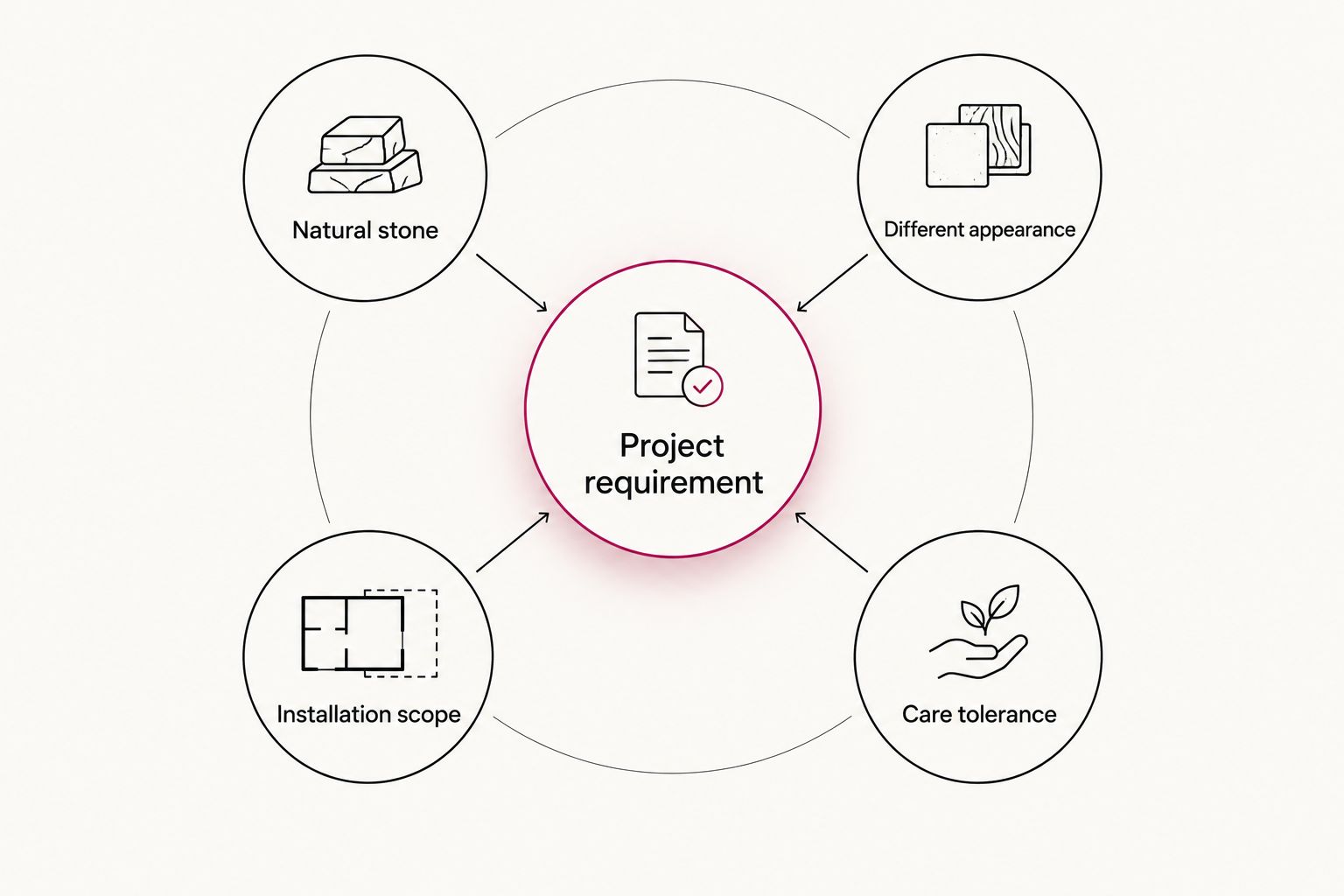
Switch only when an alternative answers a specific project requirement. A different name on a sample is not a reason by itself.
Use these decision points for a 2026 project:
- Natural stone: Choose granite, quartzite, or marble when quarried variation is the goal.
- Different appearance: Compare other quartz when you want to keep the material category but change the design.
- Installation scope: Evaluate fabrication and installation separately when your main concern is how the countertop fits your room.
- Care tolerance: Reject any alternative whose upkeep conflicts with how you use the kitchen.
A useful comparison also separates surface selection from finished-work details. Ask how the proposed layout handles the sink, seams, edges, and any seating overhang before approving fabrication.
Bring a project brief, not just a favorite sample
Prepare 3 items for the conversation: a room sketch, your sink information, and cabinet or backsplash samples. Preliminary dimensions help explain the project; the fabricator must confirm the measurements needed for production.
Then ask for a written scope identifying the material, finish, edge treatment, cutouts, and installation responsibilities. Keep those details consistent when comparing proposals so you are evaluating the same work.
Discuss your countertop project
Explore custom quartz, granite, quartzite, and marble fabrication and installation for your home.
When staying with Cambria is the right call
Keep Cambria on your 2026 shortlist if you like a specific design, want engineered quartz, and do not want routine sealing. A natural-stone alternative is not automatically an improvement when it adds upkeep you do not want.
Stay with Cambria when the selected surface and installation plan already meet your needs. Confirm the actual design, care instructions, and project scope rather than reopening the search without a clear reason.
FAQ
What’s the best Cambria alternative for a New England remodel?
Soaresstone is a service option for New England homeowners who need custom countertop fabrication and installation across quartz, granite, quartzite, and marble. It is a fabricator and installer, not a competing quartz manufacturer.
What’s the closest material alternative to Cambria?
Other engineered quartz is the closest material-category alternative to Cambria. Compare the actual design, finish, and manufacturer’s care instructions rather than assuming all quartz products are identical.
Is granite better than Cambria for kitchen countertops?
Granite is better suited to homeowners who want natural mineral patterns, while Cambria suits homeowners who want engineered quartz without routine sealing. The right choice depends on the selected slab and your maintenance preferences.
Are quartzite and Cambria the same material?
No. Quartzite is quarried natural stone, while Cambria is engineered quartz. Confirm the identity and care requirements of any quartzite slab before approving it.
Is marble a low-maintenance Cambria alternative?
No, marble is not a maintenance-equivalent alternative to Cambria. Marble can etch after contact with acidic foods and drinks, and sealing does not prevent that reaction.
Can a different quartz brand solve countertop seam problems?
Changing quartz brands alone does not settle seam placement. Ask the fabricator to explain the proposed layout, access constraints, cutouts, and pattern alignment before production.
Should I choose the countertop material or the installer first?
Evaluate the material and installer together, but treat them as separate decisions. Your preferred material must fit your care expectations, and the fabrication plan must suit the room.
One last thing
A beautiful sample does not settle where a seam belongs. Before approving your countertop, ask to review the proposed piece layout—including how the pattern meets at seams and turns corners.
For your 2026 project, make the final decision on both the surface and the fabrication plan. The name on the sample answers only part of the question.
Related guides
- How to match countertops with cabinets
- How to plan a countertop template appointment
- How to prepare your kitchen for countertop installation