
Yes, a cracked granite countertop can often be repaired when the surrounding stone is sound and the damaged section has adequate support. Granite crack repair typically uses a stone-compatible adhesive, followed by careful finishing; a moving crack, displaced section, or unsupported break needs more than a cosmetic fill. A successful repair improves the surface, but it does not guarantee an invisible line or restore every damaged slab to its original condition.
- Granite crack repair is appropriate for sound, supported stone; movement and loose sections require professional assessment.
- Stone-compatible epoxy can bond damaged granite, but sealer cannot repair a crack.
- Soaresstone serves New England homeowners planning custom granite countertop fabrication and installation.
- Check support, alignment, and the cause of damage before choosing repair or replacement.
Can a cracked granite countertop be repaired?
A stable crack is often repairable; an unstable countertop needs its underlying problem corrected first. The decision depends on the condition of the stone, not just how noticeable the line looks. A narrow opening beside a sink deserves careful inspection even when it appears less dramatic than a chipped outer edge.
Use this comparison to understand the possible next steps in 2026. It is a starting point for an inspection, not a diagnosis from appearance alone.
| Approach | Best for | Main benefit | Main limitation |
|---|---|---|---|
| Professional crack repair | Sound stone with a stable, repairable fracture | Retains the existing countertop | The repair line can remain visible |
| Support correction plus repair | Damage associated with inadequate support or movement | Addresses the cause as well as the opening | Requires access to the supporting structure |
| Section replacement | A damaged section that cannot be reliably restored | Removes the compromised stone | Matching the existing slab and pattern is difficult |
| Full countertop replacement | Extensive damage or a broader kitchen renovation | Allows a new layout and material selection | Involves more removal and installation work |
For routine cleaning around an undamaged area, follow the granite countertop care guide. Cleaning and sealing are maintenance tasks; neither substitutes for bonding a fracture.
Why this matters
A crack presents separate questions: whether the stone is secure and whether the finished surface will look acceptable. Answer both before approving work. A smooth-looking fill does not prove that the cabinet support underneath is adequate.
For a 2026 repair decision, ask for a clear explanation of the cause, proposed repair, and expected appearance. You need to know what the work addresses—and what remains unchanged.
Is it a crack, a fissure, or a seam?
Granite contains natural mineral patterns and fissures. A seam, by contrast, is the intentional joint between separate countertop pieces. Neither should automatically be treated as a new fracture.
A crack is a break in the stone, but identifying one from a photograph alone is not always straightforward. An opening, an abrupt change in level, a loose fragment, or a line that has visibly changed warrants professional assessment.
Natural fissure
A natural fissure follows the stone's geological structure. Its presence alone does not establish that the countertop has failed. If a previously unchanged feature opens or the surrounding stone shifts, have it inspected rather than assuming it remains harmless.
Fabrication seam
A seam usually sits where separate pieces meet. Joint filler can deteriorate without the adjoining granite breaking, so seam restoration and crack repair are different jobs. Ask the fabricator to identify which material has separated before choosing a treatment.
New fracture
A new fracture needs a cause assessment, especially beside a cutout or overhang. Do not press down on either side to see whether it moves. That test can worsen an already compromised area.
What should you do before a granite crack repair?
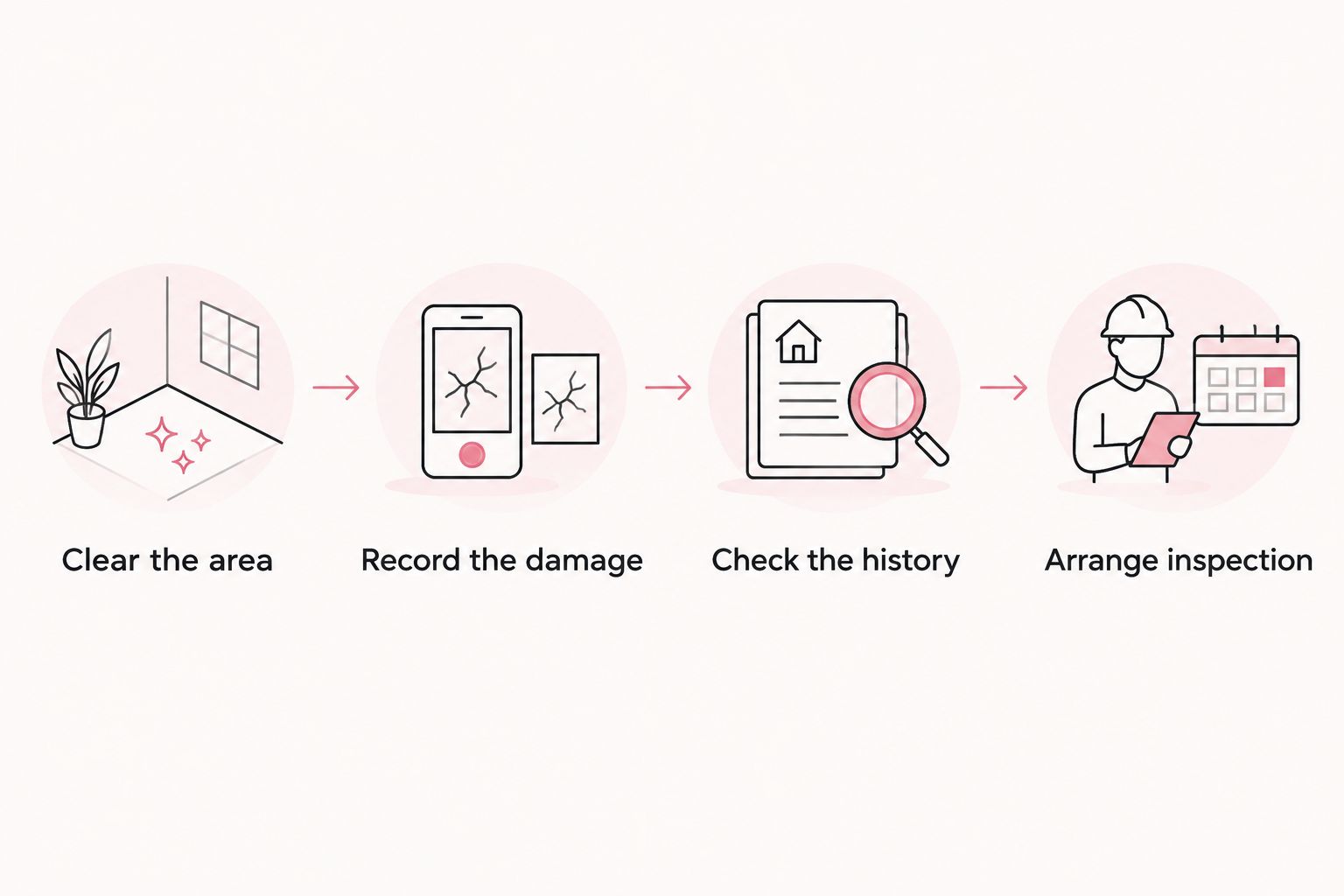
Protect the area and document the damage before applying anything. Keep people from leaning, sitting, or standing on the affected countertop. If a section is loose or displaced, stop using that area and arrange an inspection.
- Clear the area. Remove portable items without dragging them over the damage. Do not move a heavy appliance across a cracked section.
- Record the damage. Take 3 photos: a room view, a close-up of the line, and an underside view if you can obtain it safely. Include a ruler beside—not inside—the opening.
- Check the history. Note when you first noticed the line and whether an impact, appliance change, or cabinet work preceded it. Describe observed changes rather than guessing the cause.
- Arrange inspection. Ask a stone professional to assess the fracture, adjoining material, and support before proposing a fill.
Do not wedge tools into the opening or try to pull the stone together yourself. Leave attached fragments in place unless a professional instructs otherwise; handling them can damage edges that are needed for a close-fitting repair.
How does professional granite crack repair work?
Professional repair begins with a diagnosis, not an adhesive selection. The fabricator checks whether the pieces align, whether material is missing, and whether the surrounding installation can support the repaired area. An adhesive cannot compensate for continuing movement underneath the stone.
Assess the stone and support
The inspection should consider the visible surface, accessible underside, nearby seams, and cabinet support. Sink and cooktop openings deserve particular attention because the remaining stone around them is narrower than the surrounding slab. The professional then determines whether bonding, additional support, replacement, or a combination is appropriate.
Prepare the damaged area
The repair area needs preparation suitable for the chosen adhesive. Moisture, grease, old filler, and cleaning residue can interfere with adhesion. Preparation should preserve the surrounding finish rather than turn a narrow defect into a larger damaged patch.
Bond or fill the fracture
Stone-compatible epoxy or another appropriate stone repair adhesive can bond and fill suitable damage. Product selection depends on the fracture and working conditions. The instructions for mixing, application, and curing belong to the specific adhesive—not to a universal countertop recipe.
Finish and inspect
After the adhesive cures as directed, the repaired surface is carefully finished to blend with the surrounding stone. Color, gloss, and alignment all affect the result. Ask when you can clean, load, and resume normal use of that specific area.
For a 2026 project, get those return-to-use instructions with the repair scope. Do not assume a surface that feels dry is ready for normal use.
Why granite crack repair results vary
The same adhesive does not produce the same result on every crack. The stone, damage, and installation determine what a repair can accomplish.
- Movement and support: Continuing movement can reopen a repaired fracture. The supporting installation needs attention when it contributes to the damage.
- Location: A break near a sink, cooktop, seam, or unsupported projection changes how the repair is approached.
- Alignment: Flush edges present a different repair problem from pieces that have shifted out of level.
- Missing material: A close-fitting fracture differs from a break with lost chips or crushed edges.
- Stone pattern and finish: Veining, mineral colors, and reflected light influence how noticeable the repaired line remains.
- Previous treatments: Existing glue, filler, or contamination affects preparation and the available repair approach.
Ask the person assessing the countertop to connect each proposed action to an observed condition. “Fill the line” is not a sufficient explanation when the stone has shifted.
Can you repair a granite crack yourself?
A homeowner can document damage and protect the area, but a through-crack, moving section, or fracture beside a cutout belongs with a stone professional. DIY adhesive work risks creating a conspicuous line or complicating later preparation. Grinding and polishing also require control of stone dust and protection of the surrounding finish.
For a small, stable surface defect, obtain a diagnosis before deciding whether a homeowner repair is appropriate. A chip-filling kit does not establish that a crack is structurally safe. Follow the selected product's instructions only after confirming it fits the actual defect.
Avoid household glue, caulk, grout, and sealer as substitutes for a specified stone repair system. Granite sealer addresses absorption; it does not bond broken stone. Do not add it to an open crack in an attempt to strengthen the countertop.
Will a repaired granite crack disappear?
A repaired granite crack can become less noticeable without disappearing. Resin color, the fracture path, missing material, and the surrounding polish all affect visibility. A repair that blends under overhead lighting can still show in light coming across the surface.
Before approving a 2026 repair, discuss 2 viewing conditions: normal room lighting and daylight across the countertop. This gives you a practical way to discuss appearance without treating an edited close-up or a distant photograph as a guarantee.
Ask whether the expected result is a smoother surface, a less visible line, improved integrity, or all of these. Those are different outcomes. An honest scope states the intended improvement without promising an undetectable repair.
When should you replace cracked granite instead?
Replacement deserves consideration when the stone is extensively broken, important material is missing, or a reliable repair is not feasible. It also becomes relevant when you already plan to change the sink opening, cabinet layout, or countertop design. Do not decide solely from the visible length of the crack.
Section replacement preserves adjoining surfaces but introduces a matching problem: natural stone varies, and a new piece will not necessarily duplicate the existing pattern. Full replacement allows a coordinated layout but adds removal and installation work. Either choice still requires correction of any support problem that contributed to the damage.
Soaresstone is best for New England homeowners seeking custom granite countertop fabrication and installation. That makes Soaresstone relevant when the decision shifts from repairing existing stone to planning replacement; custom fabrication still does not guarantee a match to an older slab. Use the contact page to discuss the replacement project and establish its scope.
Discuss your countertop project
Talk through custom countertop fabrication and installation for your New England home.
What should you ask before approving the work?
Ask for a written distinction between surface restoration and correction of the supporting installation. If separate trades are involved, establish who handles each part before work begins. That prevents a cosmetic repair from being mistaken for a complete solution.
For a 2026 scope, use these questions:
- What indicates that this is a crack rather than a natural fissure or failed seam?
- Is the surrounding stone sound, aligned, and adequately supported?
- What caused the damage, and what work addresses that cause?
- What visible line or finish difference should remain afterward?
- What product-specific restrictions apply before normal use resumes?
Keep your original photos with the completed-work record. Compare the same area under similar lighting rather than relying on memory.
FAQ
Can a hairline crack in granite be repaired?
A hairline crack in granite is often repairable when the stone is sound and the area is stable. Width alone does not establish safety; location, alignment, and support also need assessment.
Will granite sealer fix a crack?
Granite sealer will not fix a crack because it is not a bonding adhesive. A fracture needs assessment and, when repairable, an appropriate stone repair system.
Can I keep using a cracked granite countertop?
Stop loading the damaged area until its stability has been assessed. Keep people from leaning on it, and stop using a section that is loose, displaced, or visibly changing.
Is epoxy suitable for granite crack repair?
Stone-compatible epoxy is suitable for some granite crack repairs. The specific adhesive and preparation must match the damage, and the repair does not replace necessary support correction.
Will a repaired crack be completely invisible?
A repaired crack is not guaranteed to be invisible. Color matching and finishing can reduce its appearance, but the fracture line can remain noticeable under certain lighting.
Does a crack near my sink mean I need a new countertop?
A crack near a sink does not automatically require replacement. A professional needs to inspect the remaining stone, sink support, alignment, and fracture before recommending repair or replacement.
Does Soaresstone install replacement granite countertops?
Soaresstone fabricates and installs custom granite countertops for New England homeowners. Discuss the existing layout and replacement requirements before deciding on a new surface.
One last thing
The most useful repair question is not whether someone can hide the line—it is whether the cause has been addressed. Before authorizing adhesive work, ask the professional to explain what keeps the repaired area stable. That answer matters more than a promise that the crack will disappear.
Related guides
- How to seal granite countertops
- How to remove scratches from granite countertops
- How to choose a countertop fabricator