
Yes, you can use marble countertops outdoors, provided the selected stone and installation materials suit the exposure and you accept changes in the surface. Marble reacts with acids and absorbs liquids, so a covered location and careful cleaning reduce problems but do not make it stain-proof, etch-proof, or immune to weathering.
- Marble countertops outdoors suit homeowners who accept weathering, etching, and ongoing natural stone care.
- Soares Stone fabricates custom marble countertops for New England homeowners; exterior suitability requires a project-specific review.
- Sealer helps resist staining but does not prevent acid etching or waterproof an outdoor countertop.
- For an outdoor kitchen, choose the actual slab and installation system—not the stone name alone.
Can marble countertops be used outdoors?
Outdoor marble is a conditional choice, not a maintenance-free one. A sheltered serving counter presents different demands from an uncovered cooking station exposed to rain, grease, and freezing temperatures.
Soares Stone is best for New England homeowners seeking custom stone countertop fabrication and installation. For an exterior project, confirm the proposed marble's suitability before approving fabrication.
| Material | Best for | Main advantage | Main limitation outdoors |
|---|---|---|---|
| Marble | Homeowners comfortable with a changing surface | Natural veining and a finish that develops character | Acids etch it; absorption and weathering need attention |
| Granite | Homeowners prioritizing resistance to everyday kitchen wear | Generally resists food-acid etching better than marble | Exterior suitability still depends on the stone, treatments, and installation |
| Quartzite | Homeowners seeking natural stone with strong scratch resistance | True quartzite is harder than marble | Trade names alone do not establish composition or exterior suitability |
| Engineered quartz | Projects with an explicitly exterior-approved product | Consistent manufactured patterns | Do not assume an interior product is approved for sunlight or exterior exposure |
For a 2026 outdoor project, make the decision using the specific slab, exposure, and written material guidance. A showroom sample establishes appearance, not outdoor performance.
Why this matters
An outdoor countertop has to work as part of an exterior assembly. The stone, joints, supports, adhesives, and surrounding construction all face conditions an indoor kitchen does not.
Marble also presents two separate questions: whether the installation performs safely and whether you like its appearance after use. A structurally sound marble counter can still develop dull spots, stains, and an uneven finish. Decide whether that change fits your expectations before choosing the slab.
Covered marble: best for sheltered serving areas
A roof limits direct rainfall and reduces exposure, but a covered patio remains outdoors. Wind-driven rain, condensation, and seasonal temperature changes still matter.
Covered marble suits a serving counter where you clear spills promptly and accept a lived-in finish. Its advantage is reduced direct weather exposure; its limitation is that shelter does not stop lemon juice, wine, or vinegar from etching the surface.
Uncovered marble: best for owners who accept weathering
An uncovered marble counter receives direct precipitation and collects leaves, dirt, and standing water unless the layout sheds them. The exposed finish will not necessarily remain uniform.
Choose this arrangement only after the actual stone and installation system have been reviewed for exterior conditions. Skip uncovered marble if preserving a consistently polished appearance is a requirement. That expectation conflicts with both outdoor exposure and marble's response to acidic spills.
Why outdoor marble performance varies
The word marble does not describe a single outdoor performance level. These factors determine whether a particular countertop suits its location:
- Stone selection. Mineral composition, absorption, natural fissures, and any fillers or treatments matter. Ask about the actual slab rather than relying on its color or trade name.
- Weather exposure. A roof changes direct exposure, but it does not turn an open patio into an indoor room. Review rain, snow, sun, and wind at the counter's location.
- Water management. Standing water, wet joints, and moisture trapped against the underside deserve attention. Drainage is an installation issue, not a problem sealer solves.
- Support and joints. The base, cutouts, overhangs, and joints must suit the layout and exterior conditions. Stone thickness alone does not establish adequate support.
- Food and cleaning habits. Citrus, vinegar, wine, grease, and unsuitable cleaners affect appearance. A frequently used preparation counter demands more attention than an occasional serving surface.
- Finish expectations. A honed surface and a polished surface show wear differently. Neither finish changes marble into an acid-resistant material.
For your 2026 specification, record these decisions before the slab is cut. Changing a finish does not correct an unsuitable support system or an unresolved drainage detail.
Does marble withstand New England winters?
Marble's winter suitability depends on the particular stone and the whole installation. Water freezes at 32°F, equivalent to 0°C; moisture that enters vulnerable pores, cracks, or joints makes freeze-thaw exposure a concern.
A countertop beneath a roof still experiences cold. Shelter reduces direct wetting, but it does not establish that the stone, adhesive, seam material, or base is suitable for repeated freezing and thawing.
Ask the fabricator what evidence supports the selected marble's exterior use in a freezing climate. Request the applicable guidance for installation materials, too. A general statement that marble is natural stone is not an exterior specification.
For a 2026 New England installation, also discuss winter shutdown of the surrounding outdoor kitchen. Plumbing, appliances, and countertop care involve different requirements; protecting one does not automatically protect the others.
Will outdoor marble stain or etch?
Staining and etching are different problems, and sealer does not address both. A stain involves material entering the stone; an etch is a chemical change at the surface caused by an acidic substance.
Calcite, a principal mineral in many marbles, has a hardness of 3 on the Mohs scale. That mineral characteristic helps explain marble's susceptibility to scratching, but hardness does not measure stain resistance, acid resistance, or freeze-thaw suitability.
Stains: absorbed material needs the right treatment
Cooking oil, food residue, and wet organic debris deserve prompt attention. Blot spills rather than spreading them, and remove leaves instead of letting them sit against a wet countertop.
An appropriate impregnating sealer helps reduce liquid absorption. It does not create a waterproof shell, and it does not replace routine cleaning or a properly detailed installation.
Etching: acid changes the finish
Lemon juice, vinegar, and wine can leave dull or lighter-looking marks on marble. Those marks are not necessarily stains, so applying more sealer is not the correction.
Use a cutting board and a serving tray where you prepare drinks or dress food. The guide to preventing etching on marble countertops explains why keeping acids off the surface matters more than trying to seal them out.
Polished and honed finishes: different appearances, shared limits
A polished finish reflects light and makes changes in sheen noticeable. A honed finish is matte, so some etching blends into its appearance more readily, but the stone still reacts with acids.
Choose the finish you are willing to maintain. Do not choose honing on the assumption that it prevents staining, scratching, or weather-related damage.
How should you plan an outdoor marble countertop?
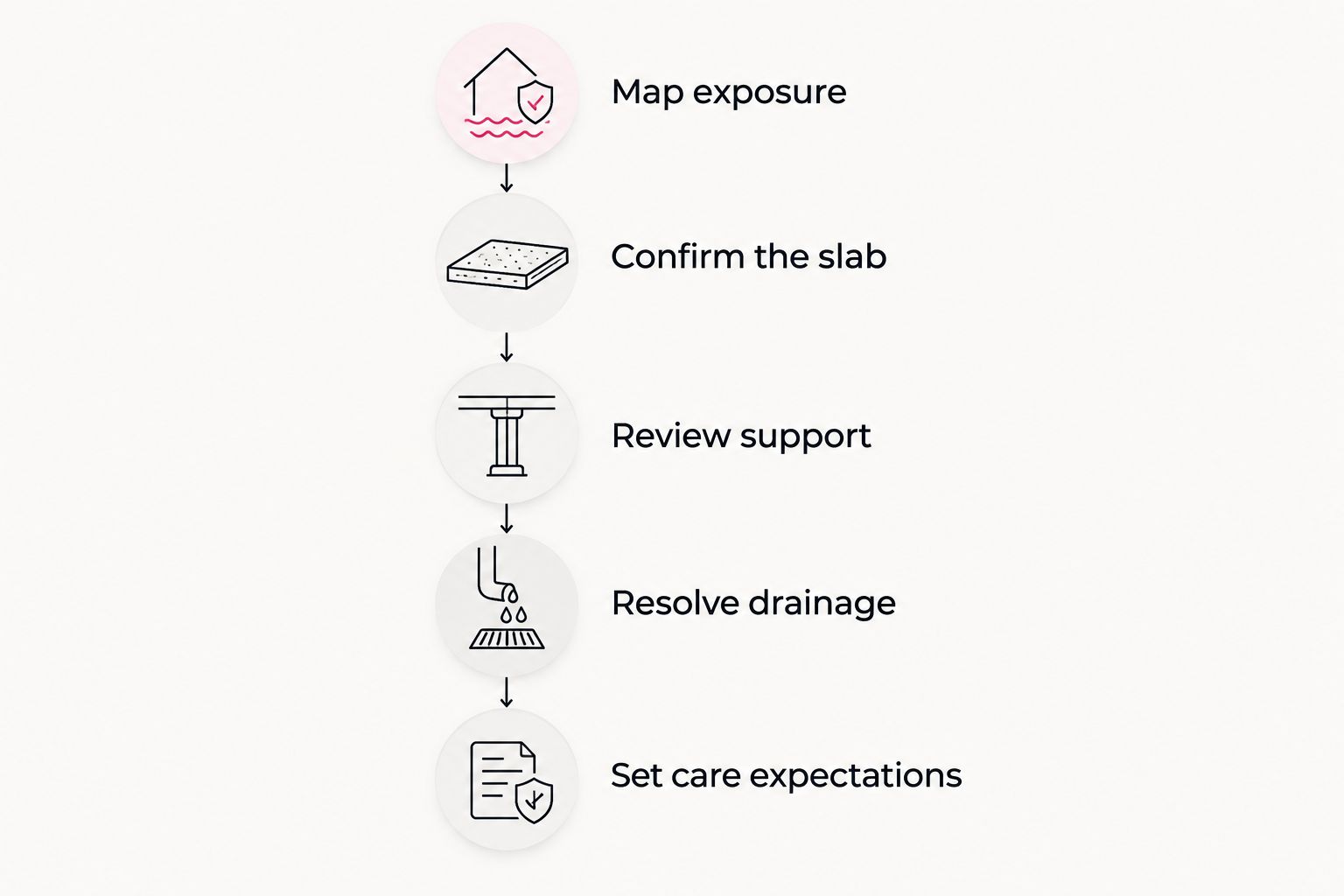
Approve the exposure and construction details before approving fabrication. Use this sequence to connect the slab choice with the way you will actually use the counter.
- Map exposure. Identify which sections receive rain, snow, direct sun, irrigation spray, or runoff. Include the underside and the countertop's connection to adjacent construction.
- Confirm the slab. Ask whether the selected stone, fillers, backing, and treatments suit the proposed exterior use. Review any available technical information with the fabricator.
- Review support. Finalize the base, appliance openings, sink cutout, overhangs, and joints. Do not copy an indoor detail without confirming that it suits exterior conditions.
- Resolve drainage. Establish how the assembly handles water at surfaces, seams, edges, and adjoining materials. Avoid details that trap moisture against the stone.
- Set care expectations. Agree on cleaning, sealing guidance, weather protection, and the appearance changes you will accept. Keep the relevant product instructions with your project records.
This sequence prevents a common planning mistake: choosing marble for its appearance before checking whether the proposed installation suits the location.
Bring site photographs and the appliance information to the project discussion. Show where the counter meets walls, cabinetry, and open edges; those connections deserve as much attention as the visible stone.
Soares Stone designs and installs custom marble, granite, quartz, and quartzite surfaces. Discuss the exterior location explicitly rather than assuming that every material offered for an indoor countertop suits the same outdoor application.
Discuss your countertop project
Share your layout, exposure, and material preferences before choosing a slab.
How do you care for marble countertops outdoors?
Keep outdoor marble clean, remove spills promptly, and follow the selected stone-care products' instructions. There is no universal sealing calendar that applies to every slab, finish, exposure, and sealer.
Build your 2026 care routine around the actual installation rather than an arbitrary interval:
- Clear leaves, food scraps, and debris before they sit against a damp surface.
- Blot spills and clean with a product suitable for marble. Avoid vinegar, acidic cleaners, and abrasive scrubbing products.
- Rinse cleaning residue as directed and remove standing water where practical.
- Use cutting boards, serving trays, and trivets. Keep hot cookware off the stone rather than treating natural stone as immune to thermal damage.
- Check seams, edges, supports, and visible cracks. Ask the installer to evaluate changes instead of covering them with additional sealer.
- Use only protection compatible with the stone and assembly. A cover should not become a way to trap moisture against the surface.
Ask for a care plan that distinguishes ordinary cleaning from stain treatment and surface refinishing. They solve different problems, and using an aggressive cleaner on an etch mark can make the finish less uniform.
Is granite better than marble for an outdoor kitchen?
Granite is generally the stronger choice when resistance to food-acid etching matters more than marble's appearance. That advantage does not make every granite slab or installation suitable for every exterior location.
Choose marble when you specifically want marble and accept its care requirements and changing finish. Choose an exterior-suitable granite when you want a natural stone preparation surface with better resistance to common kitchen acids.
Both choices still require attention to support, moisture, joints, and the selected slab's characteristics. Do not let a material comparison replace the project-specific review.
Can sealing make outdoor marble waterproof?
Sealing does not make outdoor marble waterproof or prevent acid etching. An impregnating sealer helps limit absorption, while water management depends on the construction details around and beneath the countertop.
Use a sealer appropriate for the stone, exterior exposure, and intended food-contact application. Follow its instructions for application and maintenance rather than assuming that additional coats provide additional protection.
FAQ
Can I put marble countertops in an uncovered outdoor kitchen?
Yes, but the actual marble and installation system must suit the exposure, and you must accept weathering and etching. An uncovered location needs particular attention to moisture, drainage, and freezing conditions.
Will a roof protect my outdoor marble countertop?
A roof reduces direct exposure but does not eliminate wind-driven rain, condensation, or freezing temperatures. It also does not prevent food acids from etching marble.
Does outdoor marble need to be sealed every year?
Outdoor marble does not have a universal annual sealing requirement. Follow guidance for the selected slab, sealer, finish, and exposure rather than using a fixed calendar.
Is honed marble better than polished marble outside?
Honed marble suits homeowners who prefer a matte finish and accept surface changes. It can make some etching less noticeable, but it does not prevent etching, staining, or weathering.
Can I use vinegar to clean an outdoor marble counter?
No, vinegar is acidic and can etch marble. Use a marble-compatible cleaner and follow its directions for cleaning and rinsing.
Can marble crack in freezing weather?
Freeze-thaw exposure is a concern when moisture enters vulnerable stone or installation details. Confirm the actual marble’s exterior suitability and address drainage, joints, and support before installation.
Can I use indoor engineered quartz instead of marble outdoors?
Do not use an indoor engineered quartz product outdoors without explicit exterior approval. Check the specific product’s technical guidance rather than assuming all quartz surfaces have the same exposure limits.
One last thing
Ask to see the selected marble in the finish you intend to install. A polished showroom sample does not show how a honed countertop will look, and neither sample establishes exterior suitability.
For a 2026 project, write down your acceptance standard before fabrication: a surface that develops character, or one you expect to remain visually uniform. If you want the latter, reconsider outdoor marble before committing to the slab.
Related guides
- Marble countertops for boat house bars
- How to remove stains from marble countertops
- Best stone countertops for coastal New England homes