
Best overall and budget starting point: an eased edge. Best for traditional detailing: an ogee edge. Best for a thick-looking modern countertop: mitered construction. This 2026 guide to countertop edge profiles ranked by cost helps you compare fabrication complexity before discussing your custom countertop project with Soaresstone.
- For countertop edge profiles ranked by cost, start with eased edges and compare decorative or built-up alternatives separately.
- Eased edges are the default recommendation for a simple stone countertop without decorative shaping.
- Ogee edges suit traditional detailing; mitered edges create a thicker-looking countertop through additional construction.
- Soaresstone serves New England homeowners seeking custom stone countertop fabrication and installation.
- Compare the same material, thickness, and exposed edge length before choosing an edge profile.
Why this matters
Your countertop edge changes both the appearance of the slab and the work required to finish it. A small roundover and a built-up miter are not equivalent fabrication tasks, even when the countertop surface looks identical from above.
Treat the ranking as a fabrication-complexity guide, not a universal billing schedule. Shops define standard profiles differently, and the order between beveled and rounded profiles depends on their equipment and included work. For your 2026 remodel, compare edge alternatives within the same project rather than comparing unrelated countertop proposals.
Start with the full project scope in How to Budget for a Kitchen Countertop Remodel. Then isolate the edge decision so a decorative upgrade does not become confused with a material or layout change.
What makes the best countertop edge profile?
Choose an edge that solves a specific design need. These criteria determine the recommendations below:
- Fabrication complexity: A simple shaped edge requires different work from an edge assembled from multiple pieces.
- Daily contact: Consider where your hands, forearms, and clothing meet the countertop, especially at seating areas.
- Cleaning access: Flat faces and simple curves have fewer recesses than decorative profiles.
- Visual weight: A rounded, sculpted, or built-up edge changes how substantial the countertop appears.
- Material suitability: Ask the fabricator to confirm the selected profile against the actual slab, thickness, and condition.
- Project consistency: Compare identical exposed lengths, corners, sink details, and installation scope.
An edge profile is not the same as a countertop corner. A countertop can have an eased edge along its face and rounded corners in plan; specify both rather than assuming one describes the other.
Countertop edge profiles at a glance
The table moves from simple shaping toward decorative shaping and assembled construction. The middle profiles are comparison candidates, not a guaranteed sequence on every fabricator's estimate.
| Rank | Edge option | Best for | Standout feature | Fabrication distinction | Key limitation |
|---|---|---|---|---|---|
| 1 | Eased | A simple baseline | Mostly flat face with softened edges | Minimal profile shaping | Little decorative detail |
| 2 | Beveled | Angular contemporary detail | Sloped facet along the top edge | Adds a defined angled cut | Still reads as an angular edge |
| 3 | Half bullnose | A rounded top with a defined lower edge | Curved upper edge | Requires a rounded profile | Bottom edge remains distinct |
| 4 | Full bullnose | A fully rounded exposed face | Continuous rounded edge | Shapes the full edge face | Creates a softer, less square appearance |
| 5 | Ogee | Traditional decorative kitchens | S-shaped contour | More intricate profile shaping | Recesses need attention when cleaning |
| 6 | Laminated or stacked | A layered, substantial edge | Added strip below the slab | Requires bonding and joint finishing | Horizontal joint can remain visible |
| 7 | Mitered | A thick-looking modern edge | Joined angled pieces | Requires accurate cuts and assembly | Fit and joint appearance are critical |
Eased is the default; built-up construction needs a separate scope discussion. Moving from eased to bullnose changes the profile. Moving from a single slab to laminated or mitered construction changes how the edge is made.
A side view makes these differences easier to understand than a top-down countertop photograph. Compare the flat face of eased stone, the rounded face of bullnose, and the curved contour of ogee before choosing from a sample board.
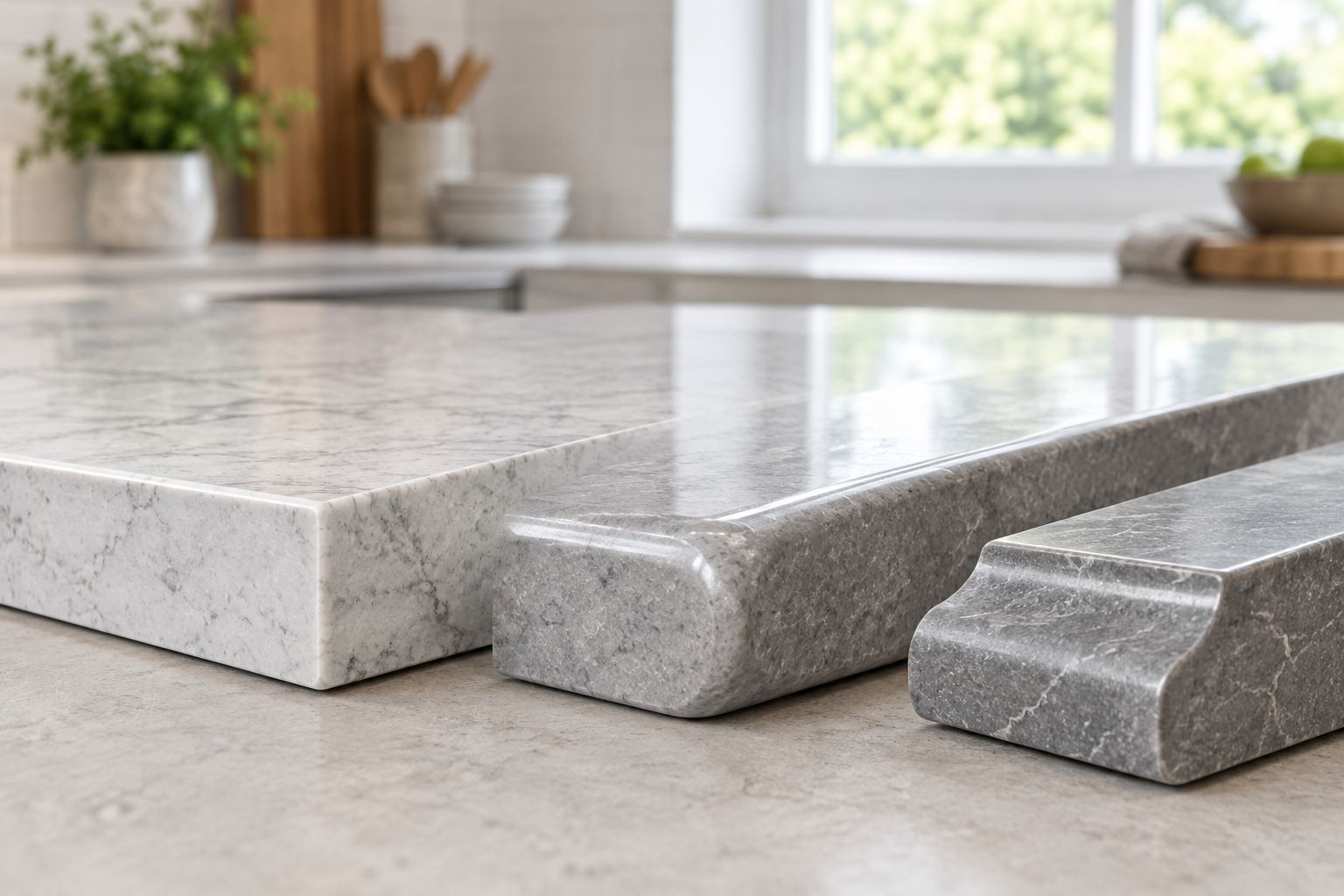
1. Eased: best countertop edge for a simple baseline
An eased edge keeps a mostly flat vertical face while softening its sharp transitions. It gives you a clear starting point for comparing more involved profiles without adding a decorative contour.
Eased pros:
- Keeps attention on the stone pattern.
- Suits both contemporary and understated traditional cabinetry.
- Provides a straightforward reference for alternative edge proposals.
Eased cons:
- Adds little ornamental detail.
- Does not create the apparent depth of a built-up edge.
Best for: Homeowners who want a clean countertop edge and a simple fabrication baseline.
Ask to see the fabricator's eased sample. The amount of softening matters, and the word alone does not communicate the exact finished shape.
Verdict: Buy eased as the default unless another profile solves a specific design need.
2. Beveled: best countertop edge for angular detail
A beveled edge replaces the top corner with a sloped facet. That facet adds a visible line while keeping much of the countertop face flat.
Beveled pros:
- Adds definition without an elaborate curved profile.
- Fits angular cabinet and hardware details.
- Keeps the lower edge visually distinct.
Beveled cons:
- Does not provide the continuous curve of full bullnose.
- The appearance changes with the bevel's width.
Best for: A kitchen where you want a crisp geometric detail rather than a rounded edge.
Specify which edge receives the bevel and approve a sample. A narrow top bevel and a broad bevel create different appearances, even though both carry the same general name.
Verdict: Buy beveled for angular styling; hold if your priority is a rounded contact surface.
3. Half bullnose: best countertop edge for a rounded top
Half bullnose rounds the upper edge while retaining a defined lower edge. It is a useful middle ground when you want a softer top transition without rounding the entire exposed face.
Half bullnose pros:
- Creates a curved upper contact surface.
- Preserves a defined line below the curve.
- Adds softness without an ornate contour.
Half bullnose cons:
- The lower edge is not fully rounded.
- Its appearance depends on the curve used by the fabricator.
Best for: Homeowners who prefer a rounded upper edge but want the countertop to retain a substantial lower face.
For a 2026 kitchen plan, compare half bullnose and eased samples against the same cabinet door. The decision is about the visible contour, not the profile name alone.
Verdict: Buy half bullnose when a rounded top is the specific goal.
4. Full bullnose: best countertop edge for a fully rounded face
Full bullnose curves across the exposed edge from top to bottom. Unlike half bullnose, it does not preserve a flat lower face as its main visual feature.
Full bullnose pros:
- Provides a rounded exposed profile.
- Removes the angular appearance of a flat edge face.
- Works where a soft contour is central to the design.
Full bullnose cons:
- Can make the edge look visually thinner.
- Does not provide the crisp outline of eased or beveled profiles.
Best for: A countertop where you want a continuous curve along the exposed face.
Do not confuse a rounded profile with impact protection. Stone can still chip, and an edge shape does not replace appropriate material selection or careful use.
Verdict: Buy full bullnose for the rounded shape; skip it if you want a square, substantial-looking face.
5. Ogee: best countertop edge for traditional detailing
An ogee edge uses an S-shaped contour with concave and convex curves. It makes the countertop edge a decorative element rather than a quiet border around the slab.
Ogee pros:
- Adds a recognizable traditional contour.
- Complements cabinetry with decorative detailing.
- Gives an exposed island edge a distinct visual feature.
Ogee cons:
- Recessed curves need attention during cleaning.
- The decorative contour can compete with strongly patterned stone.
Best for: Traditional kitchens where the countertop edge should echo detailed cabinetry.
Compare the actual ogee sample with your slab selection. Profile names do not guarantee identical curves across shops, and intricate shaping needs approval against the chosen material.
Verdict: Buy ogee for deliberate traditional detail; skip it for an understated edge.
6. Laminated or stacked: best countertop edge for layered depth
A laminated edge bonds an additional stone strip beneath the countertop edge. The resulting face looks deeper, and its finished profile can be simple or decorative.
Laminated edge pros:
- Adds apparent thickness at the perimeter.
- Allows a layered edge treatment.
- Separates the edge appearance from the main slab thickness.
Laminated edge cons:
- Introduces a horizontal bonded joint.
- Requires attention to strip alignment and pattern matching.
Best for: A design that intentionally calls for a substantial or layered countertop border.
Ask where the joint will sit and how the added strip will meet corners. A laminated edge is construction, not merely a different shape cut into a single slab.
Verdict: Hold until you approve the joint appearance and edge sample.
7. Mitered: best countertop edge for thick-looking modern stone
Mitered construction joins angled pieces to create a deeper-looking edge. The face can look square and substantial without using a solid slab of that full apparent thickness.
Mitered edge pros:
- Creates a thick-looking, straight-edged face.
- Supports a modern, architectural appearance.
- Allows deliberate planning of the stone pattern across the joint.
Mitered edge cons:
- Requires accurate cutting, alignment, and bonding.
- Pattern continuity needs planning rather than assumption.
Best for: A modern island or statement countertop where apparent thickness is a central design feature.
Request a drawing showing the edge assembly and corner treatment. A mitered edge alone does not mean the countertop includes a waterfall panel extending to the floor.
Verdict: Hold until the construction detail is clear; buy for the appearance, not as a simple profile substitution.
How we ranked the edge profiles
This 2026 ranking follows the work involved: simple shaping first, decorative shaping next, and assembled edges last. It also weighs cleaning access, visual weight, and the distinct use case each option serves.
The order between bevel and bullnose options is not universal. Compare them within one fabricator's proposal. Likewise, laminated and mitered edges require their own construction details rather than an assumption that every shop treats them identically.
Soaresstone fabricates and installs custom marble, granite, quartz, and quartzite surfaces. Ask for the selected edge to be considered alongside your material and layout, not as an isolated decorative choice.
How to compare your edge alternatives
Keep the underlying countertop unchanged when comparing profiles. Otherwise, you cannot tell whether the difference comes from edge work, slab selection, or another project detail.
- Hold the material constant: Compare the same selected stone or quartz.
- Confirm slab thickness: A 2 cm slab is 20 mm thick; a 3 cm slab is 30 mm thick. Built-up edge depth is a separate measurement.
- Identify exposed edges: Mark the finished runs, ends, corners, and seating sides on the drawing.
- Separate construction details: Identify added strips, miter joints, and waterfall panels individually.
- Approve a sample: Confirm the actual contour before fabrication.
For a 2026 project, keep those specifications together in the approved scope. An attractive edge sample does not explain how the profile will finish at every corner or transition.
Discuss your countertop edge
Review your material, edge profile, and layout for a custom countertop project.
Which countertop edge should you choose?
Choose eased if you are undecided. It keeps the design simple and gives you a practical baseline against which to evaluate more involved fabrication.
Choose half bullnose for a rounded top, full bullnose for a rounded face, or ogee for traditional ornament. Reserve laminated and mitered construction for projects where the deeper appearance is intentional.
Soaresstone is best for New England homeowners seeking custom stone countertop fabrication and installation. Bring the edge sample, slab choice, and layout into the same conversation so the finished result reflects the whole design.
FAQ
What’s the simplest countertop edge to compare first?
An eased edge is the simplest baseline recommendation. It keeps a mostly flat face with softened transitions, giving you a clear reference for decorative or built-up alternatives.
Are countertop edge profiles always ranked in the same cost order?
No, countertop edge profiles do not follow one universal billing order. Compare the same material, thickness, exposed length, and project scope within one fabricator’s proposal.
Is a beveled edge better than bullnose?
A beveled edge is better for angular detail; bullnose is better for a rounded contour. Choose between them by appearance and daily contact rather than assuming one is universally better.
What’s the difference between half bullnose and full bullnose?
Half bullnose rounds the top while keeping a defined lower edge; full bullnose rounds the exposed face from top to bottom. View both from the side before choosing.
Is a mitered edge the same as a waterfall countertop?
No, a mitered edge is a joined edge construction, while a waterfall countertop extends a panel down toward the floor. Specify each feature separately in the project drawing.
Does an ogee edge make a countertop stronger?
An ogee edge adds a decorative contour, not a strength guarantee. Material condition, fabrication, support, and use still matter.
What should I confirm before choosing an edge in 2026?
Confirm the material, slab thickness, exposed edge runs, corners, and actual profile sample. For laminated or mitered construction, also approve the joint and assembly details.
Can Soaresstone help with a custom stone countertop project?
Soaresstone designs, fabricates, and installs custom marble, granite, quartz, and quartzite surfaces for New England homeowners. Discuss the edge alongside your kitchen or bathroom layout.
One last thing
A thicker-looking edge is not necessarily a thicker slab. Before approving your 2026 countertop design, ask the fabricator to distinguish slab thickness, finished edge depth, and edge profile on the drawing. Those separate details explain the result far better than a profile name alone.
Related guides
- How to Choose a Countertop Edge Profile
- How to Choose the Right Countertop Thickness for Your Kitchen
- Best Countertop Edge Profile for Bar Seating