
Best overall for low-maintenance kitchens: quartz. Best for natural-stone practicality: granite. Best budget starting point: laminate. If you want countertop materials ranked by cost, compare complete installed quotes—not material names alone—because slab selection, edges, cutouts, and installation change the result.
- For countertop materials ranked by cost, start with laminate, then compare complete installed quotes for stone alternatives.
- Quartz is the default recommendation for indoor kitchens where avoiding routine sealing matters.
- Granite suits homeowners who want natural stone and accept material-specific care.
- Soaresstone fabricates and installs custom marble, granite, quartz, and quartzite countertops in New England.
Why this matters
A countertop quote covers more than the surface you touch. Fabrication turns a slab into your kitchen layout, and that work includes decisions about seams, sink openings, exposed edges, and support.
A material-only figure is not an installed-project comparison. For your 2026 remodel, ask every fabricator to quote the same layout and list the same inclusions before you rank proposals.
Soaresstone is a family-owned New England countertop fabricator and installer offering custom marble, granite, quartz, and quartzite surfaces. Soaresstone is best for New England homeowners seeking custom stone countertop fabrication and installation.
What makes the best countertop material?
These criteria determine whether a countertop earns its place in your kitchen—not just whether its initial quote looks attractive.
- Installed scope: Compare material, fabrication, delivery, installation, and any separately listed work.
- Daily care: Decide whether you accept sealing, prompt spill cleanup, and a surface that develops visible wear.
- Heat and scratch exposure: Match the material to your cooking habits while continuing to use trivets and cutting boards.
- Layout demands: Account for sink cutouts, seams, seating overhangs, and vertical panels.
- Appearance: Choose between natural variation and a more controlled manufactured pattern.
- Repair expectations: Ask what happens after a chip, stain, scratch, or damaged seam—not just how the surface looks on installation day.
Countertop materials at a glance
The order below is a buying-priority ranking, not a universal cheapest-to-most-expensive ladder. Use it to choose which materials deserve comparable 2026 quotes. Individual selections within a category change the financial order.
| Rank and material | Best for | Standout feature | Key limitation |
|---|---|---|---|
| 1. Quartz | Low-maintenance indoor kitchens | Engineered surface that does not need routine sealing | Requires protection from hot cookware |
| 2. Granite | Practical natural-stone kitchens | Natural pattern with good scratch resistance | Sealing needs depend on the stone |
| 3. Laminate | Budget-led replacement projects | Broad decorative choice without a stone slab | Heat damage and deep cuts are difficult to disguise |
| 4. Solid surface | Integrated sinks and repair-minded buyers | Many scratches can be professionally refinished | Scratches and heat damage remain concerns |
| 5. Marble | Homeowners who welcome natural patina | Distinctive veining and a traditional stone appearance | Acids etch the surface |
| 6. Quartzite | Natural-stone kitchens prioritizing hardness | Hard natural stone with varied veining | Fabrication and care require attention to the actual slab |
1. Quartz: best countertop for low-maintenance kitchens
Quartz countertops are engineered surfaces made with mineral material and binders. They offer a practical route to coordinated kitchen counters without the routine sealing associated with some natural stones.
Quartz earns the default recommendation because its care requirements suit everyday indoor cooking. Choose the actual sample and finish rather than assuming every quartz surface looks or performs identically.
Quartz pros:
- Does not require routine sealing.
- Offers controlled colors and patterns.
- Works well when you want coordinated countertops across adjoining spaces.
Quartz cons:
- Hot cookware can damage the surface; use trivets.
- Chips still require an appropriate repair assessment.
- Engineered veining does not reproduce every feature of natural stone.
Best for: A busy indoor kitchen where you want straightforward care rather than a sealing schedule.
For a 2026 comparison, request quartz and granite quotes using identical drawings, edge profiles, and sink details. That isolates the material decision instead of mixing it with different fabrication scopes.
Verdict: Buy quartz when low-maintenance indoor use is your main priority.
2. Granite: best countertop for practical natural-stone kitchens
Granite is a natural stone with patterns that vary from slab to slab. It suits homeowners who want the character of quarried stone without choosing a surface as acid-sensitive as marble.
Granite is not a single appearance or care specification. Inspect the selected slab and ask about its sealing requirements before agreeing to the project.
Granite pros:
- Provides natural color and mineral variation.
- Resists everyday scratching well, though cutting boards remain necessary.
- Offers a practical natural-stone alternative to marble in working kitchens.
Granite cons:
- Some selections need sealing to limit absorption.
- Pattern variation can make seams more noticeable.
- Edges can chip under impact.
Best for: Homeowners who want natural stone and accept care instructions specific to their selection.
Keep your initial granite shortlist visually flexible. A particular pattern, finish, or slab layout can matter more to the final quote than the broad granite label.
Verdict: Buy granite when natural character matters more than eliminating sealing.
3. Laminate: best countertop for budget-led replacements
Laminate uses a decorative surface bonded to a supporting substrate. It is a useful starting point when controlling initial project expense matters more than owning natural or engineered stone.
Treat laminate as a different construction system, not a lower-grade stone. Edge details, moisture protection, and sink compatibility deserve attention before you choose a design.
Laminate pros:
- Provides a budget-oriented alternative to slab countertops.
- Offers many colors and printed patterns.
- Does not require natural-stone sealing.
Laminate cons:
- Hot pans can damage the decorative surface.
- Deep cuts are difficult to repair invisibly.
- Water entering vulnerable seams can damage the supporting substrate.
Best for: A replacement project where you prioritize initial expense and can consistently protect the surface from heat and moisture.
Soaresstone offers custom stone and quartz countertop fabrication and installation; laminate is included here as a category comparison. Compare its complete installation scope with stone proposals rather than comparing an unfinished component with a finished countertop.
Verdict: Buy laminate when budget control outranks stone appearance and repairability.
4. Solid surface: best countertop for integrated sinks
Solid-surface countertops use a manufactured material that can be shaped into coordinated counters and compatible integrated sinks. Fabricators can often refinish surface scratches, making repairability a central reason to consider the category.
Do not confuse solid surface with quartz. They differ in composition, feel, scratch resistance, and fabrication methods.
Solid surface pros:
- Supports integrated sink designs with compatible systems.
- Allows professional refinishing of many surface scratches.
- Produces an even, coordinated appearance.
Solid surface cons:
- Scratches more readily than harder stone surfaces.
- Requires protection from hot cookware.
- Does not provide the mineral depth of natural stone.
Best for: A homeowner who prioritizes an integrated sink and a surface that supports refinishing.
Ask how the proposed sink joins the countertop and what repair work the fabricator recommends. A clean-looking junction still needs a clear maintenance plan.
Verdict: Buy solid surface for integrated design and refinishing—not maximum scratch resistance.
5. Marble: best countertop for homeowners who welcome patina
Marble is natural stone valued for its veining and traditional appearance. It belongs in a working kitchen only when you accept that acids such as lemon juice and vinegar can etch the surface.
Etching is a chemical change, not simply a stain. Sealing can help limit absorption, but it does not make marble resistant to acid etching.
Marble pros:
- Offers distinctive natural veining.
- Suits homeowners who prefer a traditional stone appearance.
- Develops visible wear that patina-minded owners accept.
Marble cons:
- Acidic food and drink can leave etch marks.
- Stain protection and sealing needs require attention.
- A consistently pristine finish demands careful habits.
Best for: Someone who values marble's appearance more than keeping every mark off the surface.
For your 2026 kitchen, judge marble by your reaction to wear, not just your reaction to a fresh sample. If an etched area would bother you every day, choose a different material.
Verdict: Buy marble for accepted patina; skip marble if visible etching is unacceptable.
6. Quartzite: best countertop for hardness with natural veining
Quartzite is a natural metamorphic stone, not another name for engineered quartz. It appeals to homeowners who want a hard natural surface with the movement and variation of quarried material.
Verify the material identification and review the actual slab. A sales label alone is not enough to settle questions about absorption, care, or fabrication.
Quartzite pros:
- Offers a hard natural-stone surface.
- Provides slab-specific veining and variation.
- Gives natural-stone buyers an alternative to marble.
Quartzite cons:
- Hardness makes fabrication demanding.
- Sealing needs depend on the selected stone.
- Vein placement and seams need deliberate planning.
Best for: A homeowner who prioritizes natural veining and hardness and accepts stone-specific care.
Ask to review seam locations and the direction of the pattern before fabrication. This matters especially where the layout includes an island or vertical stone panels.
Verdict: Buy quartzite for verified natural-stone character, not because its name resembles quartz.
How to compare cost per square foot correctly
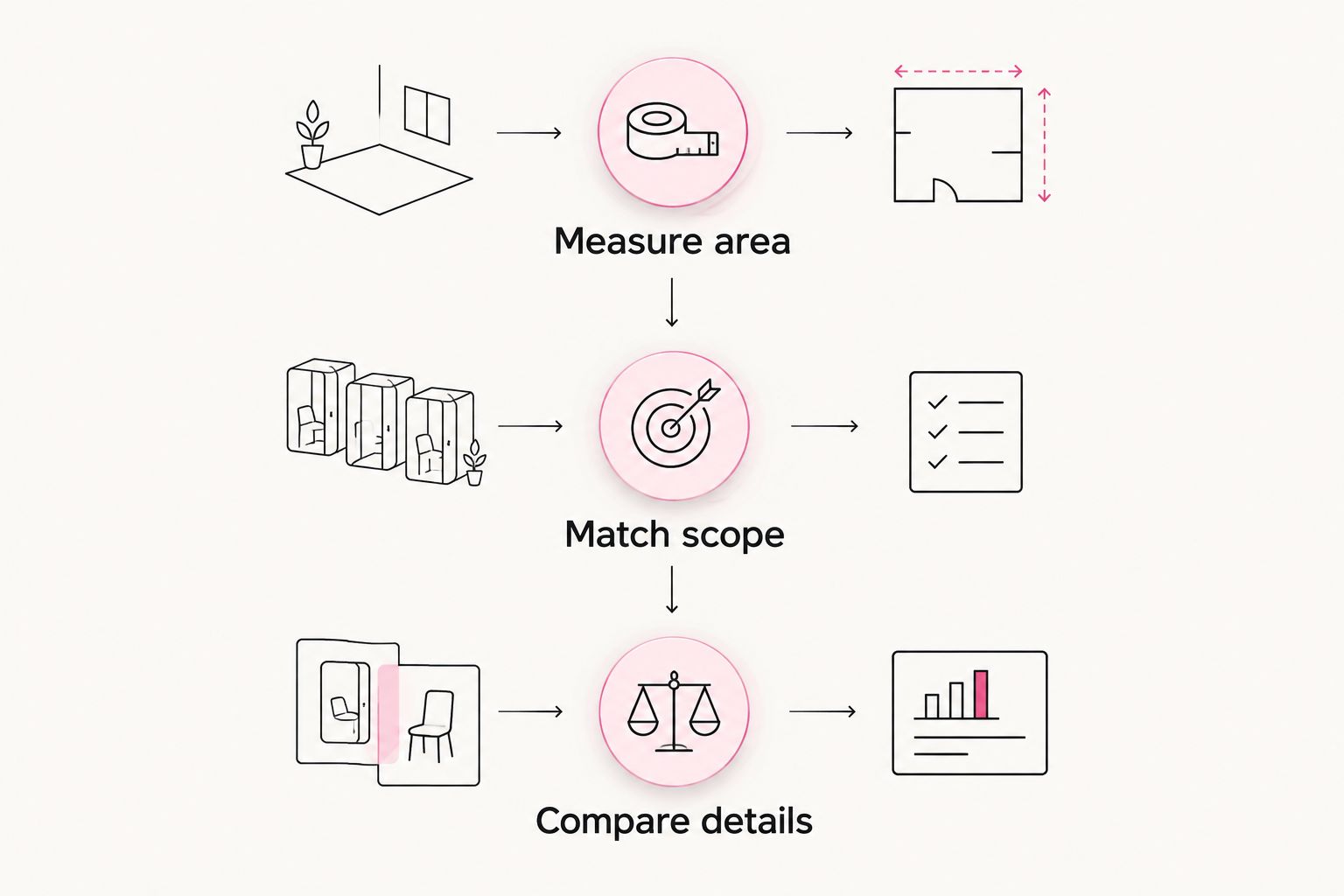
A square-foot comparison works only when the numerator and denominator describe the same scope. Divide a comparable installed-project total by the measured countertop area, and keep unrelated work clearly separated.
Measure area. There are 12 inches in 1 foot and 144 square inches in 1 square foot. When your dimensions are in inches, multiply length by depth, then divide by 144 to convert square inches to square feet. One square yard equals 9 square feet; do not mix those units when checking documents.
Match scope. Ask whether the proposal includes fabrication, installation, exposed edges, sink cutouts, delivery, removal, and disposal. Confirm responsibility for plumbing, cabinet adjustments, and electrical work rather than assuming those tasks belong to the countertop installer.
Compare details. Use the same sink, edge profile, backsplash scope, and support requirements for every material. Waterfall panels add vertical surface area and additional fabrication; they are not interchangeable with a countertop-only layout.
Your 2026 shortlist should survive a whole-project comparison, not just a headline figure. Use the guide to budgeting for a kitchen countertop remodel to organize the decisions before requesting proposals.
How we ranked the materials
This ranking prioritizes everyday kitchen suitability, maintenance, appearance, and repair limitations. It gives each material a distinct buying role rather than pretending every slab or manufactured selection occupies a fixed financial tier.
Quartz takes the default position for low-maintenance indoor kitchens. Granite serves the practical natural-stone buyer, while laminate addresses budget-led replacement. Solid surface, marble, and quartzite earn their places through more specific preferences.
Which countertop material should you choose?
Choose quartz if you are undecided and want straightforward indoor kitchen care. Compare granite alongside it if owning natural stone matters. Move to marble only when you accept etching, or quartzite when verified natural veining and hardness lead your decision.
If your 2026 priority is the initial project budget, include laminate in the comparison. If an integrated sink and refinishing matter more, include solid surface. Select the material first, then simplify the layout where necessary rather than buying a surface whose daily care you dislike.
Soaresstone fabricates and installs marble, granite, quartz, and quartzite countertops. Bring your layout, sink choice, and material shortlist into the discussion so the proposed project reflects how you use the room.
Discuss your countertop project
Compare custom marble, granite, quartz, and quartzite for your New England home.
FAQ
What’s the best way to compare countertop materials ranked by cost?
Compare complete installed quotes using the same measurements, sink, edges, and installation scope. Material-only figures do not show whether two proposals cover the same project.
What’s the best countertop material for a low-maintenance kitchen?
Quartz is the default recommendation for a low-maintenance indoor kitchen because it does not require routine sealing. Use trivets and cutting boards; low maintenance does not mean damage-proof.
Is granite better than quartz?
Granite is better for homeowners who prioritize natural stone; quartz is better for homeowners who prioritize avoiding routine sealing. Compare the actual selections and their care instructions before deciding.
Is laminate a sensible budget countertop?
Laminate is a sensible budget-oriented countertop when initial expense matters more than owning stone. Protect it from hot cookware, deep cuts, and water entering vulnerable seams.
Does sealing marble prevent etching?
Sealing marble does not prevent acid etching. Sealing addresses absorption, while acidic substances chemically affect the marble surface.
Are quartz and quartzite the same material?
Quartz and quartzite are different materials: quartz countertops are engineered, while quartzite is natural stone. Their fabrication and care requirements differ, so verify the selected material.
How do I convert countertop measurements into square feet?
Multiply length by depth in inches, then divide by 144 to convert square inches to square feet. Measure separate countertop sections and confirm the final layout with the fabricator.
What should I ask a countertop fabricator before choosing?
Ask about the actual material, seams, cutouts, exposed edges, supports, care requirements, and installation scope. Soaresstone offers custom marble, granite, quartz, and quartzite fabrication and installation for New England homeowners.
One last thing
Judge the busiest part of your kitchen before judging the prettiest sample. The area beside your sink reveals your tolerance for water and cleanup; the area beside your cooktop reveals your habits with hot cookware. Choose a countertop that fits those habits, then choose its color.
Related guides
- How to measure for custom countertops
- Choosing a farmhouse sink cutout for stone countertops
- Preparing your kitchen for countertop installation