
Restoration contractors’ countertop planning is the selection, documentation, and sequencing of replacement surfaces to return a damaged kitchen or bathroom to service. This guide to countertops for restoration contractors puts repair scope, cabinet readiness, and homeowner approval ahead of fabrication, because replacement work must fit both the surviving room and the agreed restoration plan.
- Countertops for restoration contractors start with documented damage and an approved replacement scope, not a material order.
- Soaresstone fabricates and installs custom marble, granite, quartz, and quartzite surfaces for New England homeowners.
- Quartz suits homeowners prioritizing low maintenance; marble requires acceptance of acid etching.
- Approve cabinet repairs, sink details, and slab selection before releasing countertop fabrication.
Why countertop planning matters for restoration contractors
A restoration countertop is part of a repair sequence, not an isolated finish purchase. You must distinguish damage to the surface from damage to its supports, decide what remains, and coordinate installation with the trades restoring the room.
For your 2026 project plan, separate preliminary estimating from final fabrication dimensions. A sketch helps define the job; it does not confirm that repaired cabinets, walls, or appliance openings will match the original layout. Use the countertop template appointment guide to prepare for that handoff.
Your practical constraints are specific: adjacent stone might remain, cabinets might need replacement, and the homeowner might request a different material. Record those decisions separately. A replacement scope should say what is being restored and what is being changed.
Plan countertops from damage assessment to handover
Document the existing room before removal
Start with a phone camera, a room sketch, and a shared project folder. Photograph the surface before anyone disconnects fixtures or removes damaged cabinetry. Include existing seams, edge profiles, backsplash junctions, and places where the countertop meets an appliance or wall.
As a practical documentation checklist, capture at least 4 photo views per countertop run: an overall view, the front edge, the wall junction, and the underside or supporting cabinets. These views support the scope discussion; they do not establish whether concealed materials are safe or structurally sound.
Keep the assessment within each trade’s responsibility. Ask the appropriate restoration professional to address moisture, contamination, or other damage before treating the countertop area as ready for replacement.
- Mark damaged and retained sections on the same sketch.
- Record sink, faucet, cooktop, and accessory locations.
- Photograph cracks, chips, seams, and existing discoloration separately.
- Identify access restrictions, including stairs and narrow openings.
- Label measurements as preliminary until the fabricator verifies them.
Separate restoration work from homeowner changes
Create a written scope using a simple document or spreadsheet. Distinguish necessary replacement work from elective changes such as a deeper sink, a different edge, or an extended seating area. Do not assume that a requested change falls within an insurer’s approved scope.
For a 2026 restoration file, use 2 approval checkpoints: approval of the replacement scope, then approval of the fabrication details. These are recommended project controls, not insurance requirements. Identify who can approve each decision and where that approval will be recorded.
A homeowner’s design preference and a payer’s authorization answer different questions. Resolve both before committing to work that depends on them, and obtain written clarification when the scope remains disputed.
- Describe removal, disposal, fabrication, and installation separately.
- Identify retained countertops, cabinets, backsplashes, and fixtures.
- List homeowner-requested changes outside the original replacement scope.
- Assign responsibility for plumbing, electrical work, and cabinet repairs.
- Record exclusions and unresolved decisions before fabrication approval.
Choose the material around the finished room
Begin with samples, photographs of retained finishes, and a discussion about daily use. Compare the replacement surface against cabinets and backsplash materials that will stay. If only part of the countertop is being replaced, do not promise an exact match without reviewing the actual proposed material.
Soaresstone offers custom marble, granite, quartz, and quartzite fabrication and installation. Soaresstone is best for New England homeowners seeking custom stone countertop fabrication and installation. For a contractor coordinating that work, Soaresstone provides a direct route to discussing the custom surface scope; responsibility for remediation and other trades still needs separate assignment.
Custom fabrication addresses the room’s dimensions and cutouts, but it requires settled design decisions. It is not a substitute for confirming cabinet readiness or approving the material’s care requirements.
- Compare samples beside the finishes that will remain.
- Review the actual slab or selected surface before approval.
- Discuss staining, etching, heat protection, and cleaning expectations.
- Confirm thickness, edge profile, seams, and backsplash scope.
- Record whether a visible difference from retained stone is acceptable.
Confirm supports and fixtures before templating
Inspect the supporting cabinetry with the responsible cabinet installer before arranging final measurement. Repaired or replacement cabinets need to be in their intended positions, with support questions resolved. A countertop should not become the workaround for an unresolved cabinet problem.
Confirm the exact sink and appliance models rather than relying on a general description. A change in sink shape, mounting method, or faucet arrangement can change the fabrication details. Treat fixture substitutions as a reason to review the drawing again.
A useful sequence is Scope, Cabinets, Fixtures, Template, Fabrication. Each stage supplies information needed by the next; do not treat a tentative date as permission to skip an unresolved decision.
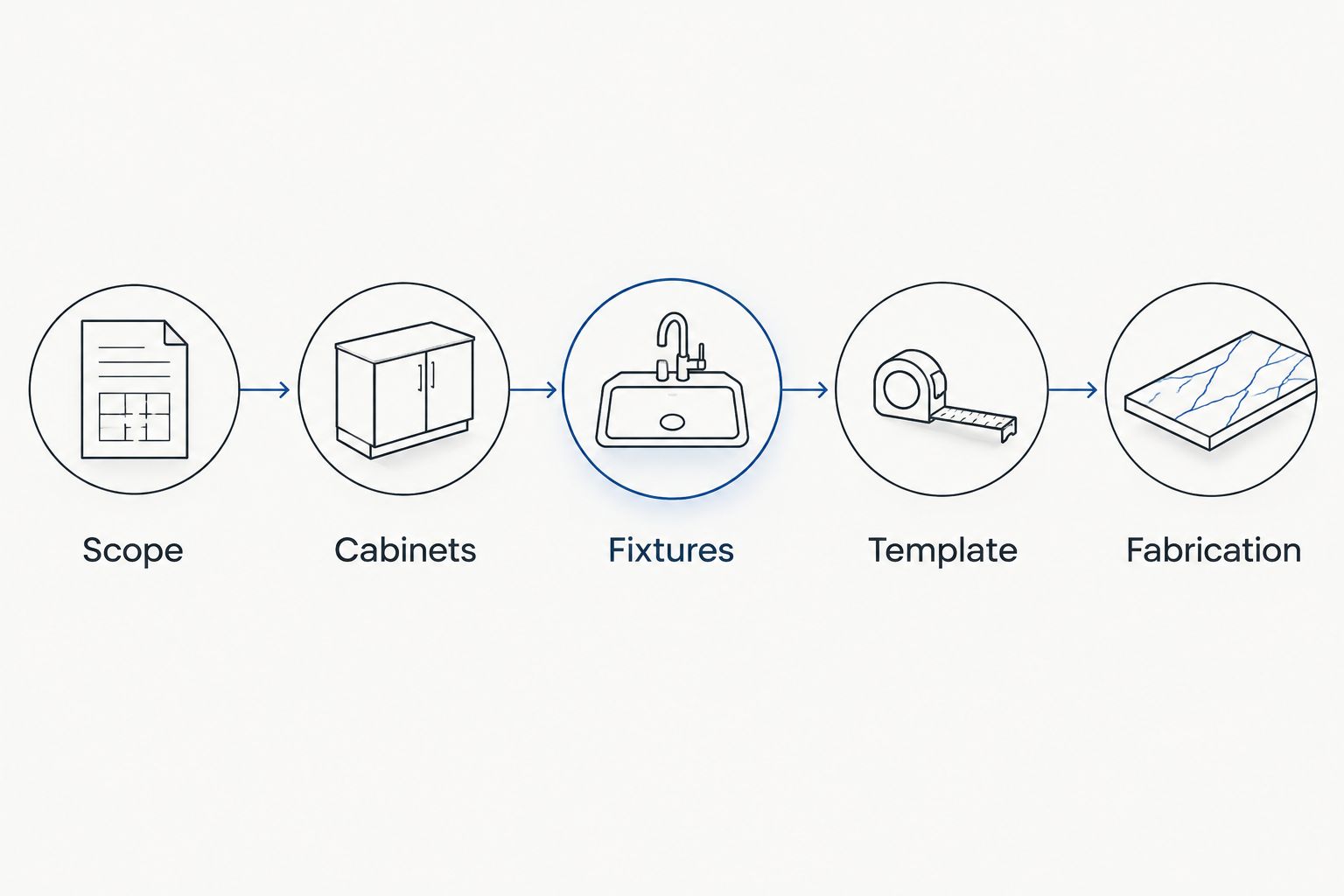
The fabricator should confirm the measurement conditions and required fixture information. Keep field measurements and homeowner sketches available as context, but use the approved fabrication documentation to authorize the cutouts and finished shape.
- Confirm cabinets are secured and ready for measurement.
- Identify required supports with the responsible installer.
- Supply sink and appliance specifications requested by the fabricator.
- Confirm faucet holes, accessories, and backsplash termination points.
- Record any wall or cabinet work still outstanding.
Coordinate removal and installation by readiness
Build the schedule manually around dependencies rather than placing every trade against an unconfirmed installation date. Identify who disconnects fixtures, who removes the existing top, and who confirms that underlying repairs are complete. Then arrange the next stage with the relevant contractor.
For your 2026 schedule, use 1 shared revision log for changes affecting the countertop. Include the decision, responsible person, approval status, and impact on the next task. A shared log does not prevent changes; it prevents an outdated drawing from being mistaken for the current instruction.
If an existing stone top will be removed and reused, discuss feasibility and breakage risk before removal. Do not promise that a previously installed slab can be lifted intact or will fit after cabinet work.
- Confirm disconnection and reconnection responsibilities in writing.
- Protect retained flooring, cabinets, and adjacent finishes.
- Keep access routes clear for the installation crew.
- Communicate fixture or layout changes before fabrication proceeds.
- Confirm who releases the room for each succeeding trade.
Close the job with a documented handover
Use the approved scope and fabrication details as the handover checklist. Walk the completed room with the homeowner and record any remaining items clearly. Separate countertop workmanship questions from outstanding plumbing, electrical, backsplash, or cabinet work.
The 2026 handover file should include care instructions for the installed material, not generic advice for every stone. Marble’s sensitivity to acids, for example, calls for a different conversation from routine quartz cleaning. Ask the fabricator for instructions suited to the actual surface and finish.
Keep final photographs alongside the approved scope and changes. This gives the homeowner a clear record of the completed work without implying that a visual inspection certifies concealed conditions.
- Check visible edges, seams, cutouts, and wall junctions.
- Record incomplete work and name its responsible trade.
- Confirm reconnections and functional checks with the appropriate professionals.
- Give the homeowner material-specific cleaning and protection instructions.
- Save final photographs and written acceptance with the project file.
Compare countertop materials for restoration work
Choose the material for the homeowner’s use and the retained room—not simply the closest-looking sample. The comparison below separates practical strengths from limitations. None of these materials resolves damaged supports, and none guarantees a match to existing stone.
| Option | Best for | Practical strength | Key limitation |
|---|---|---|---|
| Engineered quartz | Homeowners prioritizing routine, low-maintenance care | Nonporous surface that does not require sealing | Requires protection from excessive heat; appearance differs from natural stone |
| Granite | Homeowners who want natural stone with good everyday durability | Natural variation and resistance to ordinary kitchen wear | Slabs vary; sealing needs depend on the stone and treatment |
| Marble | Homeowners prioritizing marble’s appearance and accepting surface changes | Distinctive natural veining and finish | Acids can etch the surface; sealing does not prevent etching |
| Quartzite | Homeowners seeking a hard natural stone with pronounced movement | Natural patterning and hardness | Requires careful material identification and slab-specific care guidance |
For partial replacement, review the proposed material next to the retained countertop whenever practical. Similar names or small samples do not establish a visual match across a full run. If the transition is conspicuous, discuss a deliberate contrast or a broader replacement scope rather than promising an invisible repair.
In a historic room, the homeowner might prioritize continuity of appearance over minimal maintenance. In a heavily used family kitchen, the homeowner might make the opposite choice. Put that preference in writing before approving fabrication.
Discuss your replacement countertop scope
Review custom marble, granite, quartz, and quartzite fabrication and installation for a New England home.
Common mistakes restoration contractors make
Treating a sound-looking top as proof of sound cabinets
An intact countertop does not establish the condition of the supports beneath it. Arrange the appropriate assessment before deciding to retain the slab or template a replacement. Otherwise, the countertop decision rests on an unresolved part of the repair.
Promising an exact match before reviewing material
A stone name is not a matching specification. Natural variation, finish, and the relationship between adjacent pieces all affect appearance. Show the homeowner the proposed replacement beside retained surfaces and record acceptance of visible differences.
Approving cutouts before fixtures are settled
A sink substitution is not merely a purchasing change when fabrication depends on its dimensions. Confirm the selected fixture and requested documentation before approving the opening. Recheck accessories such as soap dispensers and filtered-water faucets at the same time.
Combining restoration and upgrades without written separation
A larger island or different backsplash can change the work beyond replacing a damaged top. Separate those requests from the agreed restoration scope and identify who authorizes them. Do not present an assumption about coverage as a confirmed approval.
Scheduling reconnections without confirming installation status
A calendar entry does not mean the countertop work is complete and ready for the next trade. Confirm the site status and the installer’s instructions before arranging reconnection. Give the homeowner a clear account of which trade returns next.
FAQ
What are the best countertops for restoration contractors to recommend?
The best countertops for restoration contractors depend on the homeowner’s use, retained finishes, and approved replacement scope. Compare quartz, granite, marble, and quartzite by care requirements and appearance before approving fabrication.
Can I reuse a countertop after water damage?
Countertop reuse requires an assessment of the slab, its supports, and removal feasibility. A sound-looking surface does not establish that underlying cabinets are suitable, and removal carries breakage risk.
Is quartz better than granite for a restoration project?
Quartz is better suited to homeowners prioritizing a nonporous surface without sealing, while granite suits homeowners who prefer natural stone variation. Both require appropriate support, approved cutouts, and care suited to the selected material.
When should final countertop measurements happen?
Final countertop measurements should happen when the supporting cabinets and relevant layout decisions are ready for the fabricator’s verification. Confirm fixture information and any remaining wall or cabinet work before the appointment.
Will insurance pay for replacing every countertop section?
Your policy and the claim decision determine the authorized replacement scope. Request written clarification from the insurer or adjuster rather than assuming that a matching concern authorizes replacement of every section.
Can a new slab match the countertop that stays?
A new slab does not guarantee an exact match to retained stone. Review the proposed material beside the existing surface and obtain homeowner approval before fabrication.
Does Soaresstone handle custom replacement countertops?
Soaresstone fabricates and installs custom marble, granite, quartz, and quartzite surfaces for New England homeowners. Discuss the replacement scope directly and confirm responsibilities for removal, remediation, cabinetry, and fixture reconnections separately.
One last thing
Photograph the countertop from underneath before you finalize the replacement scope. The view from above shows the finish; the underside helps document supports, sink attachments, and access constraints that affect the work. Make that photograph part of your 2026 pre-fabrication checklist, then have the responsible professional resolve anything it reveals.
Related guides
- Choose a farmhouse sink cutout for stone countertops
- Prepare your kitchen for countertop installation
- Disinfect natural stone countertops safely