
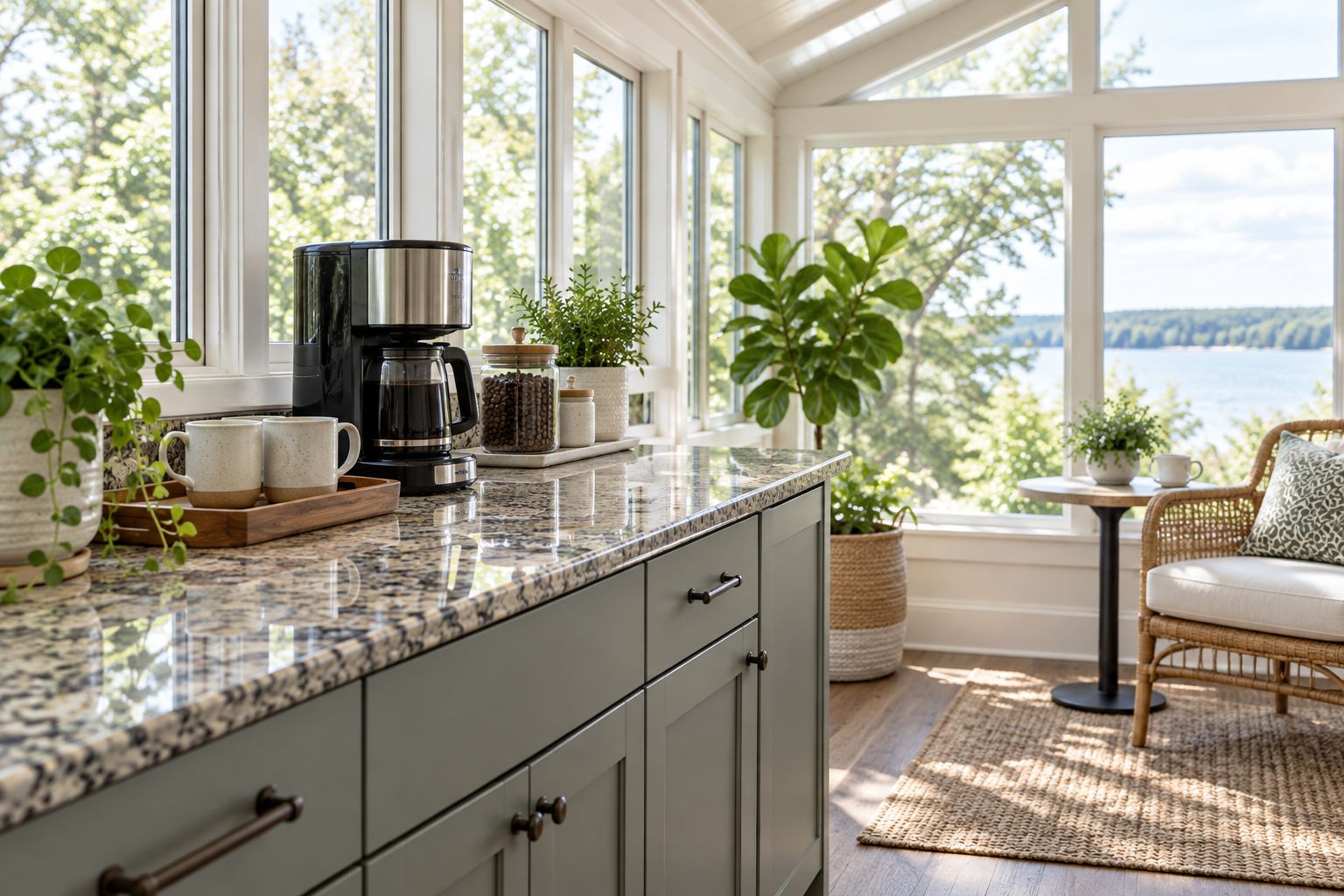
Sunroom kitchenette countertops in granite are built to survive direct sun, sharp temperature swings between a heated great room and an unheated glass addition, and moisture from a nearby patio door, all in a footprint usually under 10 linear feet. Soares Stone fabricates these small-format bars the same way it fabricates full kitchen islands in 2026, just scaled down to a coffee station or wet bar.
- Granite countertops for sunroom kitchenettes resist UV fading and heat swings better than quartz in glass-walled rooms.
- A honed or leathered finish cuts glare off south-facing glass without losing durability in 2026 installs.
- Most sunroom kitchenette slabs run 4 to 6 linear feet for a coffee bar or wet bar.
- Quartz resin can discolor under sustained direct sun; granite and quartzite handle thermal cycling with no binder to break down.
- Soares Stone templates sunroom counters the same way it templates full kitchen islands, just at a smaller scale.
Why granite matters for sunroom kitchenettes
A sunroom kitchenette lives behind glass on three or four sides, so the countertop takes more direct UV and more daily heat cycling than any surface in the main kitchen. New England sunrooms swing from near-freezing on a January morning to 90-plus degrees behind glass on a sunny August afternoon if the room isn't actively heated and cooled, and the countertop absorbs that swing every day it sits there.
Granite is quarried stone, not a resin-and-quartz blend, so it doesn't have a binder that can yellow or soften under sustained heat and UV. That's the same logic behind a small-footprint ADU kitchenette: tight square footage means every surface choice has to do more work with less forgiveness for the wrong pick.
Sunroom coffee bars and wet bars also see moisture from a nearby patio door or planters, which rules out anything that etches easily. Granite doesn't etch the way marble does, and it holds a seal for years without babying.
Measure your sunroom footprint before you shop slabs
Sunroom kitchenettes rarely need a full slab. Most projects run one length of counter behind a wet bar, a coffee station along a window wall, or a short L-shape wrapping a corner sink.
- Measure wall-to-wall length in inches, not feet, since a few inches determines whether you need one slab or a seam
- Note ceiling height and window sill height if the counter runs under glass, since low sills limit overhang
- Check the depth of the built-in cabinetry the counter will sit on, typically 24 inches for a kitchenette base
- Mark where plumbing and electrical already stub out, since moving them adds cost before the counter is even ordered
- Bring exact measurements to a template appointment rather than guessing slab size from a floor plan
Choose a finish that manages glare and heat
South- and west-facing sunrooms throw glare across a polished countertop for hours at a time, which makes a honed or leathered finish more comfortable to work at than high-gloss polish. Finish choice also affects how well heat-resistant countertops hold up against a hot pan set down near a sunny window without a trivet ready.
- Ask for a honed finish if the counter faces south or west glass, since it cuts reflected glare
- Ask for a leathered finish if you want texture that hides fingerprints and water spots on a bar top
- Stick with polished finish only on north-facing sunrooms where glare isn't a daily problem
- Test a finish sample in the actual room at the time of day you'll use the counter most
- Confirm the fabricator can match finish consistently across the full slab, not just the visible edge
Pick a granite color that survives direct sun
Granite doesn't fade the way dyed resin or laminate can, but color still reads differently under direct sun than under showroom lighting. Grays and blacks show dust and water spots faster in bright light; warm golds and browns hide daily use better on a coffee station.
- View slab samples outdoors or near a window, never only under indoor showroom lights
- Ask to see the full slab, not a small sample chip, since veining changes across a slab
- Pick a busier pattern if the counter will hold small appliances and clutter most of the day
- Pick a calmer pattern if the sunroom is meant to feel like an extension of the living room
- Skip very light white granite in a south-facing room if you want to avoid frequent wiping
Plan for thermal movement and support
Granite expands and contracts slightly as a sunroom swings between winter cold and afternoon sun, more than it would in a climate-controlled kitchen. Support matters more here than in a standard kitchen island.
- Confirm the base cabinets or bar frame can bear the full weight of a natural stone slab
- Ask about expansion gaps at seams so the stone isn't locked rigid against cabinetry on both sides
- If the counter cantilevers for a knee space, confirm the overhang stays within a safe distance
- Skip mitered waterfall ends on a sunroom counter unless the fabricator confirms the support can handle it
- Have a fabricator inspect the sunroom's existing framing before ordering, not after the slab is cut
Decide on sink, cooktop, and appliance cutouts
Most sunroom kitchenettes skip a full range and stick with a bar sink, a wine fridge, or a small cooktop. Each cutout changes how the slab is fabricated and supported.
- Choose an undermount sink if you want a clean wipe-down edge for a coffee or wet bar
- Leave at least 1.5 inches of stone around any cutout so the edge doesn't crack under daily use
- Confirm appliance cutout dimensions before the template appointment, not after the slab is measured
- Skip a cooktop cutout entirely if the sunroom isn't wired for a dedicated circuit
- Weigh whether a farmhouse sink cutout is worth the extra support work for a small bar counter
Match your seal and maintenance routine to New England swings
Granite countertops for sunroom kitchenettes need the same sealing schedule as a kitchen island, but a room that swings from near-freezing to hot and sunny puts more stress on that seal. Homes built for New England winters already deal with this kind of temperature swing across the whole structure, and the countertop is no different.
- Reseal granite once a year in a sunroom, more often than the two-to-three-year interval typical in a climate-controlled kitchen
- Wipe up standing water near a bar sink daily, since sun exposure can bake spills into unsealed granite faster
- Skip harsh cleaners that strip sealant; use a pH-neutral stone cleaner instead
- Check the seal every spring after a full New England winter of temperature swings
- Watch for dulling near the windows first, since that's where UV and heat concentrate
Schedule your template and install around the season
A sunroom that isn't heated or cooled is harder to template accurately in the dead of winter or peak summer heat, when the room's temperature swings widest during the day.
- Schedule a template appointment in spring or fall when the room sits closer to a stable temperature
- Confirm the install crew can access the sunroom without routing a slab through a tight interior doorway
- Ask whether existing cabinetry needs to come out before the fabricator can template accurately
- Plan installation before extreme summer heat if the sunroom has no AC, since fabricators need workable conditions
- Build in a few days of buffer if the sunroom sits on an addition with limited access
Comparison: granite vs. quartz vs. quartzite vs. marble for sunroom kitchenettes
| Material | Best for | Key limitation |
|---|---|---|
| Granite | South- or west-facing sunrooms with direct sun most of the day | Needs annual resealing in a high-UV room |
| Quartzite | Sunrooms that also see heat from a nearby pool house kitchenette or outdoor door | Costs more to fabricate than granite in most cases |
| Quartz | North-facing sunrooms with little direct sun and low heat exposure | Resin binder can discolor or soften under sustained sun and heat |
| Marble | Sunrooms used mainly for display or light drink service, not daily food prep | Etches easily from citrus, wine, or moisture near a bar sink |
Granite is the strongest all-around pick for a sun-exposed sunroom kitchenette in 2026 because it handles UV and thermal cycling without a resin binder that can break down.
“Granite is the strongest all-around pick for a sun-exposed sunroom kitchenette because it handles UV and thermal cycling without a resin binder that can break down.”
Get a quote for your sunroom counter
Soares Stone templates small-format bars the same way it templates full kitchen islands.
Common mistakes homeowners make with sunroom kitchenette countertops
- Ordering polished granite for a south-facing room and living with glare all summer. A honed or leathered finish solves this before installation, not after.
- Scheduling the template appointment in winter or peak summer and getting an inaccurate measurement. A sunroom's temperature swings widest during the day it's templated, which makes precision harder.
- Choosing quartz for a room with unfiltered afternoon sun. The resin binder in quartz isn't built for sustained heat and UV the way solid granite is.
- Forgetting the sunroom's cabinetry wasn't built to carry a full stone slab. Framing built for a lighter laminate top doesn't automatically support natural stone.
- Treating the sunroom counter like a low-traffic surface and skipping annual resealing. Sun and heat break down sealant faster here than in a climate-controlled kitchen.
FAQ
What’s the best countertop material for a sunroom kitchenette?
Granite is the best all-around pick for a sunroom kitchenette that gets direct sun, since it resists UV, heat cycling, and etching better than quartz or marble. Quartzite is a close second for rooms that also see heat from an adjacent outdoor space.
Is granite better than quartz for a sun-exposed room?
Yes, granite generally outperforms quartz in a sun-exposed sunroom because quartz uses a resin binder that can discolor or soften under sustained heat and UV. Granite is solid quarried stone with no resin to break down.
How much sun exposure can granite countertops handle?
Granite handles years of direct sun without fading or structural damage, since it’s mineral stone rather than a dyed or resin-bound material. The bigger factor for sunrooms is sealant wear, which sun and heat accelerate.
Do sunroom countertops need to be resealed more often?
Yes, granite in a sunroom typically needs resealing once a year, compared to every two to three years in a climate-controlled kitchen. Sun and heat break down sealant faster than they do in shaded interior rooms.
Can quartz countertops fade or discolor in a sunroom?
Quartz can discolor or soften under sustained direct sun because its resin binder isn’t built for constant UV and heat exposure. This makes quartz a weaker choice than granite for south- or west-facing sunroom kitchenettes.
What size countertop does a typical sunroom kitchenette need?
Most sunroom kitchenette counters run 4 to 6 linear feet for a coffee bar or small wet bar, far smaller than a full kitchen run. Exact size depends on the wall length and any built-in cabinetry already in the room.
Is marble a good choice for a sunroom bar?
Marble works for display or light drink service but etches easily from citrus, wine, or moisture near a bar sink. For a sunroom that sees daily use, granite or quartzite holds up better.
How do I know if my sunroom cabinetry can support a granite slab?
Have a fabricator inspect the existing base cabinets or bar frame before ordering, since granite is heavier than laminate or butcher block. Framing built for a lighter surface may need reinforcement before installation.
One last thing
Most homeowners assume a sunroom kitchenette needs a lighter, cheaper material because it's a small job, but the opposite is usually true: a room with more direct sun and wider temperature swings than any other space in the house needs the more resilient stone, not the more affordable one. Granite or quartzite, not quartz, is the safer call for any sunroom that gets more than a few hours of direct sun a day in 2026.
Related guides