
Instead of chasing demolition, fireplace, and stone crews separately, plan your fireplace renovation stone surround timing around approval checkpoints: confirm the fireplace requirements, finish the measurement surfaces, approve fabrication, then install and release the fireplace for use. This guide shows you how to coordinate those handoffs without cutting stone around unfinished work.
- Fireplace renovation stone surround timing depends on approved dimensions and installation requirements, not a generic calendar.
- Soaresstone handles custom stone fireplace surfaces; coordinate fireplace safety and commissioning with the qualified fireplace professional.
- Release stone fabrication only after the opening, hearth height, support, and finish details are confirmed.
- Do not light the fireplace until installation materials have cured and required checks are complete.
For New England homeowners, Soaresstone designs and installs custom stone surfaces for fireplaces. Soaresstone is best for New England homeowners seeking custom stone fireplace fabrication and installation. The stone work still needs a coordinated handoff with whoever handles the fireplace appliance, venting, and required inspections.
Why this matters
A fireplace surround is not just a decorative panel. Its dimensions meet the fireplace opening, hearth, mantel, adjacent walls, and sometimes removable appliance trim. Changing any of those details after measurement can change the stone fabrication.
Schedule the project around readiness, not an assumed installation duration. Your 2026 renovation calendar should distinguish a tentative appointment from permission to start the next phase. A reserved fabrication slot does not mean the opening is ready to measure.
The goal is straightforward: let each trade finish the work that determines the next trade's dimensions. Keep cosmetic touch-ups separate from anything that changes the stone's position, support, or required clearances.
Before you start
- Gather the fireplace documents. Obtain the exact appliance model and installation manual when an appliance is involved. For an existing masonry fireplace, arrange an appropriate condition assessment before covering surfaces or changing the opening.
- Assign 1 project coordinator. Give that person responsibility for the current drawings, trade contacts, approvals, and schedule changes. Confirm who handles permits, inspections, gas or electrical work, and fireplace commissioning where applicable.
- Check the hidden gotcha: service access. Confirm how doors, trim, screens, controls, and service panels come off before approving stone dimensions. A surround that looks correct can still obstruct a component that must remain accessible.
Do not use a countertop material's reputation as proof that it suits a fireplace. Ask the fabricator and fireplace professional to confirm the proposed stone, backing, adhesive, and joint details for the specific assembly.
Fireplace scope and approval record
Start your 2026 fireplace plan with a shared record of what stays, what changes, and who approves each decision. Use plain document labels such as Fireplace scope, Approved dimensions, and Installation release; these are organizational labels, not software settings.
- Define the work boundary. State whether you are replacing only the decorative surround or also changing the hearth, mantel, appliance, opening, venting, or wall construction. Identify demolition that requires a qualified trade rather than treating all removal as cosmetic.
- Collect the controlling requirements. Have the responsible professional identify applicable installation instructions and local requirements. Record required clearances, hearth details, support requirements, and inspection stages on the project documents rather than relying on a verbal summary.
- Assign approval responsibility. Name the person who confirms fireplace requirements, the person who prepares the wall and support, and the person who approves the stone layout. Send changes through the coordinator before anyone proceeds.
Expected result: Everyone can identify the approved fireplace configuration and the decisions that must be settled before final measurement. No one is waiting for the stone installer to resolve appliance or venting questions on installation day.
Keep 2 drawings together: a front elevation showing the opening and surround, and a section showing how the stone, backing, hearth, and adjacent finishes meet. These are recommended planning documents, not a substitute for any drawings your project requires.
Measurement-ready opening
Final measurement belongs after the dimension-setting work, not simply after demolition. For a 2026 replacement project, confirm the actual fireplace configuration rather than carrying dimensions forward from the old surround.
- Finish the underlying work. Complete repairs and establish the support and backing required by the approved assembly. Arrange any inspection that must occur before work is concealed. Do not cover unresolved damage with new stone.
- Fix the surrounding reference points. Confirm the fireplace opening, appliance position where applicable, hearth elevation, wall finish build-up, and mantel relationship. If flooring is not installed, document its approved finished elevation and have the relevant trades accept that reference.
- Request the fabricator's readiness check. Ask what must physically be in place for measurement and what can be represented by an approved specification. Give the fabricator access to the opening, edges, and adjoining surfaces needed to establish the layout.
Expected result: The fabricator measures against stable, agreed reference points. Any unfinished item has an accepted detail instead of a guessed thickness or location.
A rough opening measurement can support early planning, but it is not automatically a fabrication dimension. Do not release cutting from preliminary measurements unless the fabricator explicitly accepts the documented conditions.
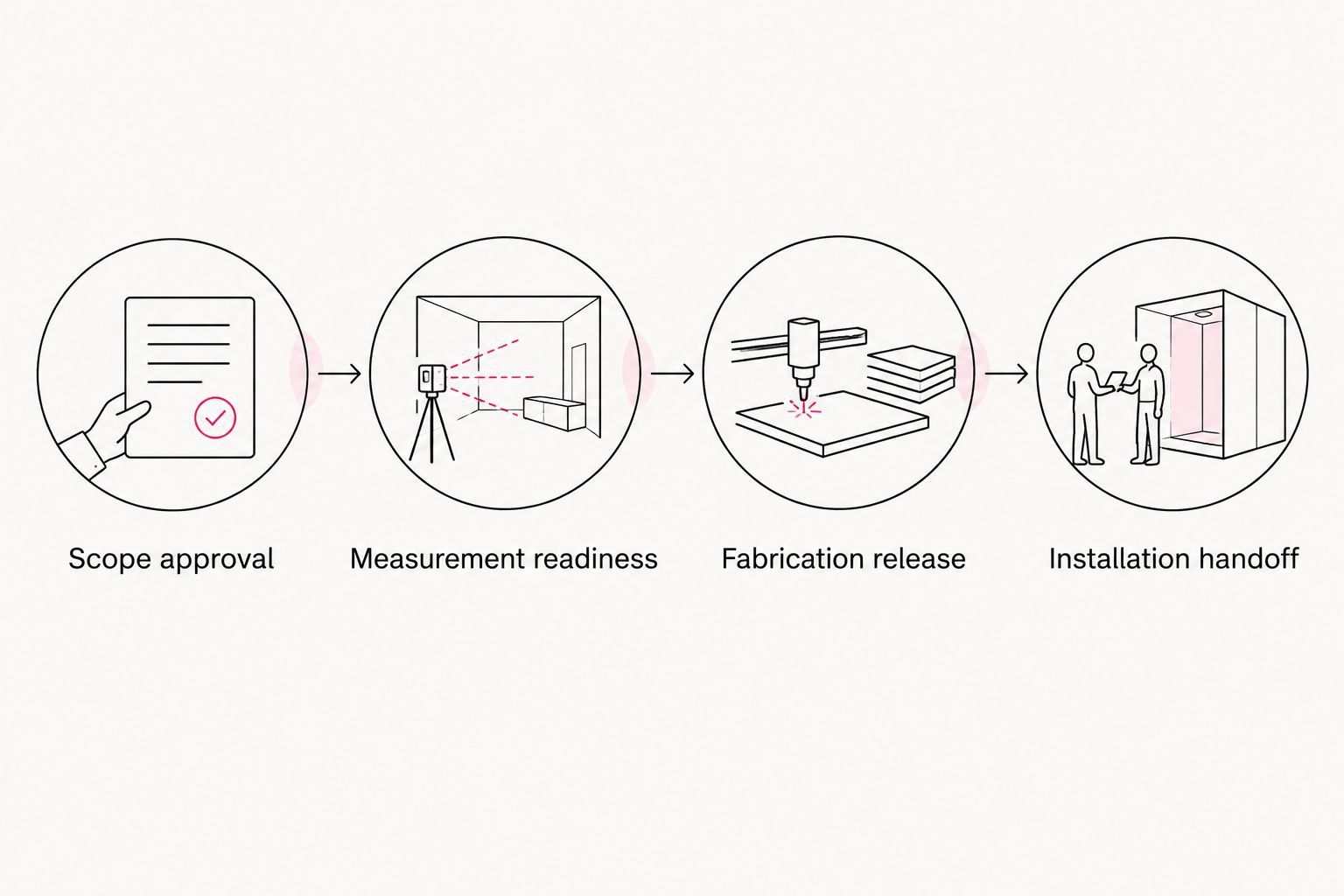
Fabrication release and trade calendar
Once measurement is complete, the next task is controlling changes. The stone layout should resolve how the pieces meet each other and the fireplace, not merely record the overall width and height.
- Approve the fabrication details. Review material suitability, piece layout, visible edges, joints, cutouts, hearth transitions, and the relationship to removable trim. Ask the fabricator to flag decisions that become difficult to change after cutting.
- Record the release. Mark the accepted drawing and material selection as the current approved version. Put a revision date on your 2026 plan, and withdraw superseded copies so another trade does not build from an earlier detail.
- Confirm dependencies before booking follow-on work. Ask the fabricator for the project-specific sequence between approval, fabrication, and installation. Coordinate flooring, mantel work, painting, and fireplace service around that sequence, including access and protection requirements.
Expected result: The fabrication team has a clear release, while adjacent trades know which dimensions are fixed and which tasks must wait.
Use 3 checkpoints before releasing fabrication: approved dimensions, approved assembly, and approved layout. These are decision gates, not a promise about how many days the work takes.
If an appliance, mantel, or floor detail changes after approval, stop and ask whether the drawing needs revision. Do not let a small-looking adjustment bypass the people responsible for the stone fit and fireplace requirements.
Installation handoff and return to use
Stone installation and permission to use the fireplace are separate milestones. Keep both visible on your 2026 schedule so an attractive finished surround does not get mistaken for a completed fireplace project.
- Prepare the installation area. Clear the agreed delivery route and work zone. Confirm who protects nearby finishes, who receives the stone, and which other trades must stay out while pieces are handled and installed.
- Inspect the completed interfaces. Have the responsible trades check stone placement, joints, support, access, and the relationship to the appliance and mantel against the approved documents. Resolve discrepancies before covering edges with trim or completing adjoining finishes.
- Obtain the return-to-use instructions. Follow the specified curing requirements for installation materials and complete required fireplace checks or inspections. Ask the responsible fireplace professional to confirm when operation can resume.
Expected result: The surround is installed, remaining finishing tasks are assigned, and you have an explicit basis for returning the fireplace to service.
For more detail on the stone installation stage, read how to install a marble fireplace surround. Use that guide alongside the requirements for your actual fireplace and selected assembly, not as a replacement for them.
Plan your custom fireplace stone work
Discuss your surround design and installation scope with Soaresstone.
Alternate workflow: keep the existing fireplace
A surround-only renovation has a different starting point from an appliance replacement. Keeping the fireplace does not remove the need to verify its condition, required clearances, or service access. It changes which decisions must be reopened.
| Workflow | Best for | Advantage | Limitation | Measurement gate |
|---|---|---|---|---|
| Retain the existing fireplace | Homeowners changing the decorative surround without changing the fireplace configuration | Keeps the scope focused on the existing assembly | Existing conditions and access still need verification | Confirm the retained opening, support, hearth, and trim details |
| Replace or reposition the appliance | Homeowners whose renovation includes a different fireplace configuration | Allows the surround to follow the approved new design | Appliance and related work must be coordinated before dimensions are fixed | Confirm the new configuration and all dimension-setting work |
For a retained fireplace, have the responsible professional assess the existing installation first. Then remove the old decorative work as agreed, repair the exposed area, and establish measurement readiness.
For a replacement, resolve the new appliance requirements before finalizing the surround layout. Ask the fireplace installer and fabricator to agree on the measurement stage; do not assume that delivery alone makes the appliance ready for stone work.
For either workflow, Soaresstone's custom stone fireplace work depends on an agreed design and site conditions. Custom fabrication addresses a particular layout; it also means later dimensional changes need review rather than an on-site assumption that every piece can be adjusted.
Troubleshooting schedule conflicts
The fireplace model changes after measurement
Pause fabrication release and submit the new model documents. Have the fireplace professional and fabricator compare the opening, trim, clearances, and access requirements. Resume only after they confirm whether the measured layout remains valid.
Demolition exposes damaged or uneven construction
Resolve the underlying condition before final measurement. Ask the appropriate contractor to define the repair and the fabricator to confirm acceptable support and backing. Do not ask stone adhesive to compensate for an unresolved construction problem.
Flooring or the mantel is still undecided
Identify the exact interface that remains open. A finish selection can remain undecided only if it does not change an approved dimension or requirement. If hearth height, stone termination, or mantel clearance changes, settle that detail before release.
Stone installation is complete, but the fireplace cannot be used
Keep the fireplace off until the remaining requirements are satisfied. Check the installation-material instructions and ask the fireplace professional which inspections, adjustments, or commissioning tasks remain. Do not substitute a generic waiting period for those instructions.
Customize your workflow
If the fireplace renovation shares a room with flooring, built-ins, or a kitchen remodel, use one calendar but separate approval gates. A cabinet delivery does not establish fireplace readiness, and a finished surround does not establish countertop readiness.
Add a short change record to the project documents: what changed, who reviewed it, and which appointment it affects. This gives you a concrete reason to move a date instead of asking every trade to hold an uncertain slot.
For your 2026 handover, keep the approved stone drawing, fireplace documents, care instructions, and return-to-use directions together. Ask Soaresstone for guidance specific to the installed stone rather than applying an unrelated surface-care routine.
FAQ
When should stone be measured during a fireplace renovation?
Measure when the opening, support, backing, and relevant finished elevations are established to the fabricator’s requirements. Resolve appliance, hearth, mantel, and trim details that affect the stone before releasing fabrication.
Should the fireplace appliance be installed before the stone surround?
The appliance position and installation requirements must be confirmed before the stone dimensions are finalized. The fireplace installer and fabricator should agree on what must be physically installed at measurement and how trim will be fitted afterward.
How long does a stone fireplace surround renovation take?
The schedule depends on the approved scope, site preparation, fabrication sequence, and required checks. Get project-specific dates after the trades confirm readiness rather than applying a generic duration.
Can I replace the surround without replacing the fireplace?
Yes, a surround-only renovation can retain the existing fireplace when the proposed work is appropriate for the existing assembly. Have its condition, clearances, support, and service access verified before approving the new stone.
Can stone fabrication start before demolition is finished?
Release fabrication only when the fabricator accepts the dimensions and documented site conditions. Demolition can expose conditions that change the opening or support, so preliminary measurements are not automatically suitable for cutting.
When can I light the fireplace after the stone is installed?
Use the fireplace only after the specified installation-material curing requirements and required fireplace checks are complete. Obtain return-to-use guidance from the responsible fireplace professional rather than relying on appearance or elapsed time alone.
One last thing
Ask how the fireplace will be serviced before approving how the surround will look. A removable trim panel needs a removal path, not just a neat border. Mark that access on the drawing while changes are still design decisions rather than installed-stone problems.
Related guides
- How to plan a countertop template appointment
- How to connect a contractor's schedule to countertop lead times
- How to maintain a granite fireplace surround