
Yes, granite is worth it for countertops in 2026 if you want natural stone, strong resistance to everyday wear, and a pattern that is not manufactured. The trade-off is that granite is not maintenance-free: you need to manage spills, follow slab-specific sealing guidance, and plan carefully around seams and unsupported edges.
- Is granite worth it in 2026? Yes for natural variation and everyday durability, provided you accept stone-specific care.
- Granite suits homeowners who want natural stone; quartz suits homeowners who prioritize avoiding routine sealing.
- Choose the actual slab, not just a small sample, before approving your countertop layout.
- Soaresstone provides custom countertop fabrication and installation for New England homeowners.
Why this matters
A countertop decision affects how you cook, clean, and coordinate the rest of your kitchen. Granite's value depends on whether you like the actual slab and accept its care requirements—not whether someone calls natural stone fashionable or outdated.
Soaresstone is best for New England homeowners seeking custom stone countertop fabrication and installation. For your project, the useful next step is to compare materials against your household's habits, then review the layout before fabrication.
Is granite still worth it for countertops in 2026?
Granite remains a practical choice in 2026, but it does not win every comparison. Its natural variation and resistance to everyday wear are strengths; sealing needs, slab variation, and vulnerable edges are the compromises.
Use this comparison to identify the material that fits your priorities. These are material-level distinctions, not guarantees about every slab or finished installation.
| Material | Best for | Main advantage | Main drawback |
|---|---|---|---|
| Granite | Homeowners who want durable natural stone | Natural mineral patterns and good resistance to everyday wear | Absorption varies; sealing and careful spill cleanup remain relevant |
| Engineered quartz | Homeowners who want to avoid routine sealing | Nonporous surface that does not require routine sealing | Resin-containing surfaces need protection from hot cookware |
| Marble | Homeowners who value marble's appearance and accept patina | Distinctive veining and a traditional natural-stone appearance | Acids can etch the surface; scratches and wear become visible |
| Quartzite | Homeowners who want hard natural stone with flowing patterns | Hard natural-stone surface with distinctive variation | Sealing requirements vary, and fabrication details matter |
Granite is not automatically better than quartz because it is natural. Quartz is not automatically better because it avoids sealing. Choose the maintenance trade-off you can live with, rather than expecting either material to be indestructible.
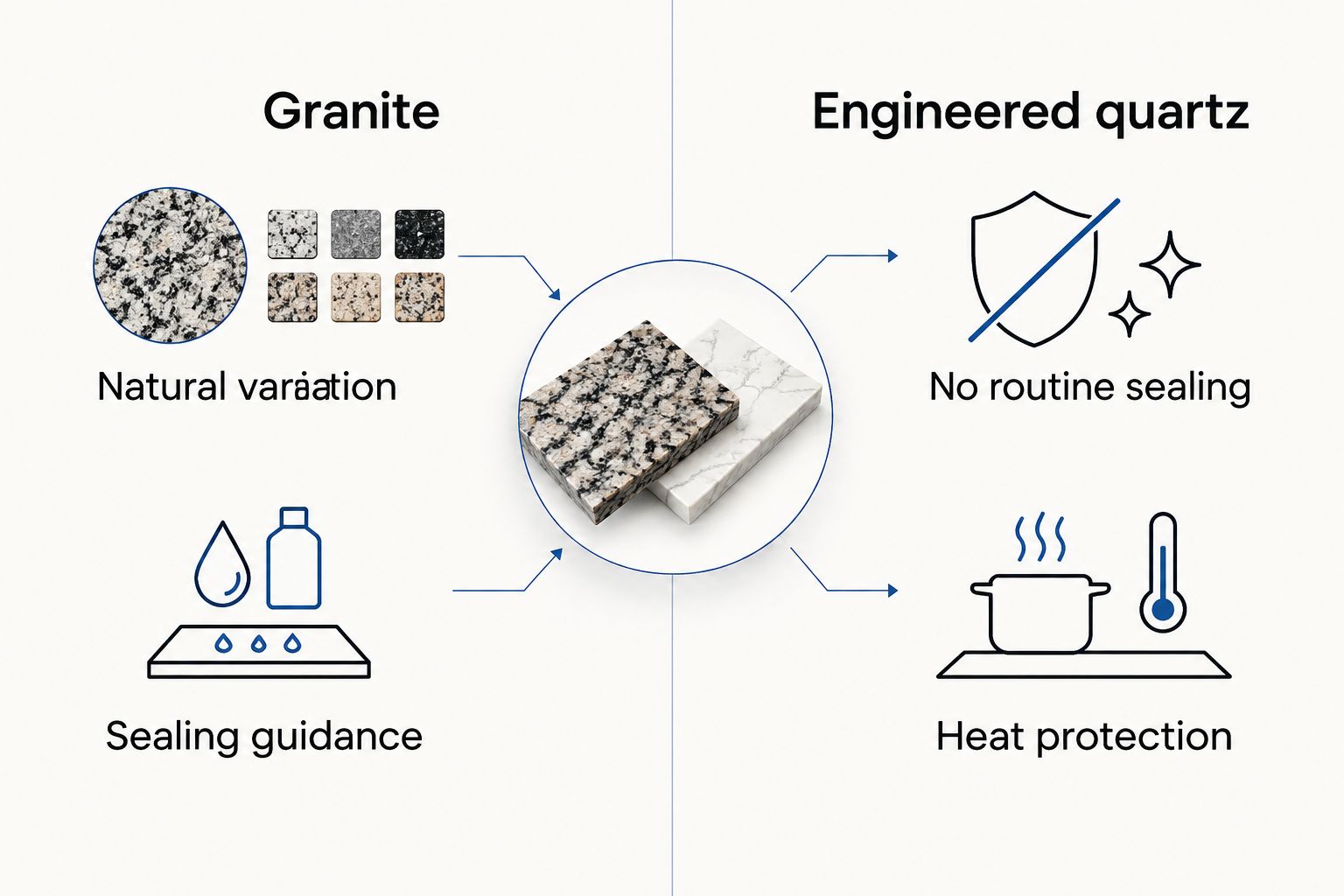
When granite is the right choice
Granite: best for natural variation
Choose granite when you want a surface with mineral movement, speckling, or color changes that come from the stone itself. View the whole slab because a small sample cannot show every shift across an island or long countertop run.
The same variation creates a limitation. Adjacent pieces will not necessarily look identical, and a seam can interrupt a prominent pattern. Ask to see how the proposed pieces relate before approving the layout.
Recommendation: choose granite when you like the slab's variation, not merely the idea of owning natural stone.
Engineered quartz: best for avoiding routine sealing
Choose engineered quartz when routine sealing is a task you do not want. Its nonporous surface simplifies that part of countertop care, although you still need to clean spills and follow the manufacturer's instructions.
The trade-off is heat management. Use trivets rather than placing hot cookware directly on the surface, and check the selected product's care guidance before using cleaners.
Recommendation: choose engineered quartz when avoiding sealing matters more than having a naturally formed slab.
Marble: best for homeowners who accept visible aging
Choose marble because you want marble's appearance and understand that use will leave marks. Acidic ingredients can dull the finish through etching, which is different from a stain.
Sealer does not prevent that chemical reaction. If a visible mark would frustrate you every time you cleaned the kitchen, marble is a poor match regardless of how much you like the sample.
Recommendation: choose marble only when its appearance outweighs your need for an unchanged finish.
Quartzite: best for a hard natural-stone surface
Choose quartzite when you want natural stone and the particular slab has the appearance you prefer. Confirm the material identification, finish, and care instructions rather than relying on a display name alone.
Quartzite does not remove the need for careful planning. Absorption, edge details, cutouts, and support still deserve a discussion with the fabricator.
Recommendation: choose quartzite for the verified slab and its characteristics, not because the name sounds similar to quartz.
Why granite's value varies
Granite's value in your kitchen depends on the finished project, not just the material label. These factors explain why two granite installations can deliver very different results:
- Slab selection: Color, movement, and natural features determine whether you enjoy the surface across the entire room.
- Layout: Corners, sink openings, and long runs affect where pieces join and how patterns meet.
- Edge profile: Exposed edges influence appearance and need protection from hard impacts.
- Thickness and support: Cabinet conditions, overhangs, and the selected stone determine the support plan.
- Finish: Polished and textured surfaces show light, marks, and residue differently.
- Care expectations: Spill habits and willingness to follow sealing guidance affect how well granite fits your household.
Do not judge a proposal by the stone name alone. Ask what the fabrication and installation include, which decisions remain open, and who is responsible for plumbing or other associated work.
For a 2026 remodel, write those details into the project scope before approving fabrication. A clear scope makes competing proposals easier to compare without assuming that every installer includes the same work.
How to decide before approving granite
Inspect the slab
Look at the actual slab under good lighting. Review the areas intended for the island, perimeter counters, and any backsplash pieces included in your project.
Identify features you want to keep and features you want to avoid. Photographs help document preferences, but they do not replace reviewing the material itself.
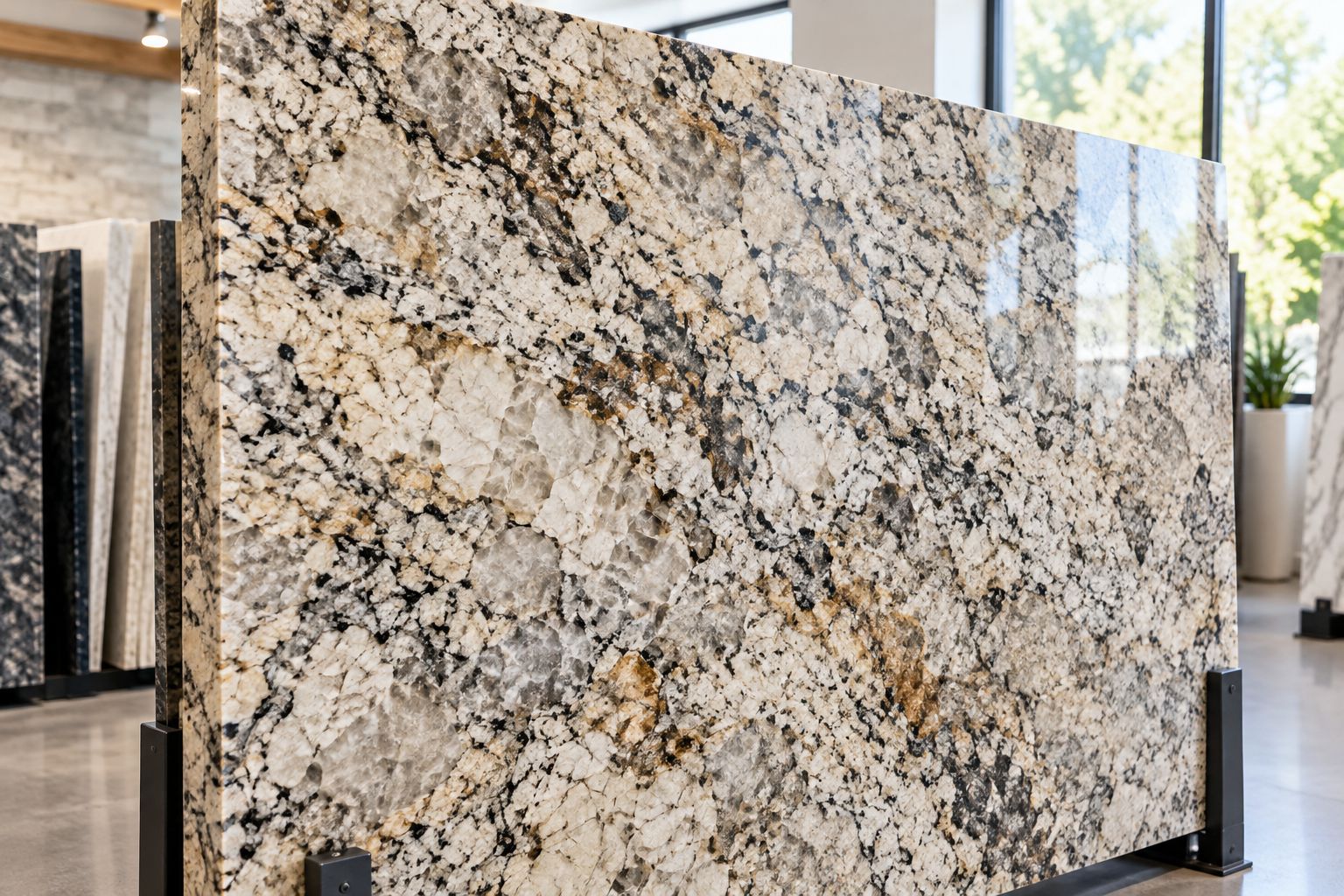
Confirm the layout
Ask where seams will fall and how the pattern will run through the room. A seam is a joint, not a defect, but its placement affects the finished appearance.
Review the sink, cooktop, and faucet openings before fabrication. Final product specifications matter more than a rough sketch or an appliance category name.
Resolve thickness and support
If you are comparing 2 cm and 3 cm stone, discuss the complete assembly rather than treating thickness as a stand-alone quality score. These correspond to 20 mm and 30 mm, respectively; neither measurement alone tells you whether an overhang is properly supported.
Ask how the proposed thickness works with your cabinets, edge treatment, seating area, and sink opening. Do not approve an unsupported span based on appearance alone.
Agree on care
Ask whether the selected slab needs sealing, which products are appropriate, and how to recognize when care is needed. Avoid adopting a universal sealing calendar without checking the stone and sealer instructions.
Keep those instructions with your project records. The guide to how to care for granite countertops provides a useful next step for organizing everyday maintenance.
Confirm the project scope
Before authorizing fabrication, ask Soaresstone to confirm your selected material, layout, edge, cutouts, and installation scope. Custom countertop work involves decisions that a material sample cannot settle.
Keep a written record of approved details. That is especially useful when your remodel also involves cabinet, appliance, plumbing, or backsplash work.
Discuss your granite countertop project
Review your kitchen plans and ask about custom countertop fabrication and installation.
Is granite better than quartz for a busy kitchen?
Granite is better for a busy kitchen when natural stone is your priority and you accept its care requirements. Engineered quartz is the stronger fit when avoiding routine sealing is the deciding factor.
Both need sensible use. Keep cutting boards and trivets nearby, clean spills promptly, and protect edges from heavy impacts instead of treating either surface as damage-proof.
For your 2026 kitchen plan, describe what actually happens at the counter: baking, coffee preparation, quick family meals, or frequent entertaining. Those habits give you a better selection framework than a generic durability ranking.
Is granite outdated in 2026?
Granite is not inherently outdated in 2026; the slab, cabinets, backsplash, and lighting determine the overall appearance. A particular color combination can feel dated to you without making the material itself unsuitable.
Compare samples together rather than selecting each finish separately. If the granite has strong movement, test it beside the cabinet and backsplash choices so competing patterns do not become an expensive surprise after installation.
Should you keep existing granite instead of replacing it?
Keep existing granite when you like the stone, the layout works, and a professional assessment finds no condition that requires replacement. Replacing a functional countertop solely because it is granite does not solve a specific kitchen problem.
Investigate cracks, movement, damaged edges, or problems around openings before deciding. A fabricator can assess whether repair, adjustment, or replacement fits the actual condition; a photograph alone does not establish structural soundness.
FAQ
Is granite worth it if I cook every day?
Granite is worth considering for daily cooking when you want natural stone and accept its care requirements. Use cutting boards and trivets, clean spills promptly, and follow guidance for the selected slab.
Does every granite countertop need sealing every year?
No, every granite countertop does not need the same annual sealing schedule. Absorption, the existing treatment, use, and sealer instructions determine the appropriate care.
Can I put a hot pan directly on granite?
Use a trivet rather than putting a hot pan directly on granite. Heat resistance does not make stone immune to thermal stress or protect every treatment applied to the surface.
Will granite increase my home’s resale value?
Granite does not guarantee a resale return. Choose it for your kitchen’s function and appearance rather than assuming the installation will produce a specific financial gain.
Is granite harder to maintain than quartz?
Granite adds a sealing consideration that engineered quartz does not have. Both surfaces still require appropriate cleaning, spill management, and protection from misuse.
Can granite countertops chip or crack?
Yes, granite countertops can chip or crack despite their hardness. Impacts, vulnerable edges, inadequate support, and stress around openings deserve attention during planning and use.
Should I choose granite from a small sample?
Do not approve granite solely from a small sample. Review the actual slab and proposed layout because natural patterns and color can change across the surface.
One last thing
Before replacing granite you already own, test the surrounding design choices first. Put your proposed cabinet and backsplash samples beside the stone, then review them under your kitchen lighting.
That simple comparison separates disliking the granite from disliking its surroundings. If you are choosing new countertops, bring those same samples into your discussion with Soaresstone so the stone selection serves the whole room.
Related guides
- How to choose between granite and quartz for a kitchen remodel
- How to match countertops with cabinets
- How to choose a countertop fabricator