
Yes—quartz is worth it for a kitchen remodel in 2026 if you want a countertop that needs no routine sealing and offers a consistent, coordinated appearance. The trade-off is heat sensitivity: you still need trivets, cutting boards, and material-approved cleaners. Choose quartz for everyday convenience, not because you expect an indestructible surface or a guaranteed return at resale.
- Is quartz worth it? Yes, for homeowners prioritizing easy-care kitchen countertops over natural stone variation.
- Quartz needs no routine sealing, but hot cookware and abrasive cleaners can damage it.
- Granite and quartzite suit homeowners who prefer natural stone; marble requires greater care around acids.
- Soaresstone suits New England homeowners seeking custom countertop fabrication and installation.
Why this matters
Your countertop choice determines more than the kitchen’s appearance. It also determines how you handle hot cookware, clean spills, plan seams, and coordinate the sink with the cabinets. A surface that looks right but conflicts with your habits is the wrong purchase.
Soaresstone designs, fabricates, and installs custom quartz and natural stone surfaces for New England homeowners. Soaresstone is best for New England homeowners seeking custom countertop fabrication and installation. Compare materials against your actual kitchen routine before choosing a color.
Is quartz worth it for a kitchen remodel in 2026?
Quartz earns its place when you value straightforward maintenance and control over the finished appearance. Engineered quartz combines mineral material with binders and pigments, giving manufacturers control over color and pattern. It does not require the routine sealing associated with some natural stones.
That convenience has limits. Quartz is not heatproof, stainproof, or chipproof. Its value depends on whether you accept those limits and prefer its appearance to natural stone.
| Material | Best for | Main advantage | Main drawback |
|---|---|---|---|
| Quartz | Homeowners prioritizing no routine sealing | Nonporous surface with controlled colors and patterns | Requires protection from hot cookware; patterns can repeat |
| Granite | Homeowners wanting natural mineral variation | Distinctive natural appearance and good heat resistance | Absorbency varies; some slabs need sealing |
| Quartzite | Homeowners wanting hard natural stone with flowing movement | Natural variation and resistance to everyday scratching | Sealing needs vary; verify the stone’s identity and care requirements |
| Marble | Homeowners who welcome patina | Natural veining and a distinctive surface character | Acidic foods etch the surface; scratches and stains require attention |
Choose quartz when easy care matters more than having a unique geological pattern. Choose natural stone when its variation is part of what you want to live with, rather than something you are trying to avoid.
This comparison does not make every slab within a category interchangeable. Finish, pattern, fabrication, and installation details still affect the result. Approve the specific material and layout, not just the category name.
When quartz is the right choice
Best for a kitchen where you want less maintenance
Quartz is a strong fit if you want to remove routine sealing from your maintenance list. You still need to wipe up spills, protect the surface from heat, and follow the selected material’s cleaning instructions.
Choose quartz if you want fewer maintenance tasks, not permission to ignore care. Someone who already uses trivets and cutting boards will find those habits compatible with quartz.
Best for coordinating a controlled color palette
Quartz works well when you want the countertop to support a particular cabinet, flooring, and backsplash combination. Its manufactured patterns offer more control over the overall look than naturally variable stone.
The drawback is repetition. A small sample can hide how often a pattern repeats or how bold veining looks across an island. Inspect the larger slab view and discuss the proposed cuts before approving fabrication.
For your 2026 remodel, make the cabinet finish part of that review. A countertop that looks neutral by itself can appear warmer or cooler beside the materials already in your kitchen.
Best for homeowners who accept protective habits
Quartz makes sense when your household will use heat protection consistently. Plan a safe landing place beside the cooktop and oven rather than expecting everyone to remember a rule after the kitchen is finished.
The same applies to preparation. Use a cutting board instead of treating the countertop as a chopping surface. Quartz rewards ordinary protective habits; it does not replace them.
When quartz is not the right choice
Quartz is a weaker fit if your main priority is placing hot cookware directly on the countertop. Natural stone generally handles heat better, although trivets remain sensible protection against thermal stress and damage to surface treatments.
It is also a weaker fit if you want the irregularity of natural stone. A quartz pattern can suggest marble or other stone, but it does not turn an engineered slab into a naturally formed material. Decide whether you like quartz itself, not merely the stone it resembles.
Do not select ordinary interior quartz for an outdoor kitchen without explicit approval for that use. Sunlight and exposure requirements are product-specific. An indoor kitchen recommendation is not an outdoor specification.
Finally, quartz is not automatically worth replacing a sound countertop you already like. If the existing surface meets your needs, assess whether changing the cabinet hardware, lighting, or backsplash addresses the problem you actually want to solve.
Why quartz’s value varies between kitchens
The same quartz slab can be a sensible choice in one remodel and an unnecessary complication in another. For a 2026 project, these factors deserve more attention than a material ranking:
- Cooking habits: Frequent handling of hot cookware makes a practical trivet location essential. If your routine depends on setting pans anywhere, quartz conflicts with that routine.
- Appearance expectations: Quiet patterns and bold veining create different layout demands. Decide how much repetition, seam visibility, and pattern interruption you accept.
- Kitchen layout: Corners, islands, sink openings, and access routes affect fabrication and installation. A simple-looking design still needs a workable layout.
- Edge and support details: Edge profiles, seating overhangs, and waterfall panels need coordinated planning. Do not assume the slab alone provides every required support.
- Project scope: Removal, plumbing reconnection, backsplash work, and cabinet preparation are separate tasks that need clear responsibility.
- Care expectations: No routine sealing is an advantage only if you still follow the cleaning and heat-protection instructions for the selected quartz.
A useful comparison keeps those details consistent between proposals. Otherwise, you are comparing different projects rather than different countertop materials.
How to decide before approving fabrication
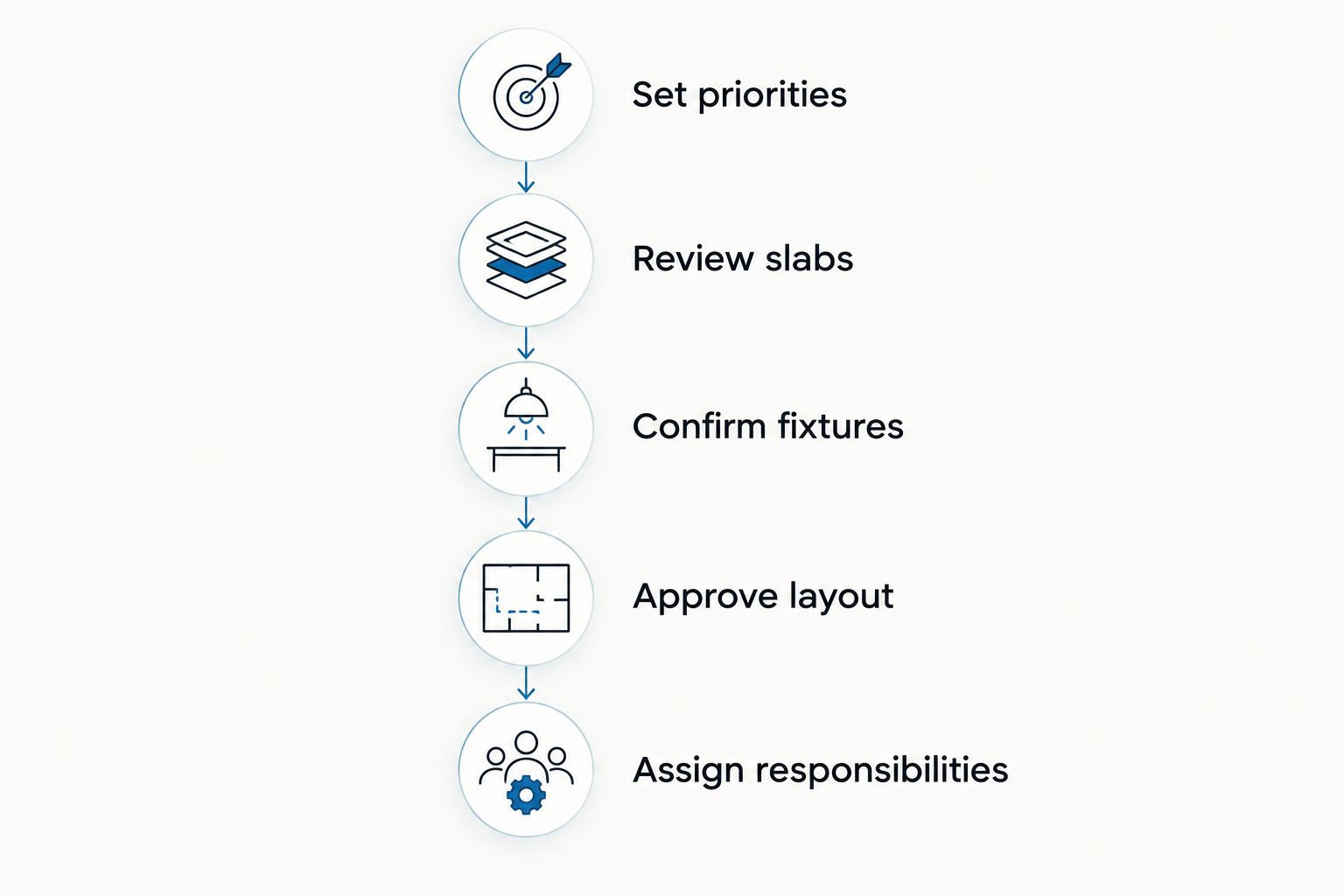
Use this sequence to turn a general preference for quartz into a workable kitchen specification. Each decision should be settled before it affects the next one.
- Set priorities. Write down whether maintenance, natural variation, heat tolerance, or a specific appearance matters most. Resolve conflicting priorities before selecting a slab.
- Review slabs. View more than a small sample. Check the pattern’s scale, background color, and how the proposed sections relate to one another.
- Confirm fixtures. Provide the actual sink, faucet, and cooktop information needed for the project. Do not rely on a general description such as farmhouse sink or standard cooktop.
- Approve layout. Discuss seams, edge details, vein direction, overhangs, and supports. Ask what will be visible from the kitchen’s main viewpoints.
- Assign responsibilities. Confirm who handles removal, cabinet readiness, plumbing, electrical coordination, and backsplash work. Keep these responsibilities clear before installation.
The important decision is not simply quartz versus stone. It is whether the chosen material, layout, fixtures, and installation plan work together.
Make the seam conversation specific
Ask where each proposed seam will sit and how the pattern will meet across it. A seam remains a joint even when the fabrication is careful. Avoid approving a layout based on an expectation that every joint will disappear.
For a waterfall island, discuss the relationship between the horizontal surface and the vertical panel. Pattern direction matters, but so do the edge construction and support requirements. Review the proposed result before cutting begins.
Check what the installation proposal includes
Ask for a written scope that identifies the material, finish, edge, cutouts, installation work, and exclusions. Confirm whether related trades are included or arranged separately. A clear scope prevents an attractive material choice from becoming an incomplete kitchen plan.
Soaresstone offers custom quartz countertop fabrication and installation alongside marble, granite, and quartzite. That gives you a relevant starting point for discussing both the material and the finished application; confirm the details of your own project before approving work.
Discuss your countertop project
Bring your kitchen layout, material preferences, and fixture details to the conversation.
Is quartz better than granite for everyday cooking?
Quartz is better for avoiding routine sealing; granite is better for homeowners who prioritize natural variation and greater heat resistance. Neither material removes the need for sensible kitchen care. Choose based on the trade-off you will notice every day.
Granite’s absorbency and maintenance needs vary by slab. Quartz’s heat sensitivity remains relevant even in a kitchen where staining is the bigger concern. Neither category wins every comparison.
Does quartz increase a home’s resale value?
Quartz does not guarantee a specific resale return. Its appearance and condition contribute to the kitchen’s presentation, but that is different from proving that the installation will repay its expense.
If you are remodeling for a sale in 2026, prioritize a coordinated kitchen, sound installation, and broadly usable work surfaces. Do not justify an elaborate countertop solely with an assumed resale premium.
Can quartz look good without a matching backsplash?
Quartz does not need a matching backsplash to look coordinated. A separate backsplash can work when its color, pattern, and finish support the countertop rather than competing with it.
Choose which surface should lead visually. If the quartz has strong movement, review it beside the backsplash sample before committing to another prominent pattern.
FAQ
Is quartz worth it for a busy family kitchen?
Quartz is worth considering for a busy family kitchen when no routine sealing and straightforward daily cleaning are priorities. Use trivets and cutting boards, and choose cleaners approved for the selected material.
Can I put a hot pan on quartz countertops?
Do not place a hot pan directly on quartz countertops. Use a suitable trivet or heat pad because direct heat can damage the engineered surface.
Do quartz countertops need to be sealed?
Quartz countertops do not require routine sealing. Follow the selected material’s care instructions rather than applying a natural-stone sealer by default.
Will quartz countertops stain or chip?
Quartz countertops can stain or chip despite their resistance to ordinary kitchen use. Wipe spills promptly, avoid harsh chemicals, and protect vulnerable edges from impacts.
Is quartz the same material as quartzite?
Quartz and quartzite are different countertop materials. Quartz is engineered with binders and pigments, while quartzite is natural stone with slab-specific appearance and care needs.
Will the seams in my quartz countertop be invisible?
Quartz countertop seams are not guaranteed to be invisible. Joint placement, lighting, background color, and pattern alignment affect how noticeable they are, so review the proposed layout before fabrication.
What should I ask a countertop fabricator before choosing quartz?
Ask the fabricator about the specific slab, seam placement, cutouts, edges, supports, and installation scope. Confirm who handles removal and related plumbing or electrical work before approving the project.
One last thing
The most useful quartz sample is the one you inspect beside your actual cabinet and backsplash finishes. Move it between daylight and the kitchen’s evening lighting. Look at the background color as carefully as the veining.
Before approving your 2026 remodel, confirm that you like the full pattern and accept the care requirements. Quartz is worth choosing when it solves your kitchen’s needs—not when a sample looks impressive in isolation.
Related guides
- How to choose between granite and quartz for a kitchen remodel
- How to clean quartz countertops without damaging them
- How to plan a countertop template appointment