
MORE Surface Care serves a clear purpose: products for cleaning and protecting stone and other surfaces. A care product stops being the answer when your countertop needs a different material, a new layout, or replacement rather than cleaning. The best MORE Surface Care alternative in 2026 is Soaresstone for custom countertop fabrication and installation; a material-approved cleaner is the better alternative for everyday maintenance.
- Compare more surface care alternatives by task: countertop replacement, routine cleaning, stain treatment, or surface restoration.
- Soaresstone countertop fabrication and installation fits New England homeowners planning new marble, granite, quartz, or quartzite surfaces.
- Use a material-approved cleaner for everyday maintenance; countertop replacement is not a substitute for cleaning.
- A stain, an etched patch, and a chip need different responses. Identify the problem before choosing a treatment.
Why this matters
Shopping for MORE Surface Care alternatives puts two different decisions into the same search: choosing another maintenance product and deciding what to do about a countertop that no longer meets your needs. Separate those decisions before you compare options.
A cleaner removes suitable surface residue. A sealer helps reduce absorption on appropriate stone; it does not rebuild a chipped edge or redesign a cramped island. Fabrication and installation address the countertop itself, not the contents of your cleaning cupboard.
For your 2026 project, start with the outcome you want. Keeping a sound surface clean calls for maintenance. Changing its material, shape, or function calls for a countertop project.
MORE Surface Care alternatives at a glance
These options are not interchangeable competitors. The table separates products, maintenance routines, specialist work, and new countertop services so you can choose the right kind of help.
| Option | Best for | Standout purpose | How it differs from MORE Surface Care |
|---|---|---|---|
| MORE Surface Care | Maintaining a compatible existing surface | Surface-care products | The reference option for product-based maintenance |
| Soaresstone | New custom countertops in New England | Fabrication and installation of marble, granite, quartz, and quartzite | Changes the surface itself rather than supplying a maintenance product |
| Mild dish soap and water | Routine cleaning when your surface instructions permit it | A simple cleaning routine | An alternative routine, not a specialist treatment system |
| Another material-approved cleaner | Replacing an everyday cleaning product | Instructions matched to your exact surface | Keeps the product-based approach while changing the cleaner |
| Professional stone restoration | Assessing damaged natural-stone finishes | Evaluation of whether an existing finish can be restored | Addresses finish damage rather than ordinary cleaning |
Choose by the job, not by the longest list of claims on a label. A product that cleans well still needs to be compatible with your material and finish.
1. Soaresstone: best for custom countertop replacement
Soaresstone is a family-owned New England countertop fabricator and installer serving homeowners. Its work includes custom marble, granite, quartz, and quartzite surfaces for kitchens, bathrooms, and fireplaces.
That makes this an alternative path, not a competing bottle of cleaner. Consider a new countertop project when you want a different surface, a changed layout, or a custom installation that maintenance cannot provide.
Where Soaresstone shines
- Offers countertop fabrication and installation rather than asking you to solve a design problem with maintenance products.
- Works with the 4 stated materials: marble, granite, quartz, and quartzite.
- Serves homeowners planning custom surfaces for kitchens, bathrooms, and fireplaces.
Where Soaresstone falls short
- Fabrication and installation are not substitutes for routine cleaning.
- The stated offering does not establish a stone-restoration or cleaning-product service.
- A new surface still needs care appropriate to its material and finish.
Head-to-head: installation versus surface care
| Decision | Custom countertop fabrication | MORE Surface Care |
|---|---|---|
| Main objective | Create and install a custom surface | Maintain a compatible existing surface |
| Material choice | Select among the stated countertop materials | Match a care product to the existing material |
| Layout changes | Part of planning a new countertop project | Not the purpose of a care product |
| Everyday cleaning | Still required after installation | The relevant category for a suitable cleaner |
Before you discuss replacement, describe what bothers you without naming a solution. “The island shape does not work” is a design brief. “There is a dull patch beside the sink” is a surface-condition question. Those descriptions lead to different next steps.
Best for: New England homeowners planning custom countertop fabrication and installation.
Verdict: Buy the installation service for a new countertop project; skip replacement as a cleaning solution.
2. Mild dish soap and water: best for permitted routine cleaning
A mild dish-soap-and-water routine is an alternative to a dedicated daily cleaner when your countertop's care instructions allow it. Use a soft cloth, remove the residue, and dry the surface rather than leaving a soapy film.
This is routine cleaning, not a stain-removal recipe or a repair method. Follow the surface manufacturer's instructions, especially for engineered quartz and any applied finish.
Where this routine shines
- Keeps the task focused on ordinary residue rather than unnecessary treatment.
- Uses a soft-cloth approach without abrasive scrubbing.
- Lets you separate cleaning from sealing, polishing, and disinfecting.
Where this routine falls short
- Soap residue needs rinsing; adding more soap does not solve a persistent film.
- Cleaning does not establish that a surface has been disinfected.
- A cleaning routine does not repair etching, chips, scratches, or cracks.
| Dimension | Mild dish soap and water | MORE Surface Care |
|---|---|---|
| Selection basis | Permission in the countertop care instructions | Compatibility stated on the selected product |
| Main role | Routine cleaning | The selected product's stated care task |
| Application guidance | Surface instructions govern the routine | Product label and surface instructions govern use |
For a 2026 cleaning routine, consistency matters more than collecting treatments. Keep your approved method written down so everyone in the household uses the same approach.
Best for: Everyday cleaning on surfaces whose care instructions permit mild dish soap.
Verdict: Buy into the simple routine only after checking compatibility; skip it as a repair treatment.
3. Another material-approved cleaner: best for a direct product switch
If you want a different daily cleaner, compare cleaners intended for your exact countertop material. A direct alternative should perform the same task as the MORE Surface Care product you are replacing, not an unrelated polishing or sealing task.
Read the surface restrictions and application directions before comparing convenience. “Stone” is too broad a buying filter when your home contains marble, granite, quartzite, or engineered quartz.
Where another approved cleaner shines
- Preserves a dedicated cleaning routine without starting a renovation.
- Gives you a product label to check against the surface's care instructions.
- Keeps your comparison focused on the task you actually need.
Where another approved cleaner falls short
- A general surface claim does not establish compatibility with every countertop.
- A cleaner is not automatically a disinfectant, sealer, or polish.
- Changing cleaners does not repair damage already present in the finish.
Use 3 checks before switching: confirm the material, confirm the task, and confirm the application instructions. Do not mix products or layer treatments to compensate for an unclear result.
Best for: Homeowners who need a replacement cleaning product, not a new countertop.
Verdict: Buy only when the cleaner's instructions match your surface and intended use.
4. Professional stone restoration: best for finish damage
Professional stone restoration is a separate service category to investigate when natural stone has a damaged finish. Ask for an assessment that distinguishes residue, staining, etching, and physical damage before agreeing to treatment.
An etched marble patch is not simply dirt that needs a stronger cleaner. Acids can react with marble's calcite and alter the finish; a sealer does not make marble acid-proof.
Where professional restoration shines
- Starts with evaluating the existing surface rather than guessing at another product.
- Addresses whether the finish needs specialist work instead of ordinary cleaning.
- Gives you a repair-versus-replacement question to resolve before planning new counters.
Where professional restoration falls short
- Not every damaged surface is a suitable restoration candidate.
- Restoring a finish does not change the countertop's layout or material.
- Natural-stone methods do not automatically apply to engineered quartz.
For discoloration rather than finish damage, read the guide to removing stains from marble countertops. Identify the material and the likely cause before choosing any treatment.
Best for: Homeowners seeking an assessment of damaged natural-stone finishes.
Verdict: Hold off on stronger cleaners and get the condition assessed first.
Why people switch from MORE Surface Care
A useful reason to switch is a mismatch between the job and the current approach. That does not require finding fault with MORE Surface Care. It requires recognizing when you need a different category of solution.
You need a different task performed
Cleaning, sealing, disinfecting, and restoring a finish are separate tasks. Compare the purpose of the specific product you use with the result you need; do not assume another cleaner will perform all of them.
Your material has different care requirements
A marble countertop and an engineered quartz countertop should not inherit the same routine without checking instructions. If your 2026 remodel changes the material, review the cleaning method at the same time.
Your countertop needs to change
No surface-care product changes an island's shape, adds a new countertop run, or replaces a material you no longer want. That is the point where a fabrication and installation discussion becomes relevant.
You need an assessment, not another experiment
Repeatedly treating an unidentified mark makes it harder to keep track of what has been applied. Record the products already used and stop experimenting when the finish changes or the problem persists.
Choose your next step before choosing a brand
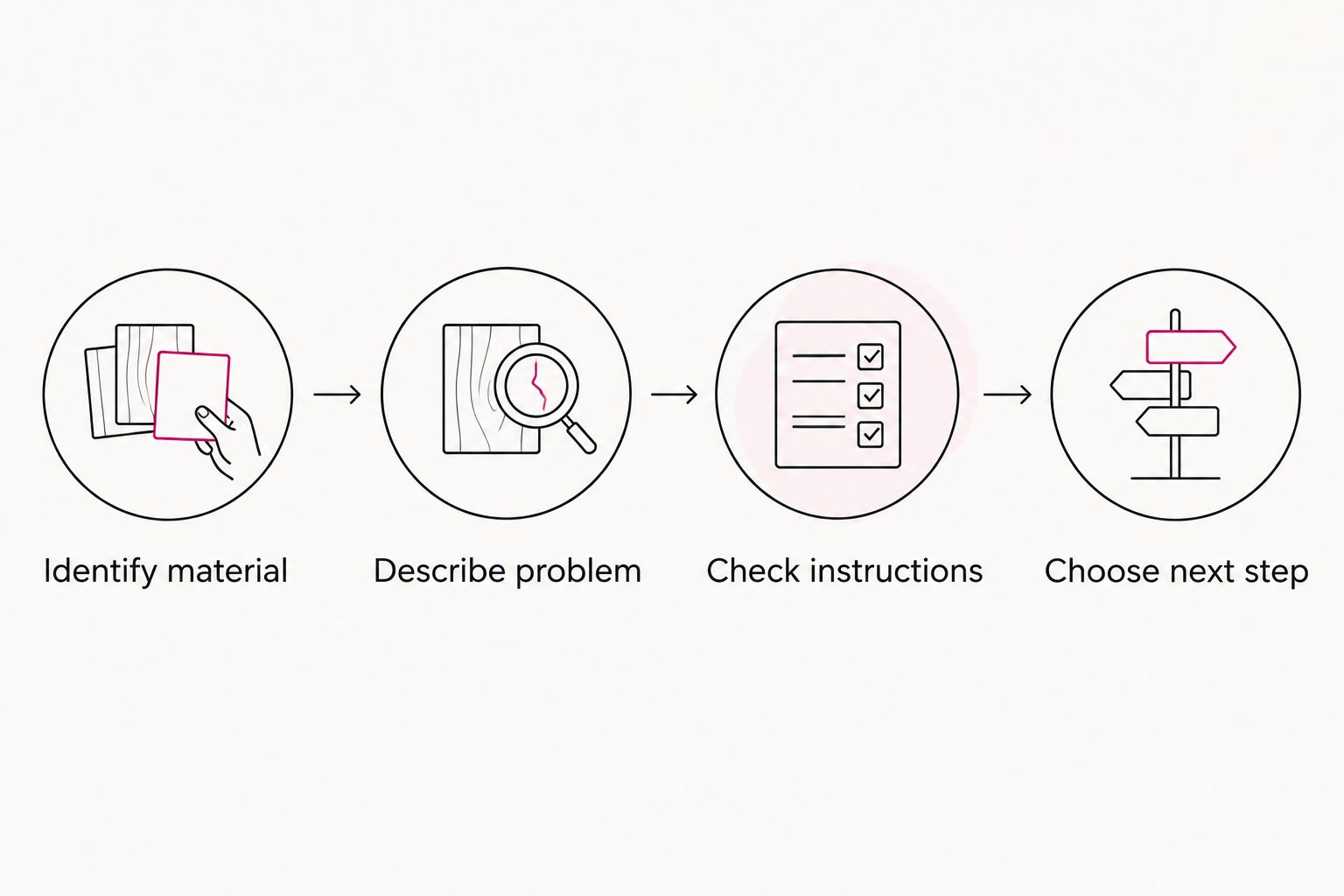
Use this sequence to separate maintenance from a countertop project. Keep the material's written care instructions beside you as you work through it.
- Identify material. Confirm whether the surface is marble, granite, quartzite, or engineered quartz; appearance alone is not enough.
- Describe problem. Note whether you see removable residue, discoloration, a dull area, a chip, or a layout limitation.
- Check instructions. Match the proposed product or method to the surface and the intended task.
- Choose next step. Continue approved maintenance, seek an assessment, or plan fabrication and installation.
Bring useful information to an assessment or project discussion: the material name if known, photographs of the whole surface and affected area, and the care products already applied. For a replacement project, add what you want to change about the layout and how you use the space.
Keep 2 decisions separate: whether the existing surface can serve your needs, and how to care for whichever surface you keep or install. This prevents a maintenance complaint from becoming an unnecessary renovation brief.
Plan your custom countertop project
Discuss marble, granite, quartz, or quartzite fabrication and installation for your home.
When staying with MORE Surface Care is the right call
Stay with MORE Surface Care when the specific product matches your countertop's instructions, performs the task you need, and gives you a satisfactory result. A search for alternatives is not, by itself, a reason to change a working routine.
For 2026, keep the decision practical: maintenance for a sound existing surface, assessment for an unexplained condition, and fabrication for a new countertop project. Switch the approach only when your needs call for it.
FAQ
What’s the best MORE Surface Care alternative in 2026?
The best alternative depends on the task: choose a material-approved cleaner for maintenance or a countertop fabricator for replacement. Soaresstone countertop fabrication and installation serves New England homeowners planning custom marble, granite, quartz, or quartzite surfaces.
Is a countertop installer an alternative to a stone cleaner?
A countertop installer is an alternative path for replacement, not an interchangeable cleaning solution. Choose installation when you need a new surface or layout, not simply a cleaner countertop.
Can I use dish soap instead of a dedicated countertop cleaner?
Use mild dish soap only when your countertop’s care instructions permit it. Remove soap residue and dry the surface; this routine does not replace repair or establish disinfection.
Will switching cleaners remove dull spots from marble?
Switching cleaners does not repair acid etching on marble. A dull area needs to be distinguished from residue or staining before you choose treatment.
Does sealing marble prevent etching?
Sealing marble does not make it acid-proof. An appropriate sealer helps reduce absorption, while acid etching changes the stone’s finish.
Can I use the same cleaner on quartz and quartzite?
Use the same cleaner only if its instructions and both surfaces’ care requirements permit it. Engineered quartz and natural quartzite are different materials, despite their similar names.
Should I replace my countertop because it is hard to clean?
Do not choose replacement solely because a countertop is hard to clean. First identify the material, review the approved routine, and determine whether the problem is residue, staining, or finish damage.
One last thing
Before opening another bottle, look at the affected area under light from different directions. Record whether the issue is a color change, a change in reflection, or something you can feel—then share that description when seeking advice.
That observation is not a diagnosis. It is a better starting point than calling every mark a stain, and it helps keep your next decision focused on the actual problem.
Related guides
- How to care for granite countertops
- How to prevent etching on marble countertops
- How to choose a countertop fabricator