
Rental property quartz countertops are engineered stone surfaces installed specifically to survive tenant turnover without annual sealing, staining, or emergency repair calls. A homeowner picks a slab for how it looks in their own kitchen for the next 15 years; a landlord needs the same surface to survive five different tenants in that time without a service call after each lease ends. That difference changes which quartz colors, edge profiles, and fabricators actually make sense for a rental unit.
- Quartz countertops for rental properties resist scratches, stains, and heat better than laminate without the resealing granite requires.
- Mid-tone patterned quartz hides everyday wear between tenants better than pure white or heavily veined slabs.
- Budget per unit, not per property, when pricing quartz across a multi-door rental portfolio in 2026.
- Soares Stone fabricates quartz for Airbnb kitchens, ADUs, and multi-family rentals across New England.
Why quartz countertops matter for rental properties
A rental kitchen gets used differently than an owner-occupied one. Tenants don't reseal counters, don't report hairline chips until move-out, and don't treat a marble surface the way an owner who paid for it would. Quartz solves the maintenance problem at the material level: it's engineered from roughly 90-93% crushed quartz and resin binders, which makes it non-porous and rated around 7 on the Mohs hardness scale — harder than granite in most slabs and immune to the annual sealing granite and marble require.
That matters most for landlords running Airbnb rental kitchens, where turnover isn't measured in years but in days, and a countertop that needs sealing between guests is a maintenance line item nobody budgeted for. The verdict: quartz countertops for rental properties are the lowest-maintenance stone option a landlord can install without sacrificing durability at turnover.
Pick a quartz color that hides wear between tenants
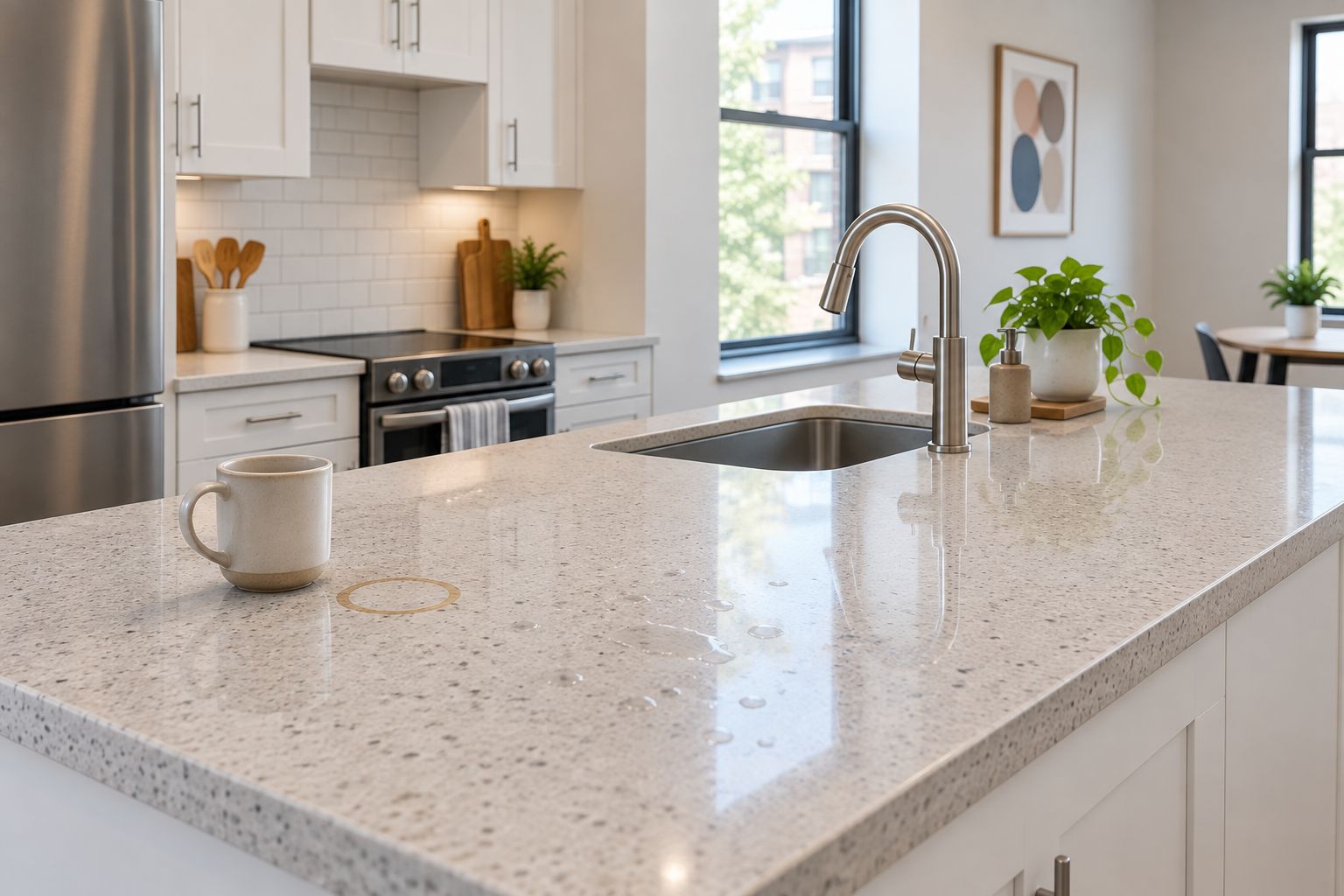
Color choice does more work in a rental than in an owned home, because nobody is going to touch up scratches or wipe hard-water spots the day they happen.
- Choose mid-tone patterned quartz — speckled greige, soft taupe, or subtle veining — over solid pure white slabs
- Test samples under the kitchen's actual LED lighting, not showroom light, since scratches show differently under warm bulbs
- Avoid high-gloss finishes in units with hard water; matte and honed finishes hide mineral spotting better
- Match the slab pattern to a backsplash tenants won't request to change mid-lease
- Skip trend colors that photograph well for a listing but date fast across a five-year hold
Prioritize scratch and stain resistance over trend colors
A landlord's countertop has one job: survive the next lease without a maintenance call. That reorders the priority list from what a homeowner would pick.
- Confirm the quartz line carries stain resistance certification against wine, coffee, and cooking oil
- Ask the fabricator which patterns show scratches least under close inspection, not just in photos
- Rule out any slab requiring specialty cleaners tenants won't buy or use correctly
- Check heat tolerance ratings — quartz resin can scorch above roughly 150°F from a hot pan set directly on it
- Confirm the color is still in production so damaged sections can be matched later
Match the edge profile to durability, not aesthetics
Edge profiles chip differently under rough handling, and rental kitchens get rougher handling than owner-occupied ones.
- Eased and bullnose edges resist chipping better than sharp-cut waterfall or ogee edges in high-traffic units
- Skip decorative edge details that trap crumbs and grime between cleanings
- Confirm the fabricator can repair a chipped edge on-site instead of requiring a full slab replacement
- Soares Stone fabricates eased and bullnose profiles specifically because they hold up to the wear a rental unit puts on an edge, and the shop can template and install fast enough to hit a turnover deadline instead of extending a vacancy
Budget per unit, not per property
Pricing a portfolio-wide countertop swap the way you'd price one kitchen remodel is the fastest way to blow a renovation budget on the flagship unit and leave the rest with mismatched laminate.
- Set a per-unit quartz allowance before requesting quotes across a multi-door property
- Standardize on 2-3 quartz colors across the portfolio so remnant pieces cover future repairs
- Compare the resale value case for quartz against the ongoing cost of resealing granite in every unit
- Get a written per-square-foot quote before committing to a color that requires a special order
Vet a fabricator who understands landlord timelines
A fabricator used to homeowner projects plans around the client's schedule. A landlord needs the schedule planned around vacancy days.
- Ask for a realistic template-to-install window before signing, not a best-case estimate
- Confirm the shop stocks the chosen quartz color instead of special-ordering it per unit
- Request a single point of contact across multiple units in one portfolio
- Check whether the fabricator can price a countertop project for a house flip on a compressed timeline, since flip and rental turnaround needs overlap
Compare quartz against granite and laminate for turnover costs
| Option | Best for | Key limitation |
|---|---|---|
| Quartz | Multi-unit rentals with frequent turnover | Higher upfront cost than laminate |
| Granite | Owners wanting a natural-stone look on a lower engineered-stone budget | Needs resealing roughly every 1-2 years |
| Laminate | Single-unit rehabs on a tight budget | Scratches and heat marks show fast, shortening lifespan |
| Quartzite | Long-term-hold premium units | Some slabs are softer than quartz and still need sealing |
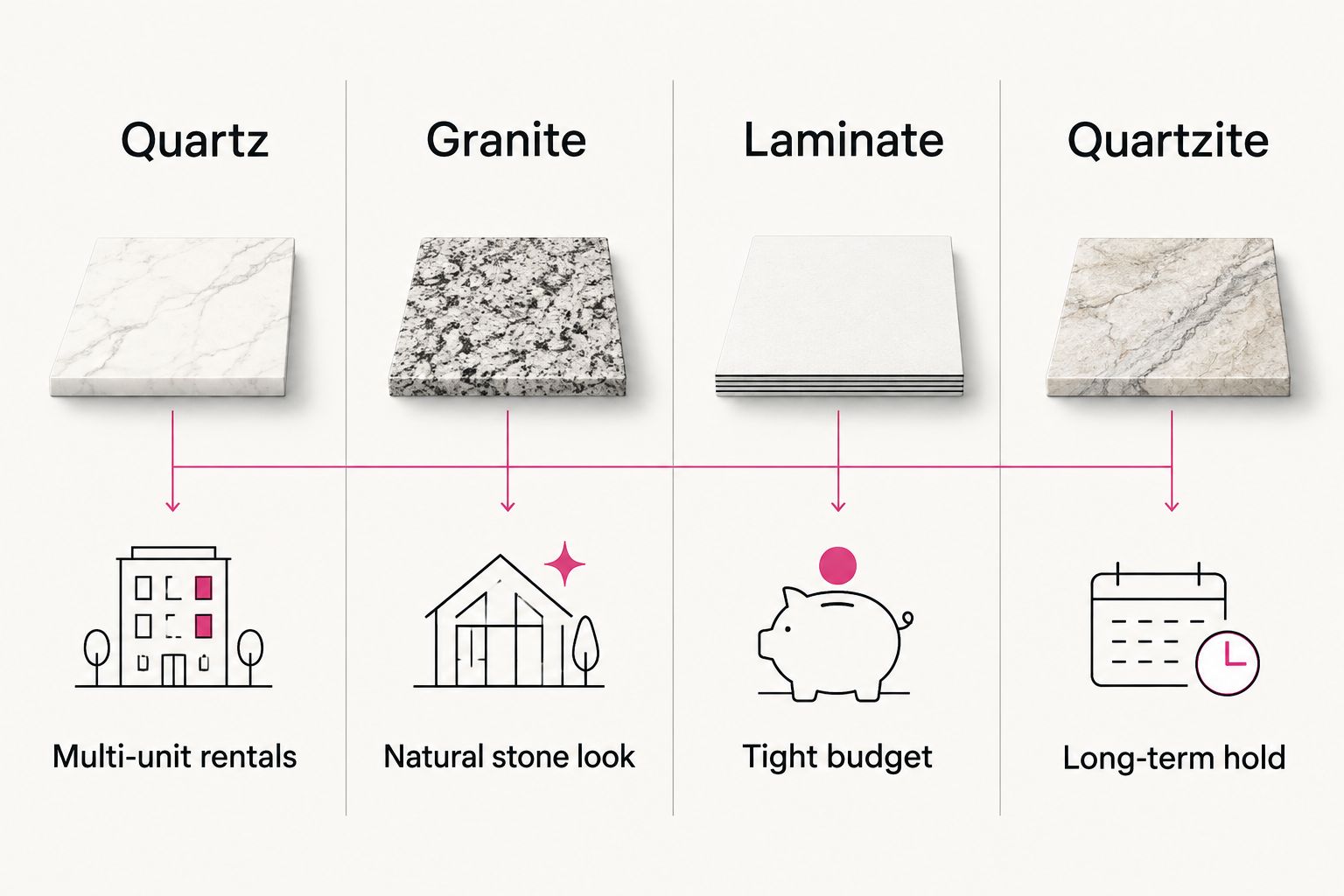
Buy: quartz for any unit turning over more than once a year. Hold: granite for owner-occupied-adjacent units where a landlord can manage annual sealing. Skip: laminate for anything held longer than a single rehab cycle.
Get a quote for your rental units
Portfolio pricing and fast turnaround scheduling for landlords.
Common mistakes landlords make with rental countertops
- Repricing after every turnover. Choosing the cheapest laminate to save money upfront, then replacing it every 2-3 tenants because scorch marks and scratches make the unit look neglected in listing photos.
- Picking a showroom favorite instead of a durability match. A heavily veined white slab looks striking on a sample but shows every scratch under kitchen lighting within a year of tenant use.
- Skipping the sink cutout plan. Ordering a slab without confirming the sink cutout forces a mismatched undermount install that tenants notice immediately.
- Blowing the whole budget on one flagship unit. Spending the entire portfolio's countertop allowance on the unit being photographed for the listing, leaving every other door with mismatched surfaces.
- Hiring without a turnaround guarantee. Signing with a fabricator who doesn't commit to a template-to-install window, which extends vacancy days a landlord is paying for either way.
FAQ
What’s the best quartz color for rental property kitchens?
Mid-tone patterned quartz — speckled greige, soft taupe, or subtle veining — hides scratches and water spots better than pure white slabs in high-turnover units. Solid white shows every scuff under kitchen lighting within a year of tenant use.
Is quartz better than granite for rental units?
Quartz is non-porous and doesn’t need resealing, while granite typically needs resealing every 1-2 years to stay stain-resistant. For a landlord managing multiple units, skipping that annual maintenance call makes quartz the lower-hassle choice.
Do landlords need to reseal quartz between tenants?
No. Quartz’s resin binder makes it non-porous, so it doesn’t require sealing at all, unlike granite or marble. That’s the main reason it fits a rental turnover schedule better than natural stone.
Is quartz durable enough for high-turnover Airbnb kitchens?
Yes. Quartz rates around 7 on the Mohs hardness scale, resists scratching and staining from daily guest use, and holds up to the kind of unmonitored wear an Airbnb kitchen sees between cleanings.
What edge profile works best for rental kitchens?
Eased and bullnose edges resist chipping better than sharp-cut or decorative profiles in high-traffic rental kitchens. Decorative edges also trap grime between tenant cleanings, adding a maintenance issue landlords don’t need.
Should house flippers use quartz or granite?
Quartz gives flippers a consistent, low-maintenance selling point buyers recognize immediately, while granite requires disclosing a sealing schedule to the next owner. For a fast resale, quartz’s no-maintenance story is the easier pitch.
Can one damaged quartz section be repaired without replacing the whole slab?
Minor chips can often be repaired on-site if the fabricator still stocks the same color, which is why standardizing on 2-3 quartz colors across a portfolio matters more for landlords than homeowners.
One last thing
Standardizing on one or two quartz colors across an entire rental portfolio in 2026 does more for long-term maintenance than any single premium slab choice — it means a damaged section in unit 3B can be patched with the same remnant that matches unit 1A, instead of forcing a full slab replacement because the original color went out of production. That's a decision made before the first quote, not after the first chip.
Related guides