
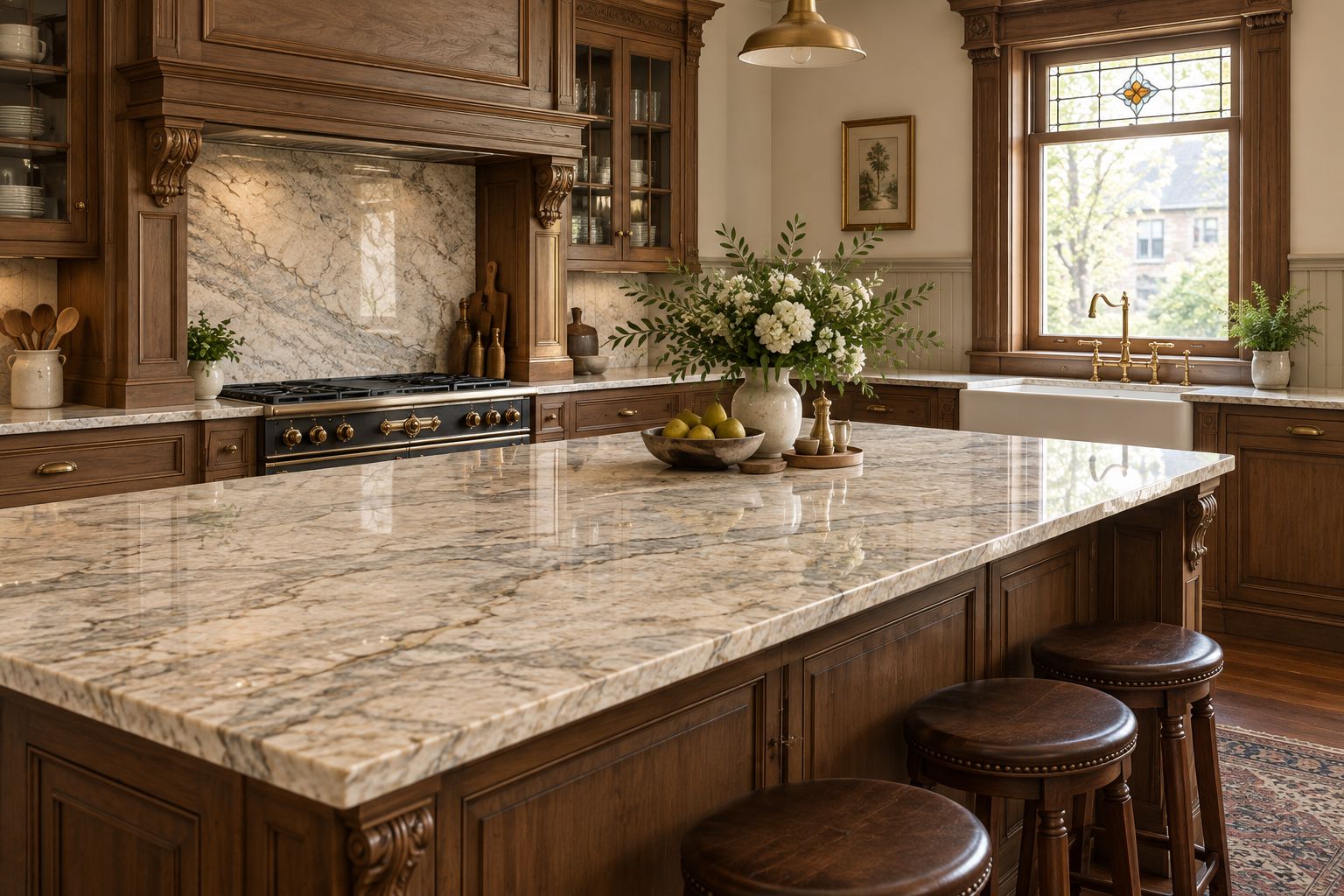
Quartzite countertops for Victorian home kitchens are natural-stone surfaces chosen to fit 19th-century floor plans, ornate millwork, and walls that were never built square, without dragging the room into a modern-farmhouse look. A Victorian kitchen runs smaller and boxier than an open-concept rebuild, and the original plaster, wainscoting, and trim carry more visual weight than they would in a 2026 new-construction kitchen, so slab pattern and finish choices matter more here than in almost any other remodel.
- Quartzite countertops for Victorian homes look best in honed finishes that echo aged woodwork and plaster tones.
- Soft, low-contrast veining reads as period-appropriate; bold blue-grey movement can fight ornate trim.
- Victorian kitchens run narrower than modern rebuilds, so seam placement matters more than square footage.
- Quartzite scores 7 on the Mohs hardness scale, harder than marble, and holds up to daily use in a working period kitchen.
- Soares Stone templates on-site around out-of-square historic walls before cutting any slab.
Why quartzite matters for Victorian home kitchens
A Victorian home built between 1860 and 1900 was framed with balloon-frame construction that has spent well over a century settling. Walls that read as straight to the eye are rarely square, and original cabinetry was often built in place, board by board, rather than installed from stock boxes. That combination punishes a fabricator who works from a blueprint instead of a physical template.
Quartzite fits this problem better than most natural stone because it takes marble's soft veining and pairs it with a hardness rating that shrugs off the daily scratches a century-old kitchen collects. Homeowners researching natural stone for historic New England homes consistently land on quartzite for exactly this reason: it looks period-correct without asking for the babying marble demands.
How to choose quartzite countertops for a Victorian kitchen
Getting a quartzite countertop right in a Victorian kitchen is less about picking a pretty slab and more about sequencing seven decisions correctly. Skip a step and you end up with a beautiful counter that clashes with the trim or a seam that lands right where the sink faucet swings.
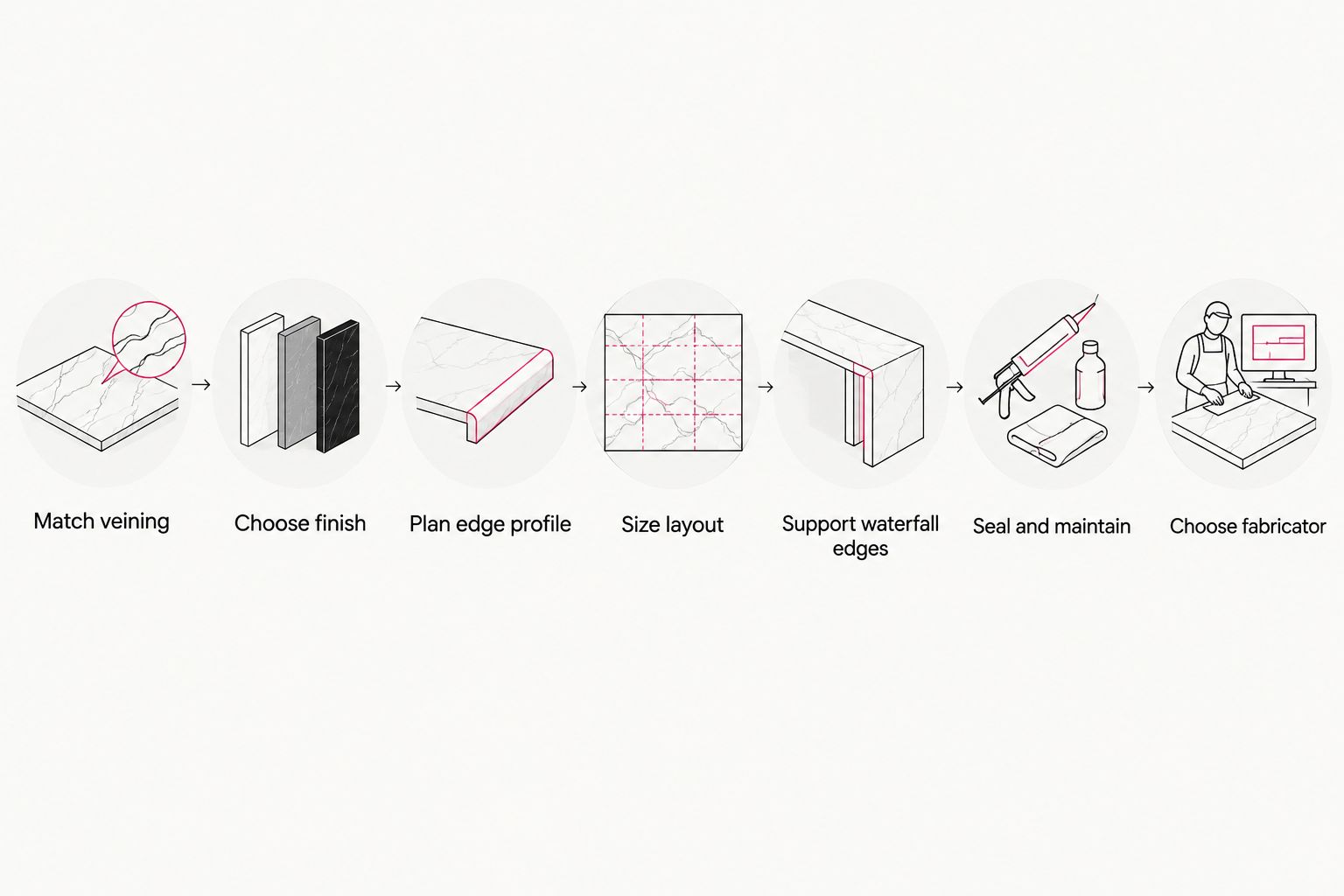
Match the slab's veining to your home's original woodwork
Start with the trim, not the stone yard. A slab that looks stunning in a showroom under bright light can clash badly against a century of stained oak baseboards.
- Pull a sample of your baseboard or window casing stain to the stone yard for a direct side-by-side.
- Photograph the kitchen in morning and evening light before committing to a slab.
- Favor soft grey-taupe or warm-toned movement over bright blue-grey veining if your trim runs toward cream or ivory.
- Ask to see the full slab laid flat, not a 12-inch sample chip.
- Avoid stark white backgrounds if the room's original plaster has aged to an off-white or cream tone.
Choose a finish that suits a century-old kitchen
Most original Victorian kitchens have one or two small windows, which changes how a finish behaves. A polished quartzite finish bounces light around a dim room but shows every fingerprint and etch mark faster than honed stone.
- Test both honed and polished samples under your kitchen's actual light, not the stone yard's showroom lighting.
- Choose honed finishes for low-ceiling rooms where glare from a polished surface reads harsh.
- Choose polished finishes only if the kitchen already gets strong natural light for most of the day.
- Ask your fabricator whether the specific quartzite you like is available in both finishes; not every slab is.
- Soares Stone finishes quartzite in-house in either honed or polished, which matters when a specific slab only exists in one finish from the quarry.
Plan the edge profile around period cabinetry
A modern eased edge or a heavy bullnose can look out of place against Victorian-era cabinet doors with beaded inset panels or ornate hardware.
- Match the edge profile's curve or bevel angle to the era of your cabinet doors, not to current trend photos.
- Keep the edge shallow if your original cabinets already carry decorative trim; two ornate details compete.
- Skip a heavy ogee edge on a small kitchen; it reads bulky in a tight period floor plan.
- Sample the edge profile on the exact slab you've chosen, since veining can shift how a profile catches light.
Size the layout for original cabinet footprints
Original Victorian kitchens typically run narrower than a modern open-concept rebuild, with shorter contiguous counter runs and more corners. That means seam placement carries more weight than it would on a long, unbroken island.
- Measure every wall independently; balloon-frame construction shifts unevenly over 150-plus years, and no two walls in an original kitchen are guaranteed to match.
- Plan seams away from the sink and stove sightline, where they're most noticeable.
- Keep overhangs shallow on narrow aisles common in period kitchens.
- Account for out-of-square corners with a full on-site template visit before any cutting starts.
- If you're adding a farmhouse sink, size the cutout before the slab is cut, not after.
Support waterfall edges and islands the right way
Waterfall edges look striking against period trim when the veining is chosen to flow continuously down the side, but they need engineering most homeowners don't think about until installation day. Homeowners weighing a bold island look often start with quartzite slabs for waterfall edge islands before deciding whether their kitchen's footprint can actually support one.
- Confirm the island base can carry the added weight of a full waterfall panel before ordering the slab.
- Ask for a mitered seam rather than a butt seam for a cleaner veining transition down the side.
- Choose a slab with movement concentrated toward one end so the waterfall panel and the main surface flow together.
- Skip a waterfall edge entirely in a kitchen under a certain footprint; it can visually overwhelm a small original Victorian layout.
Seal and maintain quartzite in a working kitchen
Quartzite is harder than marble, but it isn't maintenance-free, and porosity varies a lot from one quarry lot to the next. A how-to guide on sealing quartzite countertops is worth reading before you assume your slab behaves like granite.
- Wipe daily with mild soap and water; skip vinegar, citrus cleaners, and anything acidic.
- Reseal on a schedule your fabricator recommends for your specific slab's porosity, not a generic annual guess.
- Blot spills near the stove or sink immediately rather than letting them sit.
- Use a cutting board even though quartzite resists scratching better than marble; it's not scratch-proof.
Work with a fabricator experienced in irregular historic walls
The single biggest failure point in a Victorian kitchen countertop project isn't the stone. It's a fabricator who templates from a blueprint instead of the actual, uneven walls in front of them. Choosing between fabricators is covered in more detail in how to choose a countertop fabricator, but the short version for an older home is this:
- Ask to see photos of past installs in homes built before 1920.
- Confirm they template on-site with laser or physical templates, never from architectural drawings alone.
- Check they carry scribe pieces and shims for walls that are out of square, which is nearly every wall in a Victorian home.
- Ask about lead time for sourcing a specific slab, since quartzite quarry lots vary and a matching remnant isn't always in stock.
Get a template visit scheduled
Soares Stone templates on-site around your home’s original walls before any slab gets cut.
Quartzite vs. other stone for Victorian kitchens
Quartzite isn't the only option for a period kitchen, and it isn't the right call in every room. The table below breaks down where each material fits, based on how it behaves in an older home. Anyone still deciding between the two closest competitors should read how to choose between quartz and quartzite countertops before ordering samples.
| Option | Best for | Key limitation | Verdict |
|---|---|---|---|
| Quartzite | Homeowners wanting marble's look with more scratch and heat resistance | Porosity varies by quarry lot, so sealing schedules aren't one-size-fits-all | Buy |
| Marble | Purists restoring an all-original aesthetic in a low-traffic butler's pantry or bar | Etches from acidic spills faster than quartzite | Hold for low-use areas |
| Granite | Budget-conscious historic remodels prioritizing durability over exact period look | Bold speckled patterns can read too contemporary next to ornate trim | Situational |
| Engineered quartz | Busy kitchens where zero sealing matters more than period authenticity | Uniform, repeating pattern reads modern against Victorian millwork | Skip for strict period looks |
Common mistakes Victorian homeowners make with quartzite
- Choosing a bold, high-contrast slab that fights the millwork. Dramatic blue-grey veining photographs well but overwhelms a room full of ornate trim.
- Skipping the on-site template visit. Blueprints don't capture 150-plus years of settling; only a physical template does.
- Forcing a waterfall island into a footprint that was never built for one. Original Victorian kitchens are often too narrow to give a waterfall panel room to breathe.
- Picking a finish under showroom lighting instead of the kitchen's actual light. A polished finish that looked bright at the stone yard can glare harshly under a single small period window.
- Assuming quartzite needs the same sealing schedule as granite. Porosity swings by quarry lot, and guessing wrong shortens the slab's good years.
FAQ
What is the best countertop material for a Victorian home kitchen?
Quartzite is the strongest overall fit for a Victorian home kitchen in 2026 because it carries marble’s soft veining with a 7-on-the-Mohs-scale hardness that survives daily cookware use. Marble still wins in low-traffic rooms like a butler’s pantry where period authenticity matters more than daily wear.
Is quartzite better than marble for a historic kitchen?
For a working kitchen, yes: quartzite resists scratching and etching better than marble while offering a similar soft-veined look. Marble remains the better choice for a low-use bar or fireplace surround where its classic look outweighs its maintenance needs.
How much sealing does a quartzite countertop need in an older kitchen?
Sealing frequency depends on the specific slab’s porosity, which varies by quarry lot even within quartzite as a category. A fabricator should test and recommend a schedule rather than applying a generic annual rule.
Can quartzite handle a farmhouse sink cutout in a Victorian kitchen?
Yes, quartzite supports a farmhouse sink cutout as long as the cutout dimensions are finalized before the slab is cut. Sizing the opening after fabrication risks cracking the slab or misaligning the apron front.
Does quartzite look too modern for a Victorian-era house?
Not if the veining and finish are chosen deliberately. Soft, low-contrast movement in a honed finish reads as period-appropriate; bold blue-grey veining in a high-gloss polish can look out of place next to original trim.
What edge profile fits a Victorian kitchen best?
A shallow, subtle edge profile fits best when the cabinetry already carries ornate detail like beaded insets, since two heavy decorative elements compete for attention. Match the curve or bevel angle to the era of the cabinet doors rather than to current trend photos.
How long does a quartzite countertop last in a century-old home?
Quartzite is a durable natural stone that, with routine sealing and basic care, is built to last for decades in a residential kitchen. Its 7-on-the-Mohs-scale hardness makes it more resistant to daily wear than marble or soapstone.
Should I choose honed or polished quartzite for a dark Victorian kitchen?
Honed finish generally suits a dark, low-light Victorian kitchen better because it softens glare from a single small window instead of bouncing harsh reflections around the room. Polished finish only works well if the kitchen already gets strong natural light through most of the day.
One last thing
Ask your fabricator to concentrate a slab's veining movement toward one end before you finalize the layout. That single request lets the seam land away from the sink sightline and gives a waterfall panel, if you're adding one, a continuous flow of pattern instead of two mismatched halves. It's a five-minute conversation that changes how the whole counter reads for the next 100 years, which is roughly how long the last one lasted.
Related guides
- Marble countertops for historic colonial homes
- Best marble alternatives for high-use kitchens
- How to match countertops with cabinets
- Granite countertops for coastal New England homes