
Best overall: granite for sunroom kitchenettes. Best for natural veining with everyday durability: quartzite. Best for easy cleaning in a climate-controlled room with limited direct sun: quartz. This 2026 guide compares those materials with marble so you can choose a countertop that suits your windows, appliances, and maintenance habits.
- Granite is the best countertop material for sunroom kitchenette projects with direct sunlight and everyday food preparation.
- Quartzite suits homeowners who want natural veining without marble’s sensitivity to acidic spills.
- Engineered quartz suits controlled indoor conditions; confirm the specific product’s sunlight restrictions before choosing it.
- Marble suits decorative serving counters when you accept etching and careful cleanup.
Why this matters
A sunroom kitchenette needs a different buying decision from a kitchen tucked inside the house. Direct sunlight, seasonal temperature changes, and condensation deserve attention before color or edge shape.
For your 2026 project, separate a heated, enclosed sunroom from a seasonal room that gets cold between visits. The material name alone does not establish whether the complete installation suits the room. Cabinets, adhesives, seams, and any surface treatments also matter.
What makes the best countertop for a sunroom kitchenette?
Use these criteria before comparing slabs:
- Sun exposure: Identify where direct sunlight reaches the counter and check restrictions on the specific material and treatment.
- Room conditions: Explain whether the kitchenette stays heated and cooled throughout the year.
- Spill resistance: Match the surface to coffee, wine, citrus, and the cleanup you will actually do.
- Heat protection: Plan landing space and trivets for countertop appliances and hot cookware.
- Care requirements: Distinguish a surface that needs sealing assessment from one that does not require routine sealing.
- Installation fit: Confirm cabinet support, sink cutouts, seams, and overhangs before approving fabrication.
Sunroom countertop materials at a glance
This 2026 ranking gives each material a separate use case. Granite is the default; the other options win when your priorities or room conditions change.
| Material | Best for | Standout feature | Key limitation |
|---|---|---|---|
| Granite | Sunny, frequently used kitchenettes | Natural stone suited to everyday food preparation | Absorption and sealing needs vary by slab |
| Quartzite | Natural veining with strong scratch resistance | Hard natural stone with varied movement | Identification, treatments, and fabrication need attention |
| Engineered quartz | Easy care in controlled indoor conditions | Nonporous surface without routine sealing | Direct sunlight and heat require product-specific checks |
| Marble | Decorative serving areas | Natural veining and a patina-friendly appearance | Acidic spills etch the surface |
1. Granite: best countertop for sunny everyday kitchenettes
Granite is the strongest starting point when you want a natural stone counter for drinks, snacks, and regular food preparation. It offers good resistance to everyday scratching and does not rely on the resin binder used in engineered quartz.
That distinction does not make every granite slab identical. Some slabs absorb liquids more readily than others, and applied resins, sealers, or other treatments need their own suitability check.
Granite pros:
- Handles routine food preparation better than an acid-sensitive marble surface.
- Offers natural patterns without requiring you to accept marble’s etching behavior.
- Makes sense as a first option for a counter exposed to direct sunlight.
- Works for both serving space and an active kitchenette work surface.
Granite cons:
- Sealing needs depend on the actual slab rather than the category name.
- Edges can chip, particularly around vulnerable cutouts or impacts.
- Natural movement makes slab selection important when you want a quiet pattern.
Best for: A sunny kitchenette used for coffee, snacks, and everyday preparation.
Choose the actual slab, not just a small display sample. Check the proposed sink area and front edge for pattern changes, and ask which treatments are present. Keep hot appliances within their operating instructions and use protection beneath hot cookware.
Verdict: Buy granite as the default, subject to slab and installation approval.
2. Quartzite: best countertop for natural veining and active use
Quartzite is a natural stone formed from quartz-rich sandstone. It suits homeowners who want flowing natural movement but do not want marble’s sensitivity to lemon juice, vinegar, and similar acidic spills.
True quartzite is predominantly quartz, a mineral rated 7 on the Mohs hardness scale. That explains its scratch resistance, not a promise that every edge, seam, or finish is damage-proof.
Quartzite pros:
- Provides natural veining and variation rather than a manufactured pattern.
- Offers strong scratch resistance for an active preparation counter.
- True quartzite resists acid etching better than calcite-based marble.
- Provides a natural-stone alternative when engineered quartz has unsuitable exposure restrictions.
Quartzite cons:
- Absorption varies, so sealing requirements still need assessment.
- Commercial stone names do not always establish the slab’s geological identity.
- Hardness does not eliminate chipping or the need for sound support.
Best for: A sunroom kitchenette where natural veining matters as much as daily usefulness.
Ask the fabricator to confirm the stone’s identity and explain any resin treatment or filled areas. Do not conduct a scratch or acid test on someone else’s slab; ask for an approved sample and a suitable evaluation instead.
Verdict: Buy quartzite when you want natural movement and accept slab-specific care.
3. Engineered quartz: best countertop for easy care indoors
Engineered quartz combines mineral content with a binder to create a manufactured countertop surface. Its nonporous construction makes routine cleanup straightforward, and it does not need the periodic sealing assessment associated with many natural stones.
The sunroom qualification is important. Direct sunlight can affect some engineered quartz products, and temperature or heat exposure restrictions depend on the manufacturer’s instructions.
Engineered quartz pros:
- Does not require routine sealing.
- Offers relatively predictable pattern and color selection.
- Supports straightforward cleanup after ordinary food and drink spills.
- Fits homeowners who prioritize low-maintenance indoor use.
Engineered quartz cons:
- Direct sunlight can cause discoloration in products not suited to that exposure.
- Hot cookware and appliance heat can damage the surface or binder.
- Indoor suitability does not automatically cover an unheated seasonal sunroom.
Best for: A consistently heated and cooled kitchenette where the chosen product permits the actual sunlight exposure.
Do not treat window glass or a blind as proof that exposure is acceptable. Describe the window orientation, hours of direct sun, and seasonal use to the fabricator, then check the specific product instructions.
Verdict: Hold until the selected quartz product is confirmed for your room.
4. Marble: best countertop for a decorative serving area
Marble works when your kitchenette is primarily a place to serve drinks, display dishes, and enjoy natural stone. Choose it because you appreciate its appearance and are comfortable with a surface that changes through use.
Calcite, the principal mineral in many marbles, rates 3 on the Mohs hardness scale. Marble also reacts with common kitchen acids, making etching a separate concern from scratches or absorbed stains.
Marble pros:
- Offers natural veining with variation across each slab.
- Suits a serving-focused space where appearance is the main priority.
- Develops a patina that some homeowners deliberately prefer.
Marble cons:
- Lemon juice, vinegar, and other acids can leave etched marks.
- Sealing does not prevent acid etching.
- Everyday preparation demands more care than granite or true quartzite.
Best for: A decorative serving counter used by someone who accepts visible wear.
A honed finish can make some etched marks less conspicuous than a highly reflective finish, but it does not stop the reaction. If you expect every spill to wipe away without a trace, marble conflicts with that expectation.
Verdict: Skip marble for worry-free preparation; buy it only if you welcome patina.
Match the material to the room before selecting color
For a 2026 sunroom renovation, start with the conditions you cannot change easily. A beautiful sample cannot resolve an exposure restriction or compensate for inadequate support.
Use this sequence to narrow the decision:
- Room conditions: Record whether heating and cooling operate year-round and whether rain reaches the kitchenette through open windows.
- Sun exposure: Observe where direct light lands on the counter during your normal use of the room.
- Daily use: List the drinks, foods, and appliances that will regularly touch or sit on the surface.
- Slab approval: Confirm the selected material, treatments, finish, and care instructions before fabrication.
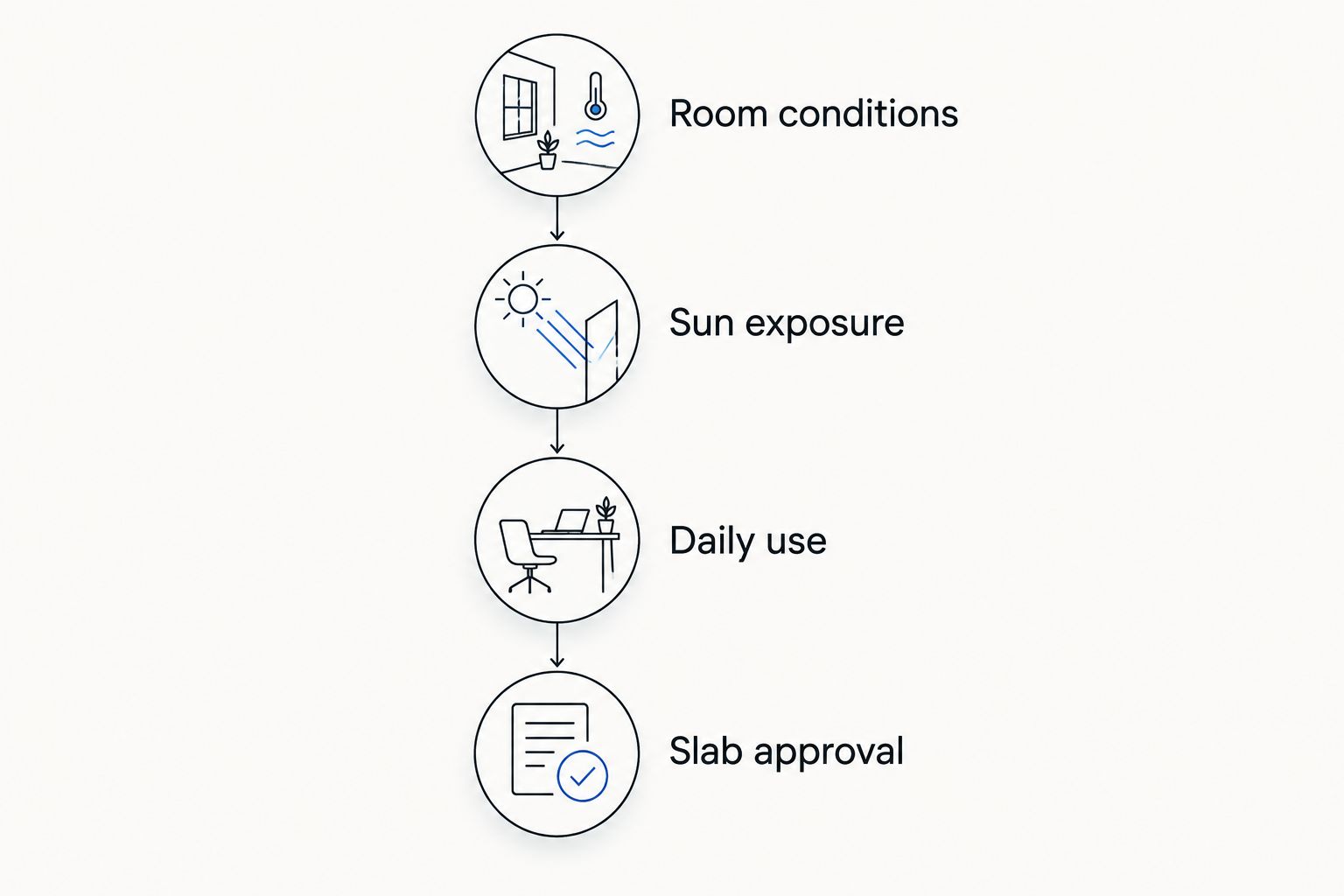
An unheated room needs a discussion about the whole assembly, not just the stone. Explain the seasonal conditions before approving cabinets, installation materials, or seam locations. No countertop selection turns an unsuitable installation into a suitable one.
Choose the finish in your actual light
Sunroom lighting exposes reflections that are easy to miss under showroom lighting. Take an approved sample into the room and inspect it beside the cabinets and window trim.
Look from both your standing preparation position and your seated position. A polished finish reflects windows more sharply; a honed finish reduces mirror-like reflection but changes the stone’s appearance and care considerations.
- Polished finish: Choose it when you want reflected light and a more reflective surface.
- Honed finish: Consider it when strong reflections distract from the room or the view.
- Pattern placement: Check where a busy vein meets the sink, backsplash, and front edge.
Choose the finish you like in the sunroom, not the finish that looks best under showroom lights. Cleaning instructions should match that finish as well as the material.
Get the small-counter details right
A kitchenette leaves little spare work surface after the sink and appliances are placed. Make a layout with the actual appliance dimensions before deciding where seams and cutouts belong.
Stone countertop discussions commonly include 2 cm and 3 cm slab thicknesses. Those dimensions describe slab thickness, not a universal rule for unsupported spans; the fabricator must evaluate the material, cabinet structure, cutouts, and proposed overhang.
For your 2026 layout, settle these details before fabrication:
- Confirm the sink model and its installation requirements.
- Reserve a clear landing area beside appliances.
- Show where cords and outlets sit relative to the backsplash.
- Ask how any overhang will be supported.
- Confirm who handles plumbing connections and appliance installation.
Soaresstone fabricates and installs custom granite, quartzite, quartz, and marble countertops for New England homeowners. Soaresstone is best for homeowners who want custom countertop fabrication and installation rather than a ready-made surface; the sunroom’s exposure still needs to guide material selection.
Discuss your sunroom countertop
Share your room conditions, sink layout, and preferred material before planning fabrication.
How the materials are ranked
This ranking prioritizes sunlight suitability, everyday spill resistance, maintenance, and installation fit. It does not treat appearance as a substitute for suitability.
Granite takes the default position because it balances natural-stone durability with everyday kitchenette use. Quartzite wins for natural veining, engineered quartz wins for easy indoor care under suitable conditions, and marble wins only when decorative use and acceptance of patina lead the decision.
Which countertop should you choose?
Choose granite if you are undecided. It is the practical starting point for a sunroom kitchenette that receives direct light and handles regular drinks or food preparation.
Choose quartzite when you want more natural movement and can commit to its care instructions. Choose engineered quartz only after checking the exact product against the room’s sunlight and temperature conditions; choose marble only when etching is an accepted part of ownership.
For a 2026 consultation with Soaresstone, bring room photos, appliance details, and a clear description of seasonal heating. That information makes the material conversation more useful than arriving with a color preference alone.
FAQ
What’s the best countertop material for a sunroom kitchenette?
Granite is the best default countertop material for a sunroom kitchenette with direct sunlight and everyday food preparation. Confirm the actual slab’s treatments, sealing needs, and installation requirements before fabrication.
Can I put quartz countertops in a sunny sunroom?
Use engineered quartz in a sunny sunroom only when the specific product’s instructions permit that exposure. Direct sunlight can discolor some products, and seasonal temperature conditions also need review.
Is quartzite better than granite for a sunroom kitchenette?
Quartzite is the better choice when natural veining is your main priority; granite remains the default for everyday use. Both require slab-specific checks for absorption, treatments, and support.
Do granite sunroom countertops need sealing?
Granite sealing needs depend on the slab’s absorption and existing treatment. Ask for care instructions for the selected stone rather than following a fixed schedule for every granite countertop.
Will sealing stop marble from etching?
Sealing does not stop marble from etching. A sealer helps reduce absorption, while acids such as lemon juice react with the stone itself.
What should I choose for an unheated sunroom?
Start with granite or quartzite, then have the fabricator assess the complete installation for the room’s seasonal conditions. The stone, treatments, seams, cabinets, and installation materials all need consideration.
Should sunroom countertops be polished or honed?
Choose polished stone for sharper reflections or consider honed stone when glare is distracting. Inspect a sample in the actual room because the finish changes both appearance and care requirements.
Can Soaresstone fabricate a custom sunroom kitchenette countertop?
Soaresstone fabricates and installs custom granite, quartzite, quartz, and marble countertops for New England homeowners. Discuss the sunroom’s exposure, cabinet layout, and sink requirements when planning the project.
One last thing
Photograph the proposed countertop location when sunlight reaches it directly, not only when the room looks its prettiest. Bring that photo to your material discussion: it shows an exposure condition that a cabinet drawing cannot.
For your 2026 selection, make the final approval about the actual slab and room together. A familiar material name is not a substitute for checking its finish, treatments, and installation.
Related guides
- How to care for granite countertops
- How to seal quartzite countertops
- How to plan a countertop template appointment