
You can install granite countertops over existing countertops only when the retained surface, cabinets, finished height, and installation method are suitable; removing the old countertop is the better default for a conventional granite slab installation. A purpose-designed overlay is different from placing a full slab on an old counter, and retaining the old surface does not eliminate sink, appliance, or support checks.
- To install granite countertops over existing countertops, get the support, finished height, and sink arrangement approved before fabrication.
- Conventional granite replacement exposes cabinet problems; retaining the old counter hides them.
- A purpose-designed overlay needs its own installation requirements, not assumptions borrowed from slab installation.
- Soaresstone provides custom granite countertop fabrication and installation for New England homeowners.
Can granite countertops be installed over existing countertops?
Sometimes, but an existing countertop is not automatically an acceptable base for granite. The decision depends on the complete assembly beneath the stone, not simply whether the old surface looks flat. A secure-looking laminate top can conceal a swollen core, loose fasteners, or cabinets that need adjustment.
For a conventional slab project in 2026, start by planning removal and cabinet inspection. Change that plan only after the fabricator approves a specific retained-base installation. The guide to removing old countertops before installation explains the preparation involved in replacement.
| Approach | Best for | Main advantage | Main limitation |
|---|---|---|---|
| Remove the old top, then install granite | Conventional slab replacement | Exposes cabinet condition and avoids retaining the old countertop's thickness | Requires removal and attention to adjoining finishes |
| Retain the old top beneath a conventional slab | Projects with an expressly approved base and installation detail | Leaves the existing surface in place | Adds height and retains concealed materials beneath the stone |
| Use a purpose-designed overlay | Projects specifically suited to the selected overlay system | Resurfaces a retained counter using a system intended for that purpose | Depends on system requirements and does not repair weak cabinets |
The table compares installation approaches, not interchangeable products. Ask the installer to identify which approach the proposal actually includes.
Why this matters
A countertop replacement affects more than the work surface. Its elevation determines where the sink sits, how the countertop meets the backsplash, and how nearby appliances relate to the finished edge.
Leaving the old top in place also leaves its concealed condition in the assembly. If the material around an old sink opening has deteriorated, covering it does not restore its strength. Approve the base before approving the stone layout.
For your 2026 remodel, separate two decisions: whether to keep the cabinets and whether to keep the countertop. Sound cabinets can remain even when the old worktop needs removal.
Removing the existing countertop: the default for slab replacement
Best for: homeowners replacing an existing worktop with a conventional granite slab. Removing the old countertop gives the installer access to the cabinet tops, connections, and support areas. It also avoids adding the entire new assembly above the old work surface.
This approach makes cabinet corrections easier to identify before fabrication. The installer can check whether adjoining cabinets sit in the same plane, whether a sink cabinet needs attention, and whether an overhang requires additional support.
The trade-off is disruption at the edges of the project. A backsplash attached to the old top needs a removal plan, and adjoining wall finishes need protection. Disconnecting plumbing and handling the existing sink also belong in the project scope.
You do not need to replace serviceable cabinets simply because the countertop is changing. Ask for a cabinet assessment rather than treating countertop removal as a full kitchen demolition.
Retaining the existing countertop beneath a slab
Best for: a project with a fabricator-approved retained base, not a general demolition shortcut. Approval must cover the old countertop's material, its attachment, its condition, and how the new stone will receive support. A visual check of the finished surface alone is insufficient.
The benefit is straightforward: the old top stays in place. The limitation is equally important: its thickness and any hidden defects stay too. A retained top also changes the geometry around the sink, exposed edges, backsplash, and appliances.
Ask how the front edge will conceal the old assembly. A drawing or section detail is more useful than a promise that the new edge will cover everything. End panels and exposed peninsula sides need the same attention as the front.
Do not authorize fabrication until the installer accepts the retained base and documents the finished arrangement. Once the slab is cut, changing the sink position or edge design becomes a different problem.
Purpose-designed overlays are a separate option
Best for: homeowners considering a resurfacing system specifically intended for installation over an existing top. An overlay follows the requirements of its selected material and system. It is not evidence that a conventional granite slab can be placed over any countertop.
The advantage is retaining the existing base where the system permits it. The limitation is that the underlying countertop and cabinets still need to meet the system's requirements. Existing movement, deterioration, or unsuitable geometry does not disappear beneath a new surface.
Confirm the actual material being proposed. A granite-look surface is not necessarily a natural granite slab, and the word overlay does not describe one universal construction method.
For a 2026 proposal, request the material description, preparation requirements, edge treatment, and sink detail in writing. Compare those details with a removal-and-replacement proposal rather than comparing appearance alone.
Why installing granite over an existing countertop varies
The answer changes with the existing assembly. These are the factors your installer needs to resolve:
- Base condition: Swelling, loose layers, cracks, or deterioration around openings undermine the case for retaining the top.
- Cabinet support: The cabinet boxes, connections, and support layout must suit the proposed stone installation.
- Finished height: Retaining the old top adds its thickness beneath the new assembly and changes adjoining clearances.
- Sink arrangement: The cutout, mounting method, clips, faucet, and plumbing need a workable combined detail.
- Appliance clearance: Check dishwasher access, range alignment, and cooktop requirements against the proposed finished layout.
- Edges and backsplash: The design must address exposed layers, wall junctions, and the relationship between old and new finishes.
No single factor settles the whole question. A flat countertop with an unsuitable sink detail still needs a different plan.
How to decide before templating
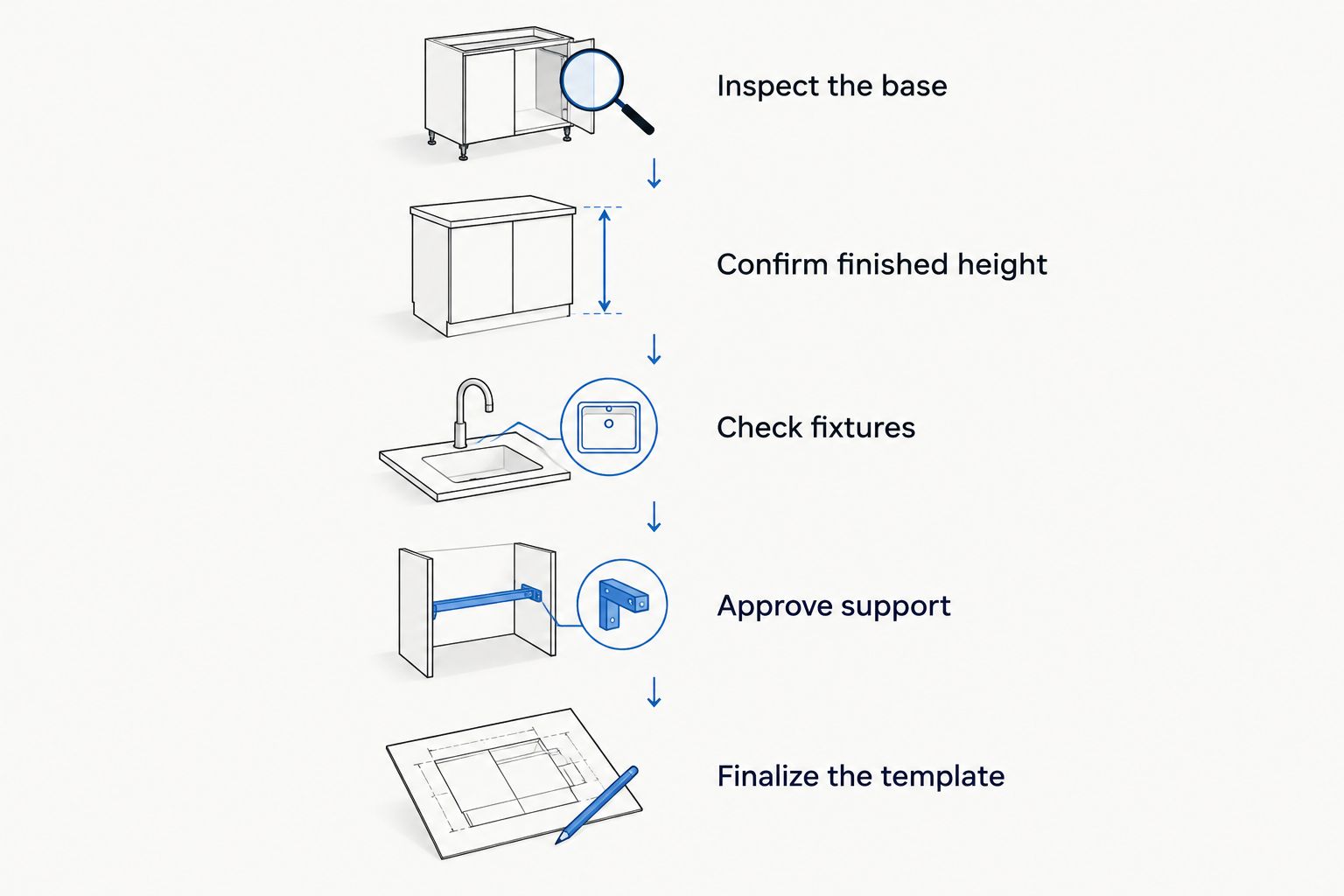
Use this sequence before committing to slab fabrication. Your 2026 installation plan should resolve the base and appliance arrangement before measurements become cutting instructions.
- Inspect the base. Identify the existing countertop material and inspect accessible areas underneath, especially near plumbing penetrations and sink openings. Have the installer assess cabinet condition and support.
- Confirm finished height. Record the proposed final surface elevation, including every retained layer. Check its relationship to the backsplash, windows, range, and surrounding work surfaces.
- Check fixtures. Choose the sink and confirm faucet requirements. Provide the actual appliance installation information rather than assuming the current openings will work.
- Approve support. Confirm how the stone, seams, sink, and any overhang will be supported. A retained countertop does not automatically replace a support detail.
- Finalize the template. Have the fabricator confirm when the kitchen is ready for final measurement. Keep the approved cabinet and fixture arrangement unchanged afterward.
These checks belong to one coordinated plan. Do not let the plumber, cabinet contractor, and fabricator work from different assumptions about whether the old countertop is staying.
How much height does retaining the old top add?
Retaining the old countertop raises the new work surface by the thickness of the assembly installed above it. The actual change depends on the slab and installation detail; an edge that looks thick does not tell you the thickness of every underlying layer.
Granite slabs are commonly described by nominal thicknesses such as 2 cm and 3 cm. Those nominal slab thicknesses differ by 1 cm, before considering any substrate or installation layers. Neither thickness is automatic permission to retain an old counter.
Ask the installer to show the proposed finished elevation, not just name the slab thickness. That measurement is what you need when checking the range, backsplash, and usability of the work surface.
Can you keep the existing sink when adding granite?
You can keep an existing sink only if its condition, mounting method, dimensions, and installation requirements suit the new countertop. Reusing the sink does not guarantee that its old opening or mounting arrangement can remain unchanged.
A drop-in sink needs an appropriate opening and adequate clearance for its mounting hardware. An undermount sink needs a compatible cutout and support arrangement; the old countertop cannot be assumed to provide that support.
Check faucet mounting as well. If a proposed detail retains material beneath the faucet mounting area, verify that the faucet hardware accommodates the resulting assembly. Resolve this before the slab is drilled.
Can you keep the cabinets but remove the old countertop?
You can keep existing cabinets when their condition, installation, and support are suitable for the new granite. Removing the countertop and replacing the cabinets are separate decisions.
Cabinet inspection still matters. Loose boxes, damaged sink cabinets, or uneven cabinet tops need attention before the stone is installed. Keeping the cabinets works best when the project includes any necessary corrections rather than assuming the old countertop proves they are ready.
Who should assess your granite replacement?
Soaresstone is best for New England homeowners seeking custom granite countertop fabrication and installation. The family-owned business designs and installs custom stone surfaces for kitchens, bathrooms, and fireplaces.
For this project, the useful discussion is about the whole installation: cabinet condition, countertop removal, sink selection, finished height, and support. Custom fabrication does not make an unsuitable retained base acceptable, so resolve that question before choosing an edge treatment.
When you contact Soaresstone about countertop installation, provide photos of the countertop, accessible cabinet interiors, sink area, and adjoining appliances. Ask whether your project calls for removal or whether a retained-base detail is appropriate.
FAQ
Can I install granite countertops over existing countertops without removing laminate?
Only if the fabricator approves the laminate assembly as part of the proposed installation. Conventional slab replacement is better planned around removing the old top and inspecting the cabinets.
Is a granite overlay the same as a granite slab?
No. A purpose-designed overlay is an installation system intended for a retained base, while a conventional granite slab needs its own approved support and installation details.
Can granite go over an existing tile countertop?
Do not treat an existing tile countertop as an approved granite base without inspection. The installer must assess the complete assembly, including tile attachment, underlying materials, support, and finished height.
Will putting granite over my old counter make it taller?
Yes, placing a new assembly above the existing work surface raises the finished countertop. Confirm the final elevation against the sink, backsplash, range, and other adjoining features.
Do I have to replace my cabinets to get granite countertops?
No, serviceable cabinets can remain when their condition and support suit the granite installation. Inspect and correct the cabinets before final measurement and installation.
Can I reuse my existing sink with new granite?
You can reuse an existing sink if its condition and installation requirements suit the new countertop. Confirm the cutout, mounting hardware, support, and faucet arrangement before fabrication.
Does Soaresstone install custom granite countertops?
Soaresstone provides custom granite countertop fabrication and installation for New England homeowners. Discuss the existing countertop and cabinet condition before deciding whether any part of the old assembly should remain.
One last thing
Check that the dishwasher can still be removed after the project is complete. Countertop height, cabinet openings, and the finished floor all affect the appliance's removal path; a dishwasher that operates today is not proof that future removal will be straightforward.
Before signing your 2026 installation scope, ask the installer to confirm that service access remains workable. A countertop plan should account for the next repair as well as installation day.
Related guides
- How to plan a countertop template appointment
- How to prep your kitchen for a countertop installation
- How to schedule countertop installation around appliance delivery