
Instead of repeatedly moving appliance deliveries and countertop appointments, build your countertop installation appliance delivery schedule around approved specifications, ready cabinets, and confirmed installation handoffs. For your 2026 remodel, separate appliance delivery from appliance connection so each crew arrives when the kitchen is ready for its work.
- Soaresstone is best for New England homeowners seeking custom countertop fabrication and installation.
- Build your countertop installation appliance delivery schedule around cabinet readiness and approved appliance specifications.
- Ask your fabricator which appliances must be physically present before countertop templating.
- Schedule final appliance connections after the countertop installer confirms the work area is ready.
Why this matters
A delivery appointment confirms transportation, not installation readiness. Your cooktop opening, range clearance, dishwasher access, and refrigerator enclosure each depend on different information; putting every appliance on the same delivery plan ignores those differences.
The key decision is not whether appliances arrive before or after countertops. It is which appliance details must be verified before stone is cut. Start with the installation instructions for the exact models you ordered, then get your fabricator's requirements in writing. For a cooktop, review how to connect cooktop cutout specs to countertop fabrication before approving the opening.
Use 3 milestones in your 2026 plan: template readiness, fabrication approval, and final connections. Assign an owner to each milestone rather than treating the retailer's delivery date as the entire kitchen schedule.
Before you start
- Collect the project documents. Gather appliance model numbers, manufacturer installation instructions, sink information, cabinet drawings, and the latest delivery confirmations. Include accessories that affect fit, such as a cooktop downdraft assembly or a range trim kit.
- Identify the people who approve each handoff. You need access to the appliance retailer, cabinet installer, countertop fabricator, and the trades handling water, power, gas, or ventilation. Choose one person to maintain the shared schedule.
- Resolve the easily missed requirement. Ask which actual appliances, sinks, templates, or mounting components must be on-site for measurement. A specification sheet is not automatically a substitute for a physical item, and delivery does not automatically include unpacking or connection.
Do not remove your existing working kitchen solely because an appliance delivery is booked. First confirm the demolition sequence, cabinet readiness, required disconnects, and the countertop team's measurement requirements.
Appliance requirements
Establish what each appliance needs
- Record the exact model. Copy the complete model number from the order confirmation and match it to the manufacturer's installation instructions. Do not approve fabrication from a general product-family brochure.
- Separate dimensions from cutouts. Identify overall dimensions, required openings, clearances, ventilation needs, and utility locations. A cooktop's overall width is not its countertop cutout width.
- Request the fabricator's requirements. Ask whether the actual appliance, a manufacturer-supplied template, or approved documentation is required before measurement or cutting.
- Assign a status. Mark each item as awaiting documents, awaiting delivery, approved for templating, or approved for fabrication. These are labels for your project record, not settings in a particular scheduling system.
Expected result: Every appliance has a confirmed model, a documented fit requirement, and a clear answer about whether physical delivery affects countertop work.
Use this comparison to separate dependencies. The “best for” column identifies the planning approach suited to each appliance, not a recommendation to buy a particular product.
| Appliance | Best for | What to confirm before countertop work | Benefit of early delivery | Drawback of early delivery |
|---|---|---|---|---|
| Separate cooktop | Model-specific cutout planning | Approved cutout, clearances, mounting, and ventilation details | Allows inspection of the actual unit when required | Requires protected storage and handling |
| Range | Opening and finished-height coordination | Exact opening, surrounding surfaces, clearances, and connection access | Supports a physical fit check when requested | Can obstruct cabinet or stone access |
| Dishwasher | Under-counter access planning | Opening dimensions, finished floor, connections, and approved mounting method | Allows inspection before final placement | Premature installation can interfere with remaining work |
| Refrigerator | Enclosure and delivery-route planning | Enclosure dimensions, door movement, utilities, and access route | Allows inspection and enclosure checks | Takes up staging space and needs protection |
Do not assume a new appliance is interchangeable with the old one because the sales description uses the same nominal size. Compare the exact installation requirements before treating a replacement as a simple swap.
Template readiness
Confirm the kitchen before measurement
- Verify cabinet readiness. Ask the fabricator what must be installed, secured, leveled, and complete before templating. Include island supports, fillers, finished panels, and any appliance opening that affects the stone layout.
- Resolve finished-floor relationships. Have the cabinet and appliance installers check how flooring affects appliance height and removal access. Do not leave this until a dishwasher is trapped beneath the finished counter.
- Check sink and fixture dependencies. Confirm the sink model, faucet-hole layout, and any accessories affecting the countertop. A farmhouse sink's installed position requires coordination with the fabricator rather than an assumption based on its packaging dimensions.
- Clear the work and delivery routes. Identify where appliances can wait without blocking cabinet measurement, stone carrying routes, or exits.
- Obtain a readiness confirmation. Ask the countertop team to confirm whether the project is ready for its template appointment, including any required physical items.
Expected result: The measurement appointment reflects the kitchen's intended finished configuration, with no unresolved appliance opening or missing required component.
Cabinet delivery alone does not establish readiness. Use the guide to timing countertop installation with cabinet delivery when cabinet work and appliance deliveries share the same calendar.
For your 2026 project record, use these 4 checkpoints: Model approval, Cabinet readiness, Fabrication approval, and Final connections. Keep each checkpoint tied to a named person who can confirm it.
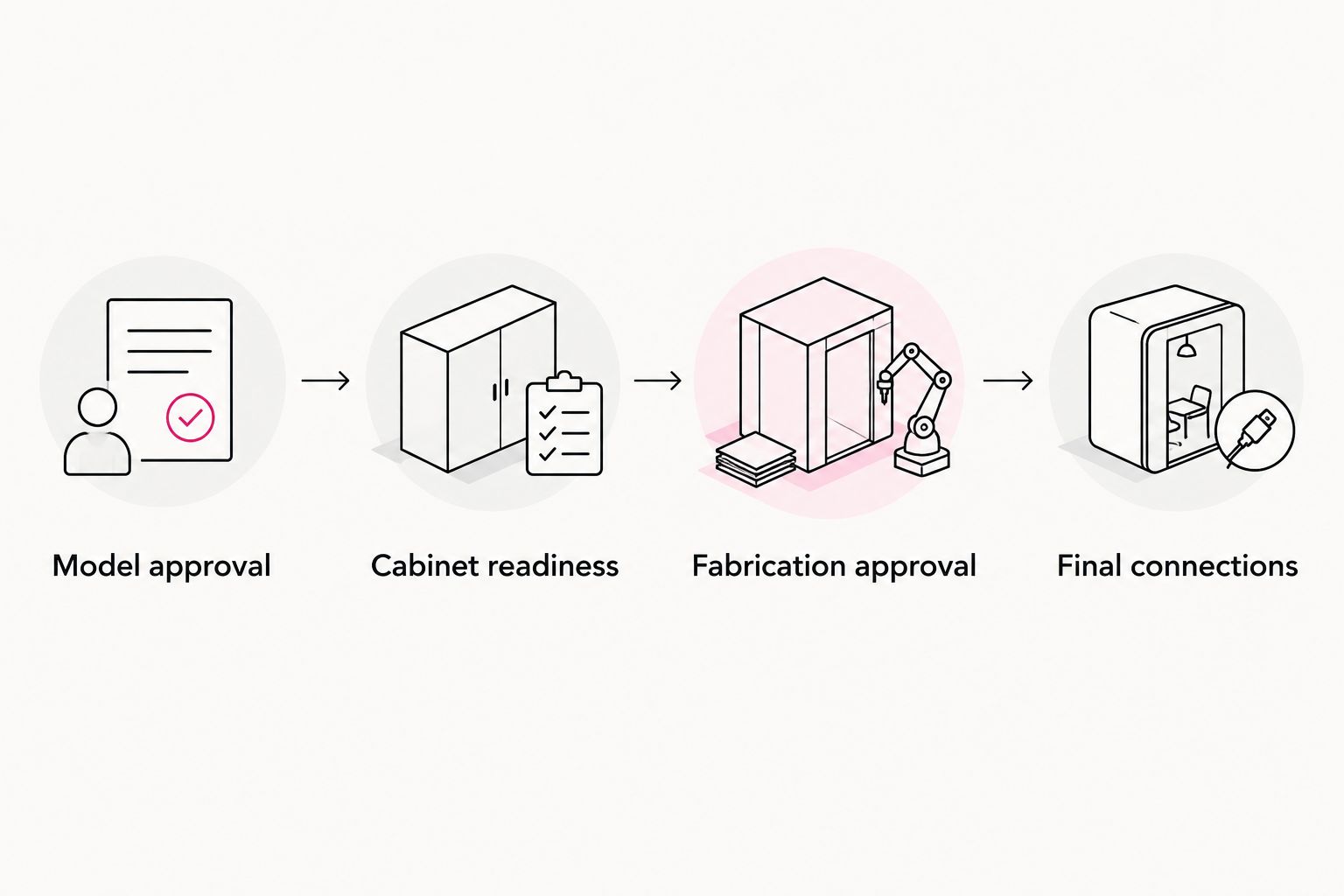
Fabrication and delivery handoffs
Release the work in the right order
- Approve the fabrication details. Review the countertop layout, appliance openings, sink details, and any documented exceptions with your fabricator. Keep the approved version with the corresponding appliance model information.
- Separate tentative dates from confirmed appointments. Mark a proposed stone installation date as tentative until the countertop team confirms it. Do the same for appliance installation rather than treating a delivery estimate as a guaranteed handoff.
- Choose delivery placement deliberately. Tell the delivery team where appliances should be placed and who will receive them. Confirm access restrictions and any building requirements before arrival.
- Inspect the delivered appliance. Check the model label and visible condition through the retailer's prescribed receiving process. Report a mismatch immediately; an unopened box is not confirmation that the correct appliance arrived.
- Schedule final positioning and connections. Coordinate with the countertop installer and the responsible trades. Follow the applicable manufacturer instructions and any project-specific waiting requirements before loading, connecting, or using the installation.
Expected result: Countertop fabrication uses approved information, delivery does not block installation, and the final connection appointments depend on confirmed readiness.
Use 2 written confirmations before final connections: the countertop team's readiness confirmation and the appliance installer's acceptance of the opening and connection conditions. These are project controls, not a promise of a particular installation duration.
Keep your 2026 schedule free of invented universal waiting periods. Adhesives, sealants, mounting methods, and installation conditions differ; the responsible installer must identify the instructions that apply.
Soaresstone provides custom countertop fabrication and installation for New England homeowners. Ask Soaresstone which appliance documents and physical items your countertop project requires before committing dependent appointments.
Discuss your countertop installation plan
Share your appliance models and cabinet status to discuss countertop coordination.
When an appliance delivery date changes
A delayed appliance does not create the same problem as a changed appliance model. Treat those as separate events, then ask the fabricator which work can continue.
- Identify what changed. Record whether the retailer changed only the delivery date or also proposed a substitute model.
- Check the dependency. If the actual appliance is required for templating or fabrication, ask the countertop team to revise that milestone. If approved documentation is sufficient, request confirmation that work can proceed without delivery.
- Pause approval for substitutions. Send the replacement model's installation instructions to the fabricator and relevant trades. Do not accept a substitute on the assumption that its advertised size guarantees the same fit.
- Update dependent appointments. Notify the cabinet installer, countertop team, and connection trades of the revised status. Keep unaffected work separate from work that genuinely needs rescheduling.
Expected result: A transportation delay changes only the appointments it actually affects, while a model substitution triggers a fit review before fabrication continues.
The same approach applies when an appliance arrives damaged. Confirm whether the replacement is the identical model; if it is not, reopen the specification review instead of carrying forward the original approval.
Troubleshooting
The cooktop arrives after the template appointment
Ask whether the approved installation documents meet the fabricator's requirements. If physical inspection or a supplied template is required, agree on the revised sequence before releasing the cutout; do not ask anyone to guess from the appliance's advertised width.
The retailer offers a different model
Request the replacement's complete model number and installation instructions. Have the fabricator review the opening and the relevant trades review utilities and ventilation before you accept it as a fit-equivalent replacement.
An appliance blocks the stone installation route
Arrange relocation before the countertop crew arrives. Confirm who is authorized to move it and where it can wait safely; do not assume the stone installers provide appliance moving or storage.
The dishwasher will not fit or cannot be removed
Have the installer check the opening, finished-floor relationship, appliance adjustment range, and manufacturer's mounting instructions. Do not cut stone, alter cabinets, or improvise attachments without the responsible professionals approving the correction.
Connection trades are booked before the kitchen is ready
Update the appointments using the actual remaining dependencies. Ask the countertop team what must happen before connection work, then give the trades a confirmed handoff rather than another hopeful date.
Customize your workflow
For a small replacement project, a shared written checklist can hold the model numbers, required documents, approvals, and appointments. A larger remodel benefits from a schedule that also tracks cabinet changes, utility work, flooring, access, and delivery staging.
Give each task an owner and an explicit completion condition. “Appliances handled” is too vague; “cooktop model approved for fabrication” tells everyone what has actually been decided.
For a Soaresstone countertop project, organize your questions around dependencies rather than asking only for an installation date. Send the appliance information together, identify unresolved cabinet work, and ask what must be complete before the next appointment.
Keep one current 2026 schedule and archive superseded versions. When a date changes, include the reason and the affected handoffs so an old message does not become the crew's working plan.
FAQ
Should appliances arrive before or after countertop installation?
Appliances should arrive when their inspection, measurement, or installation requirements make them necessary. Ask your fabricator which actual items must be present before templating or fabrication, and schedule final positioning and connections separately.
Does my cooktop need to be on-site for countertop templating?
Your fabricator determines whether the actual cooktop, a manufacturer template, or approved installation documents are required. Confirm that requirement before the template appointment rather than relying on the retailer’s product dimensions.
Can countertops be installed before my refrigerator arrives?
Countertop work can proceed without refrigerator delivery when the project team confirms that the approved enclosure, clearances, and access requirements are resolved. Physical delivery remains necessary if the project requires an actual-unit fit check.
Should I install my dishwasher before the countertops?
Confirm dishwasher placement and mounting order with the countertop and appliance installers. The opening, finished floor, connection access, and manufacturer-approved mounting method must remain compatible with the completed counter.
What happens if my appliance delivery is delayed?
Ask whether physical delivery is a prerequisite for the next countertop milestone. Reschedule dependent work when it is; otherwise, obtain confirmation that the approved specifications allow the countertop work to continue.
Can I change appliance models after countertop templating?
A model change requires a new fit review before you treat the existing template or cutout approval as valid. Send the replacement installation instructions to the fabricator and relevant trades immediately, especially if fabrication has already been approved.
Can countertop installation and appliance connections happen the same day?
Do not assume same-day connections are appropriate. The countertop installer and connection trades must confirm sequencing, access, and any installation-specific waiting requirements before you book overlapping appointments.
One last thing
Keep the exact appliance model number beside every cutout approval. A calendar tells you when work is planned; that model number tells the fabricator what the opening was approved to fit. Before stone is cut, confirm that the approved model and the delivered model match.
Related guides
- How to plan a countertop template appointment
- How to coordinate electrical rough-in with countertop templating
- How to prep your kitchen for a countertop installation