
No—do not put a hot pan directly on a quartz countertop; use a trivet designed for hot cookware. Heat can damage the resin in engineered quartz, leaving discoloration, a changed finish, or a crack that ordinary cleaning will not fix.
- A hot pan on quartz countertop surfaces risks permanent damage; use a heat-rated trivet every time.
- Engineered quartz resists everyday stains, but its resin binder remains vulnerable to concentrated heat.
- After accidental contact, remove the pan safely, let the surface cool naturally, and avoid abrasive repairs.
- Soaresstone fabricates and installs custom quartz countertops for New England homeowners; heat protection remains part of daily care.
Why this matters
Quartz makes everyday kitchen cleanup straightforward, but easy cleaning does not mean you can treat the surface like a stovetop. A pan coming off a burner or out of an oven concentrates heat where its base touches the counter.
For your 2026 kitchen care routine, separate two jobs: protecting the surface from heat and removing ordinary cooking residue. The guide to cleaning quartz countertops without damaging them covers routine cleaning; a cleaner cannot reverse heat damage inside the material.
The practical goal is simple: give hot cookware a designated landing place before you start cooking. You should not have to search a drawer while holding a roasting pan.
Can you put a hot pan directly on quartz countertops?
A hot pan belongs on a suitable trivet, not directly on quartz. Engineered quartz combines mineral particles with a resin binder. The finished surface handles normal countertop use, but the binder does not have the same heat tolerance as the mineral component.
Direct contact creates a different exposure from a warm dinner plate or a mug. Cookware fresh from a burner, broiler, or oven can transfer concentrated heat into a small area, and sudden temperature changes can stress the surface.
Use this comparison when deciding where to set cookware:
| Landing surface | Best for | Advantage | Limitation | Recommendation |
|---|---|---|---|---|
| Heat-rated trivet | Hot pans within the trivet's stated limits | Creates a purpose-made barrier between cookware and quartz | Must suit the cookware and cover its contact area | Use according to its instructions |
| Bare quartz | Food preparation and ordinary countertop use | Keeps the work surface clear | Does not provide a protective barrier against hot cookware | Keep hot pans off it |
| Folded kitchen towel | Handling tasks appropriate to the towel | Convenient to reach | Not a dependable substitute for a heat-rated trivet, especially when wet | Do not rely on it for pan placement |
A previous accident without a visible mark does not establish a safe limit. You cannot judge the next pan's temperature or the surface's response from that experience.
Why heat damage varies
There is no useful universal temperature threshold for every quartz countertop. Follow the care instructions for your particular surface rather than treating a generic figure as permission for direct contact.
These factors affect the exposure:
- Cookware temperature: A pan fresh from a hot burner presents a different heat load from a serving dish that has cooled.
- Contact duration: Leaving cookware in place continues the heat transfer; a brief touch is not equivalent to prolonged contact.
- Cookware construction: Different pan materials and base designs retain and transfer heat differently.
- Temperature difference: A sudden change between a cool surface and hot cookware creates thermal stress.
- Surface construction: The quartz formulation, seams, and any repair materials affect how the installed countertop responds.
For 2026 care planning, the useful rule is behavioral rather than numerical: protect the countertop every time you move hot cookware. That avoids turning dinner preparation into a temperature test.
What should you do if you already put a hot pan on quartz?
Remove the heat source safely, then leave the countertop to cool naturally. Do not try to cancel the heat with ice, cold water, or a frozen item; a sudden temperature change adds stress.
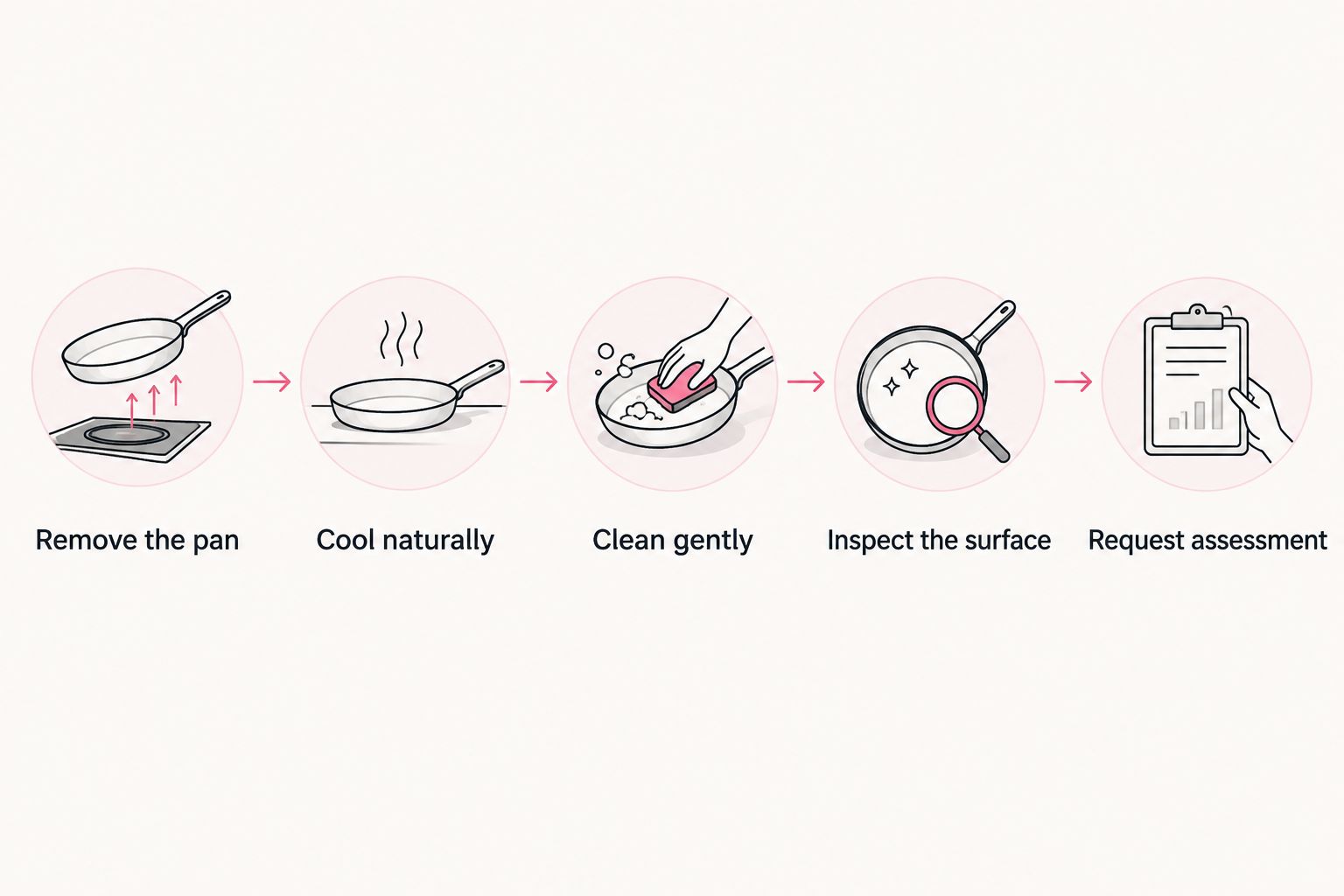
Follow this sequence:
- Remove the pan. Use appropriate oven mitts and move the cookware to a suitable trivet or another safe location. Avoid dragging it across the countertop.
- Cool naturally. Keep the affected area clear. Do not press on it, cover it with ice, or start scrubbing while it is hot.
- Clean gently. Once the surface has cooled, use the countertop manufacturer's approved cleaning method to remove any food or greasy residue.
- Inspect the surface. Look for a persistent ring, discoloration, changed sheen, roughness, or a visible crack. Check from different angles under normal lighting.
- Request assessment. If a mark remains or a crack appears, contact the installer or a qualified surface-repair professional before attempting a repair.
A photograph helps document the location and appearance, but it does not establish how deep the damage goes. Tell the professional what cookware touched the surface, where it came from, and what cleaning you have already attempted.
Do not test the damaged spot with another hot pan. Repeating the exposure provides no useful diagnosis and risks making the problem worse.
How can you tell residue from heat damage?
A mark after pan contact is not automatically a burn. Grease, food residue, or transferred material can leave a visible ring, so start with approved cleaning after the countertop has cooled.
A mark that remains after gentle cleaning needs assessment, not stronger scrubbing. A persistent change in color or sheen can involve the surface itself rather than something sitting on top of it.
Watch for these distinctions:
- Removable residue: The appearance improves with the approved cleaning method without changing the surrounding finish.
- Persistent discoloration: A pale, yellowed, brown, or otherwise changed area remains after cleaning.
- Finish change: The spot looks duller or reflects light differently from the surrounding counter.
- Cracking: A visible line appears in or around the affected area.
Avoid abrasive pads, sanding, polishing compounds, and solvent experiments unless the surface manufacturer or repair professional specifically directs their use. An aggressive cleaning attempt can turn a localized problem into a larger finish mismatch.
How do you protect quartz near a stove or oven?
Keep a heat-rated trivet within reach of the place where hot cookware leaves the appliance. A protective accessory only helps if you can use it without carrying a hot pan across the kitchen.
Build protection into your 2026 kitchen setup:
- Choose stable support. The pan should sit securely without rocking or balancing on an undersized pad.
- Check the heat rating. Follow the trivet manufacturer's intended use and temperature guidance.
- Cover the contact area. Keep the cookware's base from extending onto exposed quartz.
- Keep the landing place clear. Do not let mail, utensils, or small appliances displace the trivet during cooking.
- Plan for baking sheets. A pad that suits a saucepan does not necessarily support a wide roasting tray.
Silicone, cork, and metal trivets are not interchangeable simply because they share a product label. Check the individual item's instructions, construction, and suitability for your cookware. A decorative serving mat is not automatically a heat barrier.
Also check the instructions for countertop appliances that generate heat. Slow cookers, toaster ovens, and similar appliances introduce sustained exposure rather than a momentary pan contact. Follow both the appliance's installation requirements and the quartz manufacturer's care guidance; do not block appliance ventilation with an improvised pad.
Is quartz still a good choice if you cook every day?
Quartz suits daily cooking when you accept a consistent trivet habit. Its nonporous surface and lack of routine sealing requirements are practical advantages, while sensitivity to direct heat is a real limitation.
If you regularly move heavy roasting pans or cast-iron cookware, assess your workflow before choosing a surface. The question is not whether quartz can survive an occasional mistake; it is whether your kitchen makes the protective habit easy.
Use this material comparison as a starting point, not permission to put hot cookware directly on any countertop:
| Material | Best for | Practical advantage | Care limitation |
|---|---|---|---|
| Engineered quartz | Homeowners prioritizing straightforward routine care | Nonporous surface without routine sealing | Resin binder needs protection from concentrated heat |
| Granite | Homeowners who want natural stone and greater heat tolerance than engineered quartz | Natural stone handles heat differently from resin-bound quartz | Thermal stress, sealers, and repairs still require care; use trivets |
| Quartzite | Homeowners seeking a natural-stone alternative to engineered quartz | Does not use the same engineered resin-bound composition | Stone condition, treatments, and sealing needs vary; use trivets |
Quartz and quartzite are different materials despite their similar names. Confirm the material on your project paperwork before applying care advice found under either term.
Soaresstone is best for New England homeowners seeking custom countertop fabrication and installation. The family-owned business works with quartz, granite, marble, and quartzite; choosing quartz still means protecting the finished surface from hot cookware.
For a 2026 remodel, discuss cooking habits alongside color and edge choices. Ask where roasting trays will land, how nearby appliances discharge heat, and where you will keep protective accessories.
Discuss your countertop project
Talk through custom quartz, granite, marble, or quartzite surfaces for your kitchen.
Can you fix a heat mark on a quartz countertop?
A heat mark needs a diagnosis before a repair method. Surface residue can come off with approved cleaning, but altered resin, a changed finish, or a crack is not an ordinary stain.
A qualified professional can assess the affected area and explain whether a localized repair is appropriate. Do not assume a repair will restore an invisible, factory-matched finish or that replacement is automatically necessary.
Does a quartz countertop warranty cover hot-pan damage?
Warranty coverage depends on your specific written terms. Check the care requirements and exclusions for heat exposure, misuse, fabrication, and installation rather than assuming every type of damage is covered.
For a claim made in 2026, keep the purchase documents, material identification, photographs, and a record of the incident. Ask the responsible provider for the applicable process before authorizing repair work that changes the surface.
FAQ
Can I put a hot frying pan on quartz for just a second?
Do not intentionally put a hot frying pan directly on quartz, even briefly. Short contact is not a dependable safety allowance; use a heat-rated trivet.
What temperature is safe for a quartz countertop?
There is no universal safe direct-contact temperature for every quartz countertop. Follow your specific manufacturer’s guidance and keep hot cookware off the bare surface.
Can boiling water damage quartz countertops?
Do not deliberately pour boiling water onto quartz countertops because sudden temperature changes can stress the material. Handle an accidental spill safely and avoid adding ice or cold water to a heated area.
Is a towel enough to protect quartz from a hot pan?
A towel is not a dependable substitute for a heat-rated trivet. Its thickness, moisture, and construction do not provide a reliable basis for protecting quartz from cookware heat.
Can I put an air fryer on a quartz countertop?
Follow the air fryer’s placement and ventilation instructions together with the quartz manufacturer’s heat guidance. Use only a protective arrangement approved for that setup, and never obstruct the appliance’s ventilation.
Will a burn mark on quartz wipe off?
Actual heat damage will not wipe off like ordinary food residue. Let the surface cool, clean it using the approved method, and arrange an assessment if discoloration or a finish change remains.
Should I choose granite instead of quartz if I cook a lot?
Granite deserves consideration when natural stone and greater heat tolerance are priorities, but it still needs sensible heat protection. Choose between granite and quartz using your cooking habits, maintenance preferences, and the specific slab or surface guidance.
One last thing
Put the trivet down before you turn the heat on. The easiest mistake to prevent is the one caused by having nowhere ready to set a pan.
When discussing a kitchen with Soaresstone, include that landing place in the layout conversation. A beautiful countertop still needs a practical route from burner or oven to protected resting spot.
Related guides
- How to choose between granite and quartz for a kitchen remodel
- How to connect cooktop cutout specs to countertop fabrication
- How to care for granite countertops