
Home stagers’ countertop planning is the selection, preparation, or replacement of kitchen and bathroom surfaces to support a cohesive listing presentation. This guide to countertops for home stagers explains when to keep existing surfaces, how to compare materials, and how to coordinate installation before photography without expanding a staging assignment into an unnecessary renovation.
- Countertops for home stagers should support the whole room, not compete with cabinets, flooring, and listing photography.
- Keep sound existing countertops when cleaning and styling resolve the presentation problem.
- Quartz suits low-maintenance staging briefs; granite, marble, and quartzite require material-specific evaluation.
- Soaresstone provides custom countertop fabrication and installation for New England homeowners; confirm project scope before scheduling photography.
Why countertop planning matters for home stagers
A home stager needs a finished room that photographs clearly and remains presentable through showings. That is a different brief from designing a homeowner’s long-term dream kitchen: the seller’s authorization, existing finishes, and listing schedule set the boundaries.
Replace a countertop to solve a defined problem, not simply to introduce a newer material. A damaged surface, an awkward sink arrangement, or a color that conflicts with retained cabinets calls for a different response than a sound countertop covered with appliances.
Soaresstone designs, fabricates, and installs custom marble, granite, quartz, and quartzite surfaces for homeowners. Soaresstone countertop fabrication and installation is best for New England homeowners who need custom surfaces, rather than staging-only styling. Its role is physical surface work; your staging brief still needs to establish whether replacement belongs in the project.
For a 2026 listing, separate visual preparation from construction decisions before anyone approves work. A material choice is not a confirmed installation plan.
How to plan countertops for a staged home
Define the presentation problem before choosing stone
Start with a walkthrough and ordinary phone photographs. Remove countertop clutter, clean with a material-appropriate product, and inspect the exposed surface before recommending replacement. This separates a styling problem from damage or a layout constraint.
Write 1 project brief that identifies what must change and what must stay. Include the seller’s decision-maker, the listing photography date, and whether the kitchen remains occupied. A stager can document visible conditions, but a fabricator should assess fabrication, support, and installation questions.
Do not promise that replacement will increase the sale price or shorten the listing period. Make the recommendation around the actual condition and agreed presentation goal.
- Record chips, cracks, staining, and visible changes in surface sheen.
- Identify retained cabinets, flooring, backsplash, sink, and appliances.
- Separate essential repairs from optional appearance changes.
- Obtain the homeowner’s approval before requesting replacement work.
Test the countertop against the finishes that remain
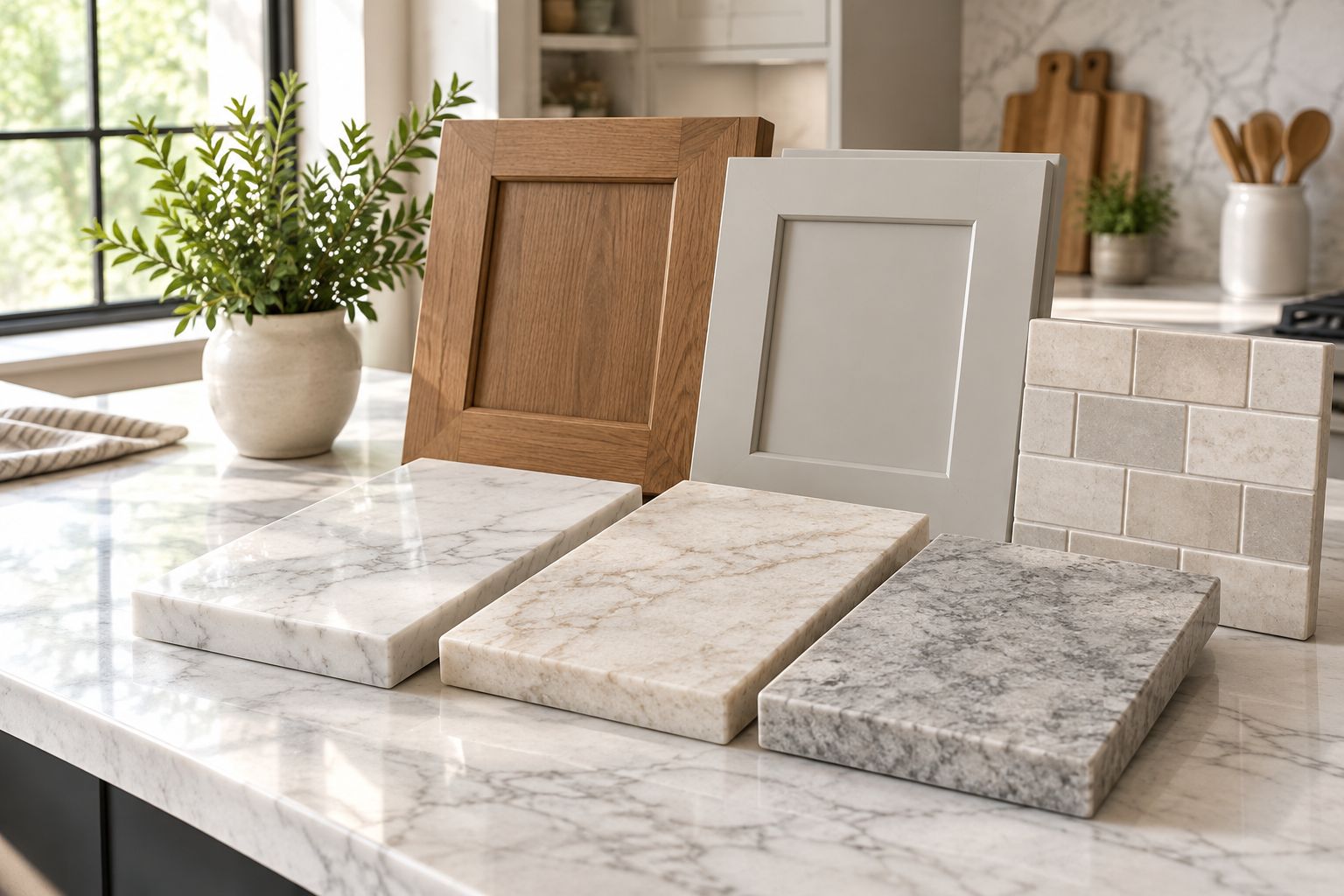
Start with physical samples beside the actual cabinet doors and backsplash. A countertop that looks neutral in isolation can introduce an unwanted warm or cool contrast once installed. Your reference is the room, not a showroom display.
Compare 3 material samples as a working shortlist, rather than collecting an open-ended set of possibilities. This is a decision method, not a rule about how many materials a project requires. Review each sample in daylight and under the lighting used for showings.
Use the guide to matching countertops with cabinets when the cabinet finish is staying. For your 2026 staging brief, document the selected combination so later styling choices follow the same direction.
- Place each sample directly beside the cabinet and backsplash finishes.
- Compare undertones before judging veining or decorative detail.
- Review the combination from the kitchen and adjoining room.
- Photograph the shortlist without filters or portrait effects.
Match the material to the staging assignment
Begin with the existing countertop. If it is sound and works with the room, keeping it avoids demolition and installation coordination. A new surface is justified when the retained surface cannot meet the agreed brief through appropriate cleaning, repair, or styling.
For replacements, compare care requirements as well as appearance. Engineered quartz does not require sealing, but it still needs protection from excessive heat. Marble is vulnerable to acid etching; sealing does not prevent that chemical reaction. Granite and quartzite need care decisions based on the particular stone and finish.
Soaresstone countertop projects include marble, granite, quartz, and quartzite. Bring the room photographs and approved brief to the material discussion rather than asking for a universally best stone. The service covers custom fabrication and installation; it does not remove the need for seller approvals or a coordinated listing schedule.
- Favor restrained patterns when the room already contains competing finishes.
- Review the actual natural-stone slab before approving its appearance.
- Ask for care instructions specific to the selected material and finish.
- Keep material choice separate from promises about resale performance.
Confirm the sink, edges, and installation scope
Start by listing every component that touches the countertop. A replacement decision also involves the sink, faucet holes, backsplash transition, cabinet condition, and any supported overhang. These details belong in the scope before fabrication begins.
Have the fabricator confirm measurements and installation requirements. Your preliminary measurements support a discussion; they do not replace professional templating. For a 2026 project, keep the approved sink information and countertop selections together so different trades are not working from different versions.
A simple edge is a useful default for an understated staging brief, but it is not automatically right for every home. Match the detail to the retained cabinetry and the property’s architectural character.
- Confirm the sink model and mounting arrangement before cutouts are finalized.
- Specify the edge profile and visible finished edges.
- Ask the fabricator to explain proposed seam locations.
- Assign responsibility for removal, plumbing, and backsplash work.
- Confirm cabinet readiness and support requirements with the installer.
Build the schedule around completed work
Start with a shared calendar and work backward from photography. Identify the dependencies rather than assigning an unsupported installation duration. Material approval, templating, fabrication, installation, plumbing, and cleaning each need a clear owner.
Ask the fabricator which decisions must be final before the next phase begins. Confirm dates directly; do not treat a quotation request or material discussion as a scheduled installation. The practical benefit of using a fabrication and installation provider is having those countertop tasks addressed together, not a guaranteed completion speed.
For 2026 listing preparation, make photography conditional on a finished, usable room. If replacement cannot fit the confirmed schedule, revisit the scope with the homeowner and agent instead of concealing unfinished work with styling.
- Record who approves the material, layout, and fabrication details.
- Confirm when the cabinets and sink information must be ready.
- Arrange plumbing and other trade work with the responsible providers.
- Schedule cleaning and staging after installation-related work is complete.
- Reconfirm photography after checking the room’s actual readiness.
Style and inspect the finished countertop
Start with a clear surface and add only objects that explain how the space functions. A tray beside a coffee station or a cutting board near a preparation area can establish purpose without hiding the countertop.
Check 2 camera views before final photography: the main kitchen view and the view from the adjoining space. This is a practical review exercise, not a photography standard. Look for glare, distracting reflections, and accessories that interrupt the countertop’s edge.
Keep the care instructions with the seller or whoever maintains the home during showings. Styling should not introduce risks such as abrasive objects dragged across a surface or acidic spills left on marble.
- Leave the sink, faucet, and primary preparation area visible.
- Remove cleaning bottles, packaging, and unnecessary small appliances.
- Use protective pads beneath accessories where appropriate.
- Inspect the surface again after props and appliances are moved.
- Give the showing team material-specific cleaning instructions.
Compare countertop options for home staging
The best countertop option is the one that resolves the documented problem with an acceptable scope of work. Use this comparison to narrow the brief, then evaluate the actual surface or slab. The best-for labels describe project fit, not a ranking of sale-price outcomes.
| Option | Best for | Main advantage | Key limitation |
|---|---|---|---|
| Keep the existing countertop | Sound surfaces that already fit the room | Avoids replacement work and preserves the existing layout | Cleaning cannot correct every chip, crack, or color conflict |
| Engineered quartz | Replacement briefs prioritizing straightforward routine care | Does not require sealing | Requires protection from excessive heat; review the selected pattern in the room |
| Granite | Kitchens where natural pattern complements retained finishes | Offers natural variation and a durable work surface | Slab variation and stone-specific care require review |
| Marble | Character-led rooms where the owner accepts visible aging | Provides natural veining and a distinctive stone appearance | Acids can etch the surface, including after sealing |
| Quartzite | Projects seeking natural-stone movement with a coordinated fabrication plan | Provides natural pattern and a hard stone surface | Care, slab characteristics, and fabrication details need individual assessment |
Do not choose from the material name alone. A highly patterned granite and a quieter granite create different visual relationships with the same cabinets. Likewise, a quartz sample does not show the entire installed pattern layout.
For a 2026 staging assignment, approve the room combination and the project scope together. An attractive material is not a complete decision if the sink, backsplash transition, and schedule remain unresolved.
Discuss your countertop project
Review custom marble, granite, quartz, or quartzite surfaces for a New England home.
Common mistakes home stagers make
Replacing a surface before testing a simpler presentation
Clutter and poor lighting can obscure a countertop’s actual condition. Clear, clean, and photograph the room before recommending construction. Keep a sound surface when styling solves the defined problem.
Selecting a sample without the retained backsplash
The backsplash sits directly against the countertop, so an undertone mismatch remains visible even after careful styling. Approve those finishes together. If the backsplash must change, include that work in the seller’s decision rather than treating it as an incidental adjustment.
Choosing marble without explaining etching
A homeowner preparing for showings needs to understand the difference between an absorbed stain and acid-related surface dulling. Do not describe sealing as protection against all marks. Provide appropriate care instructions and confirm that the owner accepts the material’s limitations.
Scheduling photography before trade work is confirmed
A finished countertop does not necessarily mean the sink is reconnected or the room is clean. Treat photography as the final presentation milestone. Assign the remaining work explicitly instead of assuming the countertop installer handles every task.
Presenting a material preference as a resale guarantee
A stager’s preference is not evidence of a financial return. Explain why the proposed countertop fits the room and solves the identified issue. Keep any property-specific pricing discussion with the seller and real estate agent.
FAQ
What are the best countertops for home stagers?
The best countertops for home stagers fit the retained finishes, the surface-care needs, and the confirmed listing schedule. Keep a sound existing countertop when cleaning and styling solve the presentation problem; compare replacement materials only when the brief requires new surfaces.
Should I replace countertops before staging a house?
Replace countertops when their condition or appearance creates a problem that appropriate cleaning, repair, or styling cannot resolve. Obtain the homeowner’s approval and confirm the full installation scope before committing to photography.
Is quartz better than granite for a staged kitchen?
Quartz is better suited to a brief that prioritizes a surface without sealing requirements, while granite suits projects where natural variation complements the room. Neither material is automatically better for staging; compare actual samples against the retained finishes.
Are marble countertops a bad choice before selling?
Marble is not automatically a bad choice, but its acid-etching risk must be understood. Retain attractive existing marble when it fits the presentation, and explain its care requirements before recommending new marble.
What countertop color should I choose for listing photos?
Choose a countertop color that coordinates with the actual cabinets, backsplash, and flooring. Compare physical samples under the home’s lighting rather than assuming a particular white, gray, or beige works everywhere.
Can a home stager measure countertops for fabrication?
A home stager can collect preliminary dimensions for planning, but the fabricator should confirm the measurements required for fabrication. Final decisions also depend on the sink, cabinet readiness, seams, and support requirements.
Does Soaresstone offer staging services?
Soaresstone provides custom marble, granite, quartz, and quartzite countertop fabrication and installation for New England homeowners. Use a home stager for presentation planning and discuss physical countertop work with the fabrication and installation provider.
One last thing
Inspect the kitchen from the doorway before adding the final accessory. A close-up rewards stone detail, but the doorway view tests whether the countertop belongs with the cabinets, backsplash, and floor. If that combination works without props, your staging has a sound starting point.
Related guides
- Countertops for real estate agents
- How to prepare your kitchen for countertop installation
- How to plan a countertop template appointment