
Yes—most quartzite countertops benefit from a penetrating sealer, but you should confirm that your particular slab absorbs liquids before applying or renewing one. Sealing reduces absorption and staining; it does not make quartzite stain-proof, repair damage, or replace prompt spill cleanup. For your 2026 care plan, follow the stone supplier’s guidance and the sealer manufacturer’s instructions rather than assuming every quartzite countertop needs annual treatment.
- Do you have to seal quartzite? Usually yes; confirm your slab’s absorption and existing treatment before applying sealer.
- Quartzite sealing reduces staining risk, but it does not prevent scratches, chips, or every spill-related mark.
- Soares Stone serves New England homeowners seeking custom quartzite countertop fabrication and installation.
- Choose resealing intervals from the stone’s condition and product instructions, not a universal annual schedule.
Does quartzite need to be sealed?
Most quartzite needs sealing because natural stone can absorb liquids through its pore structure. However, absorption varies between slabs, and an existing treatment changes whether another application is appropriate. A very dense or adequately protected surface does not benefit from sealer left sitting on top.
For homeowners planning a new installation, Soares Stone provides custom quartzite countertop fabrication and installation in New England. Before handover, ask which treatments your selected stone has received and what ongoing care those treatments require.
Use this sequence to decide whether sealing belongs on your maintenance list:
- Confirm the material. Check that your countertop is natural quartzite, not engineered quartz or another stone sold under a confusing commercial name.
- Check existing treatment. Review the fabrication paperwork and ask whether the slab or finished countertop has already been sealed.
- Assess absorption. Follow your fabricator’s recommended water-check method on a clean, inconspicuous area.
- Choose the next action. Seal absorbent stone with a compatible product; seek advice if moisture, residue, or an existing stain makes the result unclear.
That sequence matters more than choosing a recurring calendar date. In 2026, a countertop that already repels liquids does not automatically need another application simply because you cannot remember its last treatment.
Why this matters
Quartzite’s hardness and its resistance to liquid absorption are different properties. A stone can resist everyday scratching yet still develop a dark mark when oil or another liquid enters its pores.
Sealing buys protection against absorption; it does not give you permission to leave spills. You still need to wipe up cooking oil, beverages, and other contaminants promptly. Keep cutting boards and trivets in your routine because an impregnating sealer is not a protective shield against physical or thermal damage.
There is also a downside to unnecessary treatment. Sealer that the stone cannot absorb can leave streaks, haze, or a sticky residue if you do not remove the excess correctly. More product is not the same as more protection.
What does quartzite sealer actually do?
A penetrating, or impregnating, sealer enters accessible pores and reduces the stone’s ability to absorb liquids. It is different from a surface coating intended to form a film over the countertop.
For a kitchen, confirm that the selected product is suitable for your particular stone, finish, and food-preparation setting after curing. Read whether it provides water repellency, oil repellency, or both. Do not assume every product labeled for natural stone offers identical protection.
Sealing also does not remove an existing stain. If the countertop already has a dark patch, identify and address that problem before adding another treatment. Otherwise, you risk treating the symptom as a maintenance reminder without resolving its cause.
A color-enhancing treatment is another separate choice. Some treatments intentionally deepen the stone’s appearance, so test the specified product in an approved inconspicuous area before committing to the whole countertop.
Is quartzite different from quartz when it comes to sealing?
Quartzite and engineered quartz have different care requirements. Natural quartzite can absorb liquids and often benefits from an appropriate impregnating sealer; engineered quartz generally does not require routine sealing.
If avoiding a sealing task is central to your material decision in 2026, compare that maintenance difference before selecting a slab. Neither material eliminates the need for cleaning or protection from misuse.
| Material | Best for | Sealing requirement | Advantage | Limitation |
|---|---|---|---|---|
| Natural quartzite | Homeowners who want natural stone and accept slab-specific care | Assess absorption and follow stone-specific sealing guidance | Natural variation and a hard mineral structure | Absorption varies, and sealing does not eliminate staining risk |
| Engineered quartz | Homeowners who prioritize avoiding routine sealing | Generally does not need a penetrating sealer | Routine sealing is usually unnecessary | Still requires manufacturer-approved cleaning and protection from excessive heat |
This is a maintenance comparison, not a promise that either surface is damage-proof. Choose the material whose appearance and care requirements fit how you actually use your kitchen.
How can you tell whether quartzite needs resealing?
A controlled water check can help reveal absorption, but it is a screening tool rather than a complete diagnosis. Start with a clean, dry countertop and use your fabricator’s recommended method; do not test with oil, wine, lemon juice, or another substance that can leave damage or staining.
Watch the stone beneath the water, not just the shape of the droplets. Water beading alone does not prove that the countertop has adequate protection against every staining liquid.
What if the stone darkens under water?
Temporary darkening can indicate that moisture is entering the stone. Let the area dry fully, then discuss the result with your fabricator before choosing a compatible sealer.
Darkening does not automatically mean permanent staining or a failed installation. The location matters: moisture around a sink, seam, or cutout deserves closer inspection rather than an immediate whole-countertop treatment.
What if the stone does not darken?
No visible darkening supports leaving a well-performing surface alone, subject to the existing product’s care instructions. It does not establish unlimited resistance to oil or other contaminants.
Keep the observation in your 2026 maintenance notes. Record where you checked and what happened so a later comparison reflects the same area rather than a different part of the slab.
Why quartzite sealing frequency varies
There is no universal resealing interval for every quartzite countertop. Your stone’s absorption, its existing treatment, and the way you care for it determine whether another application is appropriate.
These factors explain why two quartzite countertops can need different maintenance:
- Stone absorption. Natural variation affects how readily a slab takes in liquids. Do not transfer advice from a different slab based only on a similar color or trade name.
- Existing treatment. Previous sealers and fabrication treatments affect product compatibility and whether another application can enter the stone.
- Surface finish. The finish affects surface behavior and product selection. Confirm suitability instead of assuming polished and textured surfaces need identical treatment.
- Cleaning products. Unsuitable cleaners can affect the stone, its finish, or its treatment. Use products approved for your countertop rather than treating resealing as a remedy for cleaning damage.
- Exposure and use. A frequently wet sink area and a dry serving counter face different conditions. Inspect the areas that receive spills and moisture instead of judging the entire countertop from an untouched corner.
For your 2026 schedule, set a reminder to inspect the surface and review its care instructions. A reminder to inspect is useful; an automatic instruction to add sealer regardless of condition is not.
How do you seal quartzite correctly?
The correct application method comes from the compatible sealer’s label and your fabricator’s guidance. Do not borrow dwell times, coat counts, or curing instructions from a different product.
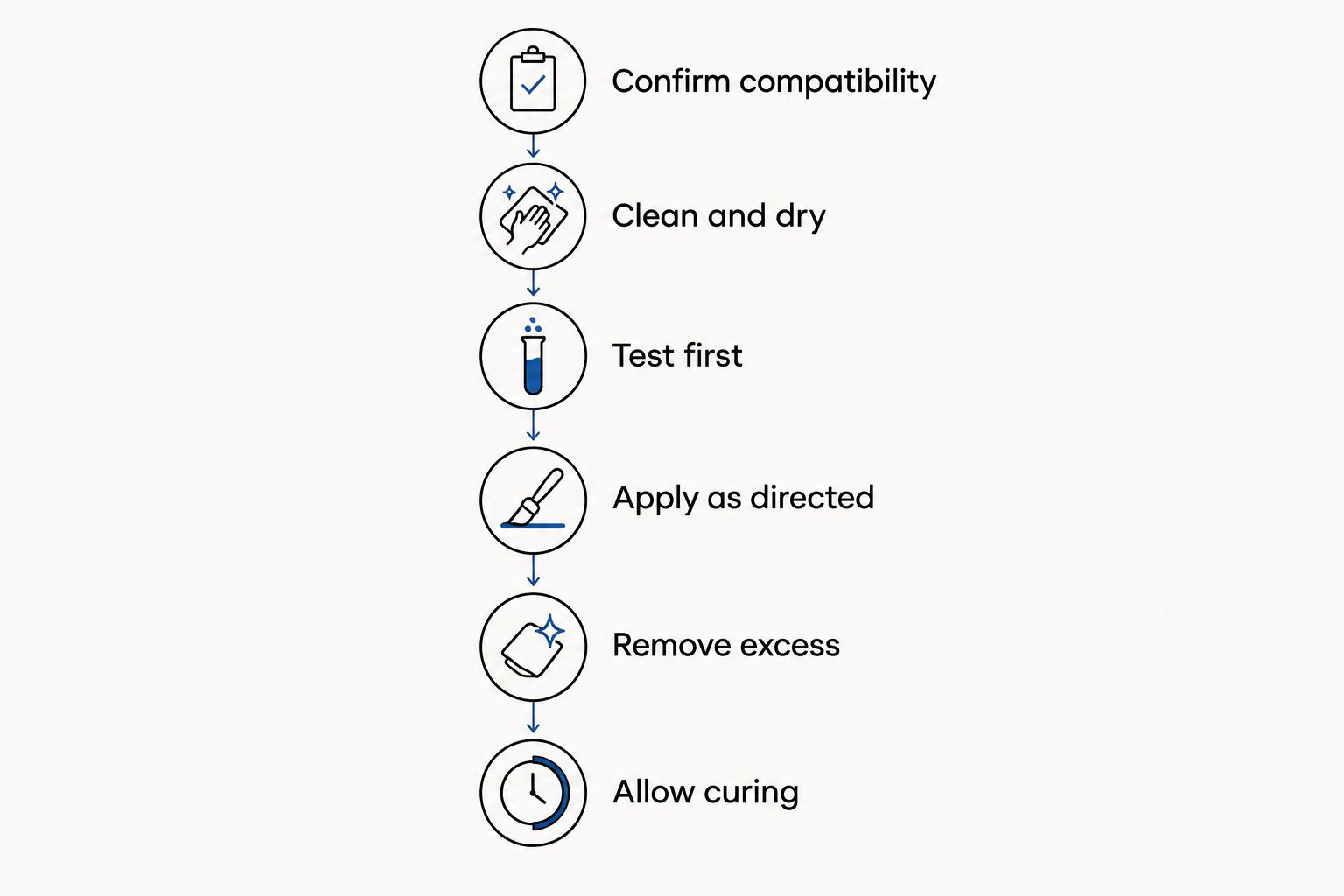
The following sequence explains the work without replacing those instructions. For a dedicated walkthrough, see how to seal quartzite countertops.
- Confirm compatibility. Identify the stone, finish, and any existing treatment. Select a product approved for that combination and the countertop’s intended use.
- Clean and dry. Remove surface contamination with an approved cleaner and allow the stone to dry as directed. Resolve unexplained moisture or staining before proceeding.
- Test first. Check an inconspicuous area for appearance changes and residue. Stop if the product produces an unwanted result.
- Apply as directed. Follow the label’s application method and working conditions. Keep the area ventilated as instructed and protect nearby materials.
- Remove excess. Wipe away unabsorbed product within the specified window. Do not leave it to dry on the surface in the hope of creating a stronger barrier.
- Allow curing. Follow the label before exposing the countertop to water, cleaning products, or food preparation. Dry to the touch does not necessarily mean fully cured.
If you cannot identify the previous treatment, get advice before layering a new product over it. The same applies to persistent haze, a sticky finish, or dark areas that do not dry normally.
Can you seal quartzite yourself, or should you get help?
DIY sealing is reasonable only when you understand the existing surface treatment and can follow a compatible product’s instructions. The practical advantage is handling a straightforward maintenance task yourself; the drawback is that product selection and residue removal still require care.
Professional assessment is the better fit when the problem is unclear. A dark area near a sink, an unidentified coating, or a changing surface appearance needs diagnosis before treatment—not simply another coat.
Soares Stone is a fit for New England homeowners seeking custom quartzite countertop fabrication and installation. For a new project, discuss sealing responsibilities and ongoing care before installation; do not assume fabrication and installation automatically include a continuing maintenance service.
Plan your quartzite countertop project
Discuss custom quartzite fabrication and installation for your New England home.
Will sealing stop quartzite from staining?
Sealing reduces staining risk, but it does not guarantee a stain-proof quartzite countertop. A protected surface still needs prompt cleanup, particularly after contact with oil or strongly colored liquids.
Blot spills rather than spreading them across a larger area. Then clean with a product approved for the stone and its treatment; avoid experimenting with aggressive chemicals to chase a mark.
Will sealing fix a dull spot or dark patch?
Sealing is not a repair for a dull spot, scratch, chip, or existing stain. Those symptoms can have different causes, and a product intended to reduce absorption does not correct all of them.
Inspect the area after ordinary cleaning and drying. If the mark persists, describe its location, appearance, and history to your fabricator before attempting a treatment.
Should you reseal quartzite every year?
Annual resealing is not a universal requirement for quartzite. Follow the actual sealer instructions and assess how your countertop handles moisture rather than treating an anniversary as proof that protection has failed.
For a 2026 maintenance record, keep the product name, application date, and care directions together. That information makes the next decision easier without committing you to unnecessary applications.
FAQ
Do you have to seal quartzite before using it?
Quartzite that needs sealing should receive an appropriate treatment and complete the specified curing process before normal use. Ask your fabricator whether the installed surface has already been treated and when it is ready for use.
How often do you have to seal quartzite countertops?
Quartzite resealing frequency depends on the slab’s absorption, its existing treatment, and the sealer manufacturer’s directions. Inspect the surface rather than assuming every countertop needs annual treatment.
Can I use the same sealer on quartzite and granite?
Use the same sealer only if its manufacturer approves it for both stones and the particular finishes and treatments involved. A general natural-stone label does not remove the need to check compatibility.
Does sealed quartzite still absorb water?
Sealed quartzite can still absorb moisture because penetrating sealers reduce absorption rather than making stone completely impermeable. Persistent darkening near sinks or seams needs assessment rather than an automatic extra coat.
Does quartzite sealer protect against heat and scratches?
Quartzite sealer does not provide a protective barrier against heat, scratches, or chips. Continue using trivets and cutting boards after sealing.
Why is my quartzite cloudy after sealing?
Cloudiness after sealing can result from excess product left on the surface, but the appearance alone does not establish the cause. Follow the product manufacturer’s troubleshooting guidance and avoid abrasive attempts to remove the haze.
Is quartzite sealing the same as polishing?
Quartzite sealing and polishing are different processes. Sealing reduces liquid absorption, while polishing changes the stone’s surface finish; neither should be used as a substitute for diagnosing damage.
One last thing
Ask for the sealer name, not just confirmation that the stone was sealed. A product label gives you compatibility, cleaning, and curing instructions that a general assurance cannot provide.
When planning quartzite countertops with Soares Stone, make that care discussion part of your installation questions. Keep the written guidance with your project documents so you can maintain the actual surface you own—not an imagined average quartzite slab.
Related guides
- Countertop sealing frequency by stone type
- How to disinfect natural stone countertops safely
- How to remove hard-water stains from stone countertops