
Your fireplace surround installation cost in 2026 depends on the stone, finished dimensions, fabrication details, and condition of the wall behind it; get an itemized project quote before setting your budget. Stone installation alone does not establish whether demolition, a new hearth, wall repairs, or fireplace appliance work is included.
- Fireplace surround installation cost requires an itemized quote covering stone, fabrication, installation, and any separate renovation work.
- Compare fireplace surround quotes against the same drawings, material selection, hearth details, and preparation requirements.
- Soaresstone suits New England homeowners seeking custom stone fireplace fabrication and installation.
- Confirm fireplace manufacturer requirements before approving stone placement, mantel details, or the finished opening.
Why this matters
A lower total means little when the quotes cover different work. A surround-only proposal and a complete fireplace renovation are not interchangeable, even when both descriptions say stone installation.
For a 2026 renovation, establish the fireplace scope before comparing material selections. Use the guide to timing a fireplace renovation around stone surround work to organize the handoffs between preparation, measurement, fabrication, and installation.
Your goal is a finished fireplace with clear responsibilities—not simply a piece of stone delivered to the room.
How much does a fireplace surround installation cost in 2026?
A fireplace surround needs a project-specific installation quote that separates the stone work from the surrounding renovation. Ask for the following breakdown so you can compare proposals without confusing included work with optional work.
| Quote component | What the written scope should identify | What to clarify |
|---|---|---|
| Stone selection | Material, finish, thickness, and selected layout | Whether the quote describes your actual selection |
| Fabrication | Finished pieces, exposed edges, openings, and returns | Which details require separate approval |
| Installation | Setting the surround and completing specified joints | Who provides the prepared installation surface |
| Existing surround removal | Removal and disposal of existing finishes | Whether removal is included or separately arranged |
| Wall preparation | Assessment and required preparation behind the stone | Who handles repairs discovered after removal |
| Hearth work | Retaining, replacing, or adding the specified hearth | Whether hearth fabrication and installation are included |
| Adjacent finishes | Mantel, trim, drywall, and paint responsibilities | Who leaves the surrounding room finished |
| Fireplace equipment | Any appliance, venting, gas, or electrical work | Which qualified contractor handles that work |
Do not treat every row as a required purchase. Treat it as a scope check: each item should be included, excluded, or marked as unnecessary for your project.
An allowance for an undecided material is different from a quote for an approved stone selection. Ask the contractor to identify unresolved selections before you compare totals or authorize fabrication.
Surround-only replacement: best for a retained fireplace layout
A surround-only replacement keeps the project focused on the visible stone around the fireplace opening. It suits a plan that retains the appliance, hearth arrangement, and general dimensions, subject to professional assessment.
Best for: homeowners who want a new stone finish without redesigning the entire fireplace. The advantage is a narrower scope with fewer design decisions outside the surround itself.
The limitation is the existing construction. Keeping the layout does not establish that the concealed wall is ready for new stone, and removal can expose preparation work that needs separate approval.
Ask the installer to distinguish between setting new stone and making the underlying surface ready. That distinction belongs in writing before demolition begins.
Surround and hearth replacement: best for a coordinated finish
Replacing the surround and hearth together lets you coordinate their appearance, junctions, and exposed edges. The hearth is the surface at the base of the fireplace; it should not disappear into a vague reference to stone work.
Best for: homeowners who want the vertical surround and hearth designed together. Reviewing both surfaces at once helps you decide how the materials meet and which edges remain visible.
The trade-off is a broader scope. Hearth dimensions, support, nearby flooring, and fireplace requirements need review alongside the surround design.
Ask whether the proposal includes removing the existing hearth and finishing the transition to the floor. A new surround does not automatically include either task.
Full fireplace redesign: best for changing the overall composition
A full redesign can include a taller stone feature, different mantel arrangement, revised hearth, or changes around the fireplace appliance. Define those changes individually rather than using a single description such as fireplace makeover.
Best for: homeowners changing more than the stone finish. This approach gives you room to coordinate the fireplace with the wall and adjacent finishes.
Its limitation is coordination. Stone fabrication does not replace the work of an appliance installer, electrician, gas professional, or contractor responsible for wall construction.
Confirm who approves the final opening and preparation before the stone is measured. A change to the appliance or wall after measurement can invalidate the dimensions used for fabrication.
Compare the installation scopes
| Option | Best for | Main advantage | Main limitation |
|---|---|---|---|
| Surround-only replacement | Retaining the fireplace layout | Keeps design work focused on the surround | Existing wall conditions still need assessment |
| Surround and hearth replacement | Coordinating adjoining stone surfaces | Resolves the surround-to-hearth details together | Adds hearth and floor-transition decisions |
| Full fireplace redesign | Changing the overall composition | Coordinates stone with a broader renovation | Requires clear responsibilities across trades |
These are scope categories, not fixed packages. Ask your contractor to describe your project rather than assuming a category includes every related task.
Why fireplace surround installation cost varies
The work changes when the design or site conditions change. Use these factors to ask specific questions instead of relying on a general description such as custom installation.
- Material selection. Identify the actual stone, finish, and approved application. A material name alone does not describe the finished fabrication scope.
- Surface area and layout. Record the surround height, width, opening, hearth dimensions, and any side returns. Those details establish what must be made.
- Fabrication details. Exposed edges, corner treatments, joints, and vein alignment affect how the pieces are planned and fabricated.
- Existing conditions. Separate removal of the old finish from repairs or preparation behind it. Do not assume the concealed surface is installation-ready.
- Handling and access. Tell the installer about stairs, narrow entries, restricted parking, and the route to the fireplace so delivery and placement can be planned.
- Related renovation work. Identify mantel changes, flooring transitions, wall finishes, and appliance work separately. Assign each task to a named contractor.
Reduce unnecessary design complexity before removing necessary preparation. Ask what changes if you retain the opening, simplify exposed edges, or keep the existing hearth, then assess each revision against the finished result you want.
How do you get a useful fireplace surround quote?
For a 2026 project, prepare a consistent brief and give the same information to every contractor. The quote is easier to evaluate when the design does not change between conversations.
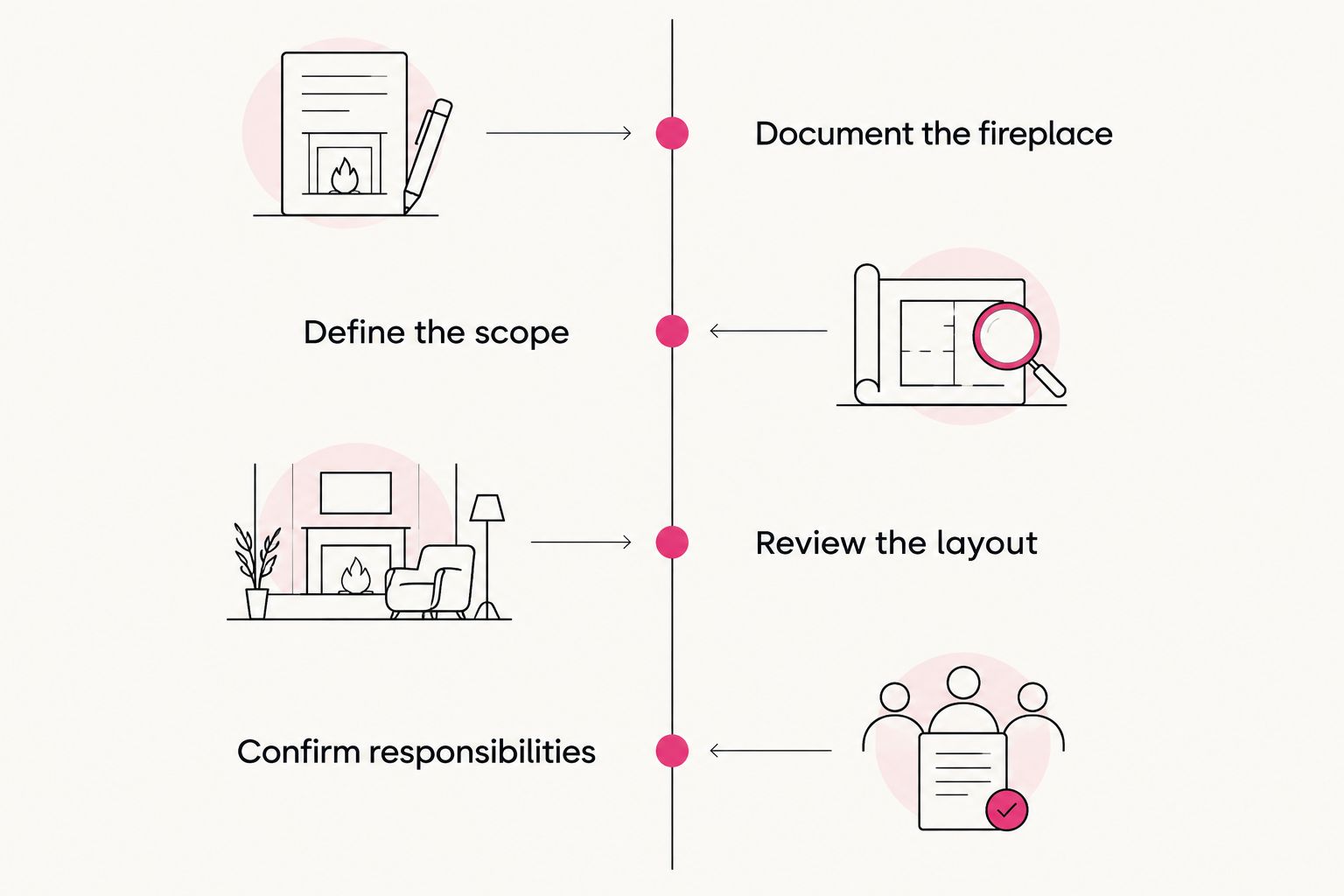
Document the fireplace
Photograph the whole wall, the opening, the hearth, and nearby trim. Include views of the access route if getting large pieces into the room requires special planning.
Find the fireplace manufacturer and model information when an appliance is present. Have the responsible professional check the applicable installation instructions; a photograph alone does not establish clearances or material suitability.
Define the scope
State what stays and what changes. Specify whether you want surround replacement only, coordinated hearth work, or a broader redesign.
Describe the desired appearance without making the drawing a substitute for technical approval. Show where you want stone, then have the installer and fireplace professional confirm the appropriate assembly.
Review the layout
Ask to review piece boundaries, exposed edges, and visible joints before fabrication. If natural veining matters to you, discuss its direction and continuity at this stage.
A small sample helps with material selection, but it does not describe the complete layout. Confirm which visual decisions are approved and which remain open.
Confirm responsibilities
Have the proposal name the party responsible for removal, wall preparation, stone installation, hearth work, and adjacent finishing. Also identify who coordinates any appliance-related work.
Ask how unexpected conditions and design changes receive written approval. Resolve the process before work starts, rather than debating responsibilities after the old surround is removed.
Is stone selection enough to establish fireplace suitability?
Stone selection alone does not establish that a fireplace assembly is suitable. The fireplace manufacturer's instructions, applicable requirements, substrate, setting materials, and installation details all need review.
Natural stone and engineered quartz are different material categories. Do not assume a surface used successfully on a kitchen counter is approved beside your fireplace opening.
Soaresstone provides custom stone fabrication and installation for homeowners' fireplaces. Discuss the intended application with Soaresstone and confirm the selected material and assembly against the specific fireplace requirements before approving the design.
Soaresstone is best for New England homeowners seeking custom stone fireplace fabrication and installation. Keep that service scope distinct from appliance servicing, chimney work, or other renovation tasks unless your written proposal explicitly includes them.
Does a new hearth have to be included?
A new hearth is a separate scope decision, not an automatic part of surround replacement. Have the fireplace professional assess whether the existing hearth works with the retained appliance and proposed design.
If you keep it, ask the stone installer to explain the junction between the new surround and existing hearth. If you replace it, include its dimensions, exposed edges, support, and floor transition in the approved scope.
Can you keep the existing mantel?
You can plan to retain the mantel, but its position and projection still need review against the fireplace requirements and proposed stone layout. Keeping it is a design preference, not confirmation that the finished arrangement meets those requirements.
Ask who removes and reinstalls the mantel if that work is necessary. Also confirm who repairs or paints the adjoining wall afterward.
Should you choose the lowest installation quote?
Choose the lowest quote only after confirming equivalent scope and acceptable installation details. A smaller total does not establish better value when another proposal includes preparation, hearth work, or finishing that it excludes.
Compare the same drawings and material selection. Then review exclusions, unresolved items, and change-approval terms before deciding.
Discuss your fireplace stone project
Share your fireplace layout and renovation scope with Soaresstone.
FAQ
How do I budget for fireplace surround installation in 2026?
Start with an itemized quote for your approved fireplace surround design. Separate stone fabrication and installation from demolition, hearth work, wall preparation, and appliance-related work.
Does fireplace surround installation include removing the old surround?
Removal is included only when the written proposal says so. Ask whether disposal and preparation of the exposed wall are included as well.
Is a hearth included with a stone fireplace surround?
A hearth is included only when it appears in the agreed scope. Specify whether the existing hearth stays, is replaced, or needs assessment before the surround is fabricated.
Can I use engineered quartz around my fireplace?
Do not assume engineered quartz is suitable around your fireplace. Confirm the specific material manufacturer’s guidance and fireplace installation requirements before selecting it.
Can I measure the fireplace myself for a quote?
Your measurements and photographs can help describe the project for an initial discussion. Have the responsible installer verify the dimensions and approved layout before fabrication.
What should I compare between fireplace surround quotes?
Compare the material selection, finished dimensions, fabrication details, installation scope, preparation responsibilities, and exclusions. Use the same project brief so each contractor is quoting equivalent work.
Who handles gas or electrical work during a fireplace renovation?
Assign gas or electrical work to the appropriately qualified professional, with responsibilities recorded in the renovation scope. Do not assume the stone installation proposal includes those services.
One last thing
Before approving your 2026 fireplace project, ask every contractor the same question: What will still need to be done after your part is finished? That answer exposes the gap between an installed stone surround and a completed room.
Add each remaining task to the renovation plan and assign an owner. A clear handoff is more useful than a proposal that leaves the finishing work undefined.
Related guides
- How to install a marble fireplace surround
- How to maintain a granite fireplace surround
- How to choose a countertop fabricator