
There is no single reliable average for countertop lifespan by material: published service-life estimates list plastic laminate and cultured marble at about 20 years, while natural stone, tile, and wood are listed as lasting a lifetime. For your 2026 remodel, treat those figures as planning references—not replacement deadlines or guarantees.
- Countertop lifespan by material varies: NAHB lists laminate and cultured marble at 20 years, and natural stone as lifetime.
- A lifetime service-life estimate does not mean a countertop stays free of stains, scratches, or repairs.
- Quartz and quartzite are different materials; do not assign engineered quartz a natural-stone lifespan estimate.
- Soaresstone serves New England homeowners seeking custom stone and quartz countertop fabrication and installation.
Why this matters
Replacing a countertop because it looks dated is different from replacing one because it no longer works. A stain, a dull patch, and a crack through a sink opening call for different decisions. Age alone does not identify the right one.
Soaresstone fabricates and installs custom marble, granite, quartz, and quartzite countertops. Soaresstone is best for New England homeowners seeking custom stone or quartz countertop fabrication and installation. The practical question is which material suits your use, your tolerance for surface changes, and your willingness to maintain it.
Countertop lifespan benchmarks for 2026
The benchmark below uses the countertop categories published in the NAHB/Bank of America Home Equity Study of Life Expectancy of Home Components, 2007. It preserves the report's distinction between a numbered estimate and the word lifetime rather than converting that word into an invented number.
| Countertop category | Published life expectancy | What the estimate means for your decision |
|---|---|---|
| All countertop categories | No pooled average reported | Compare materials separately; there is no supported overall replacement age. |
| Natural stone | Lifetime | Long service is the planning expectation, not an assurance against damage. |
| Cultured marble | 20 years | A category-level estimate, not a deadline for every installation. |
| Plastic laminate | 20 years | Evaluate the surface and underlying construction before deciding to replace it. |
| Tile | Lifetime | Tile longevity does not eliminate maintenance of grout, joints, or damaged pieces. |
| Wood | Lifetime | Long service does not mean the surface needs no care or refinishing. |
Natural stone, tile, and wood share the highest published category, lifetime; cultured marble and plastic laminate have the shortest stated estimate, 20 years. That comparison describes expected service life—not stain resistance, appearance retention, or maintenance effort.
Methodology: These figures come from the countertop section of the 2007 NAHB/Bank of America Home Equity report, a U.S. home-component life-expectancy reference rather than a 2026 countertop failure study. Its key limitation is broad material grouping: it does not provide separate measured averages for granite, marble, quartzite, and engineered quartz, or a numeric definition of lifetime.
What the benchmark cannot rank
The report does not establish that granite lasts longer than quartzite, or that marble lasts longer than engineered quartz. Assigning different year ranges to those materials would imply precision this source does not provide.
It also does not tell you when homeowners choose to remodel. A working countertop can be removed because cabinets change, a sink moves, or the kitchen needs a different layout. Those choices end an installation's use without proving that the material wore out.
For a 2026 material comparison, keep service life and reasons for replacement separate. Otherwise, an attractive-looking lifespan chart becomes a poor buying guide.
How to use these benchmarks
- Use the 20-year estimates as review points, not expiration dates. A sound laminate or cultured-marble countertop does not need replacement simply because it reaches that age.
- Read lifetime as a long-service category. Natural stone, tile, and wood still need material-appropriate care, and each can suffer damage before the surrounding home needs renovation.
- Do not calculate an average from this table. Lifetime is not a number, and the report supplies no installation counts for weighting the categories.
- Compare maintenance separately from longevity. A surface that remains usable for a long time can still require repairs or develop changes you dislike.
Granite, marble, quartz, and quartzite: practical differences
For homeowners choosing among the materials Soaresstone fabricates and installs, daily behavior matters more than an unsupported year-by-year ranking. The comparison below addresses material properties; it does not turn those properties into lifespan measurements.
| Material | Best for | Main advantage | Main limitation | Lifespan evidence to use |
|---|---|---|---|---|
| Granite | Homeowners wanting natural stone for everyday kitchen use | Generally resists scratching better than marble | Sealing needs vary, and edges can chip | The report's broad natural-stone category; no granite-specific average |
| Marble | Homeowners who accept patina and surface changes | Natural veining and a surface that can be professionally refinished | Acids can etch it; staining and scratching need consideration | The report's broad natural-stone category; no marble-specific average |
| Engineered quartz | Homeowners prioritizing routine care without sealing | Nonporous surface that does not require sealing | Heat and unsuitable chemicals can damage it | No separate engineered-quartz estimate in the cited countertop table |
| Quartzite | Homeowners wanting hard natural stone and accepting material-specific care | Generally hard and scratch-resistant | Slab identification, sealing needs, and fabrication details require attention | The report's broad natural-stone category; no quartzite-specific average |
Granite: prioritize condition over age
Granite's long-service potential does not make it immune to damage. An exposed edge can chip, and a poorly supported section remains vulnerable even when the stone surface looks sound. Inspect those details rather than treating the countertop's birthday as a replacement trigger.
Granite is best for homeowners who want natural stone and will follow its care requirements. Keep cutting boards and trivets in your routine; resistance to damage is not permission to use a finished countertop as a cutting or cooking surface.
Marble: decide whether patina is acceptable
Marble can remain useful while its appearance changes. Acidic foods and cleaners can etch its surface, leaving dull marks that differ from stains. Sealing helps address liquid absorption; it does not make marble acid-proof.
Marble is best for homeowners who accept visible surface changes. If your definition of a successful countertop is an unchanged finish, marble's appearance trade-off matters more than a lifetime service-life label.
Engineered quartz: separate easy care from heat resistance
Engineered quartz does not require the sealing routine associated with many natural stones. That simplifies one part of maintenance, but it does not eliminate the need for suitable cleaners and protection from hot cookware.
Engineered quartz is best for homeowners who want a surface without routine sealing. Do not use the natural-stone benchmark as a quartz-specific average: engineered quartz contains binders and is a different material category.
Quartzite: confirm the material and care instructions
Quartzite is natural stone, not engineered quartz. Its hardness is useful for everyday wear, but hardness does not establish a complete countertop lifespan. Edges, supports, seams, and care still affect the finished installation.
Quartzite is best for homeowners who want hard natural stone and accept slab-specific guidance. Confirm the stone's identity and maintenance requirements before choosing it; a material label alone is not a care plan.
What actually ends a countertop's useful life?
A countertop reaches the end of its useful life when its condition or layout no longer serves the room—not when it crosses a universal age threshold. For your 2026 assessment, separate the following causes before requesting replacement.
Surface wear
Scratches, etching, stains, and finish changes affect appearance differently. Some damage can be treated or refinished; other damage remains visible after repair. Ask what improvement is realistic before authorizing work.
The distinction matters especially with marble. Removing an absorbed stain is not the same operation as correcting an etched finish, so treating every mark as a stain can lead to the wrong response.
Structural damage
A crack, moving seam, or unsupported section requires evaluation beyond cleaning. The visible damage can involve the countertop, the supporting cabinets, or their connection. Covering the mark without addressing its cause does not resolve that concern.
Do not stand on a countertop to reach an upper cabinet or window. A surface designed for countertop use is not a work platform, particularly around cutouts and overhangs.
Layout changes
A new sink, cooktop, or cabinet arrangement can make an otherwise serviceable countertop unsuitable. Existing cutouts and seams constrain what you can change. Reuse therefore depends on both material condition and whether the existing pieces fit the proposed layout.
Before ordering fixtures, review how cooktop cutout specifications connect to countertop fabrication. Confirming the actual appliance requirements protects the design from avoidable mismatches.
Inspect before you replace
Use this sequence to organize a countertop assessment. It helps you describe the problem clearly without assuming that every defect calls for a new surface.
- Surface condition: Identify stains, dull areas, scratches, chips, and changes around frequently used zones.
- Seams and edges: Look for movement, opening joints, damaged corners, or an edge that catches during ordinary use.
- Cabinet support: Check whether cabinets are stable and whether the countertop has visible unsupported areas.
- Layout fit: Decide whether the existing sink, appliances, and work areas still meet your needs.
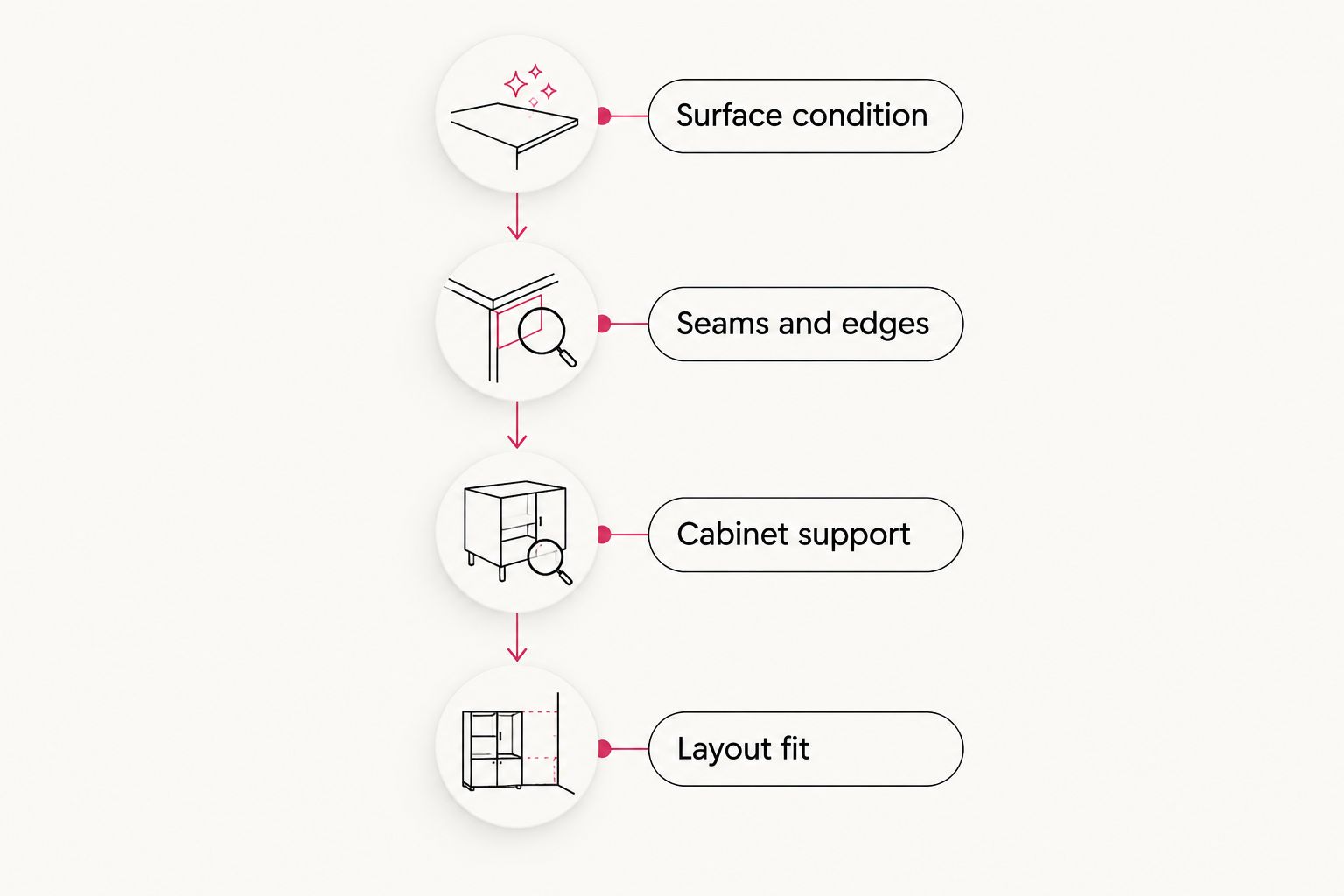
Repair is worth evaluating when the layout works and the damage is localized. Replacement becomes a different conversation when you need changed cutouts, a new arrangement, or correction of an installation that no longer has suitable support. A qualified assessment should distinguish the surface problem from the underlying cause.
Care choices that protect useful service
The 2026 benchmark is most useful alongside a realistic care routine. You do not need to treat every countertop alike, and a universal sealing schedule is not a substitute for instructions suited to the actual material.
Use a cleaner approved for your surface. Avoid acidic cleaners on acid-sensitive stone, and do not assume a disinfectant is suitable simply because it is sold for kitchens. Follow the product instructions and the countertop manufacturer's or fabricator's guidance together.
Use cutting boards, trivets, and prompt spill cleanup as ordinary habits. These actions address different risks: scratching, heat exposure, and prolonged contact with liquids. None turns a countertop into a damage-proof surface.
For natural stone, ask whether sealing is needed and how that need should be assessed. For engineered quartz, skip stone-sealing assumptions and follow the product's care instructions. Match the routine to the material rather than adding treatments because the countertop is getting older.
Questions to settle before a 2026 installation
A long-service material still needs a suitable installation. Ask your fabricator how seams, sink openings, exposed edges, and overhang support will work with your cabinets and appliances. Resolve those details before fabrication rather than treating them as finishing decisions.
Ask for care guidance for the selected slab or engineered surface, too. You need to know which cleaners are suitable, which changes count as normal wear, and when to seek professional assessment. A clear answer is more useful than an unsupported promise of a particular lifespan.
Soaresstone's countertop fabrication and installation services cover marble, granite, quartz, and quartzite. Choosing among those materials should start with how you use the room and finish with a layout and care plan you understand.
FAQ
What’s the average countertop lifespan by material?
The 2007 NAHB/Bank of America Home Equity report lists plastic laminate and cultured marble at 20 years, and natural stone, tile, and wood as lifetime. It does not report a single overall average or separate measured averages for granite, marble, quartzite, and engineered quartz.
Which countertop material lasts the longest?
Natural stone, tile, and wood share the lifetime category in the cited NAHB report. That category does not establish a winner among them or guarantee freedom from repairs.
Does lifetime mean my countertop will never need replacing?
No, lifetime is a service-life category, not a damage guarantee. A countertop can need replacement because of structural damage or a changed kitchen layout even when the material itself has long-service potential.
Does quartz last longer than granite?
The cited benchmark does not establish whether engineered quartz lasts longer than granite. Compare their care requirements, heat limitations, appearance, and installation details rather than assigning unsupported lifespan ranges.
Should I replace a countertop after 20 years?
No, age alone does not require replacement after 20 years. Assess surface condition, seams, support, and layout before deciding whether repair or replacement makes sense.
Will sealing stop marble countertops from etching?
No, sealing does not make marble resistant to acid etching. Sealing addresses liquid absorption, while etching is a chemical change to the stone’s surface.
Can I keep my countertops when I replace cabinets?
Reuse depends on the countertop’s condition, removal risks, and compatibility with the new cabinet layout. Have the existing pieces and proposed supports assessed before assuming the countertop can be transferred.
One last thing
The oldest-looking countertop is not automatically the one closest to failure. A visibly etched marble surface can remain usable, while a newer-looking surface with movement or inadequate support needs attention. In 2026, make your replacement decision from condition and function—not age or shine alone.
Related guides
- Average countertop sealing frequency by stone type
- How to prevent etching on marble countertops
- How to choose a countertop fabricator