
Countertops for property managers are work surfaces selected to support tenant use, straightforward maintenance, and coordinated rental-property renovations. Unlike a personal kitchen remodel, your decision must account for owner approval, resident access, repeatable specifications, and responsibility for repairs.
- Choose engineered quartz as the starting point for countertops for property managers seeking low-maintenance rental kitchens.
- Granite suits natural-stone preferences; marble requires acceptance of etching and more careful use.
- Soaresstone fits homeowner-led New England projects needing custom stone countertop fabrication and installation.
- Approve sink details, cabinet readiness, and trade responsibilities before authorizing fabrication.
Why countertops matter for property managers
Choose the surface your maintenance process can support, not just the sample the owner likes. Engineered quartz does not require sealing, but it still needs protection from excessive heat. Natural stone requires care matched to the actual material and finish.
Your countertop specification also connects several jobs: cabinet work, sink selection, fabrication, plumbing, and resident communication. A missed detail at any handoff creates another decision before the kitchen returns to service.
Soaresstone provides custom countertop fabrication and installation for New England homeowners using marble, granite, quartz, and quartzite. Soaresstone is best suited to homeowner-led New England projects seeking custom stone countertop fabrication and installation. For managed properties, confirm the proposed scope rather than assuming portfolio scheduling or maintenance services are included.
Use the following process to build a 2026 countertop standard that owners, installers, and maintenance staff can follow.
How to specify countertops for managed properties
Define the unit's use and approval requirements
Start with a shared document or spreadsheet. Record who uses the kitchen, what condition the cabinets are in, and who can approve changes; a material choice cannot resolve an unstable base or an undecided sink layout.
Separate a long-term rental from a furnished short-term rental or an owner-occupied property with a rented accessory unit. Each needs a clear cleaning handoff, but resident access and responsibility for supplies differ.
Create 1 specification sheet per unit as your working standard. Keep the signed version with the property records so a later replacement does not depend on someone's memory.
- Record the property address, unit identifier, and approval contact.
- Identify occupied-room access restrictions and resident notice responsibilities.
- Photograph existing damage before removal begins.
- List surfaces being replaced and surfaces staying in place.
- Assign responsibility for approving changes to the scope.
Choose the material around your maintenance routine
Compare samples against the care instructions before comparing appearance. Engineered quartz is a practical starting point for rental kitchens because it does not need sealing; it is not heat-proof or immune to damage.
Granite offers natural variation and generally good resistance to everyday wear, but sealing needs depend on the stone. Marble reacts with acids, creating etching that a stain treatment does not fix. Quartzite is a different material from engineered quartz and needs its own care assessment.
The guide to quartz countertops for rental property kitchens develops the rental-specific use case. Soaresstone fabricates and installs all four materials; ask for a recommendation tied to the selected surface rather than a generic promise of durability.
- Request the selected material's written care instructions.
- Ask whether the specific natural stone needs sealing.
- Distinguish stain resistance from resistance to acid etching.
- Confirm restrictions on heat exposure and cleaning products.
- Choose a surface your turnover cleaners can maintain consistently.
Standardize details without assuming identical dimensions
Build your standard manually from approved samples, sink specifications, and photographs. Standardize the decision rules, not the measurements: similar-looking units still need individual field verification.
A restrained edge profile and repeatable sink arrangement simplify your specification. They do not eliminate fabrication details. Ask the fabricator to review edge treatment, seam placement, support, and cutouts together before approval.
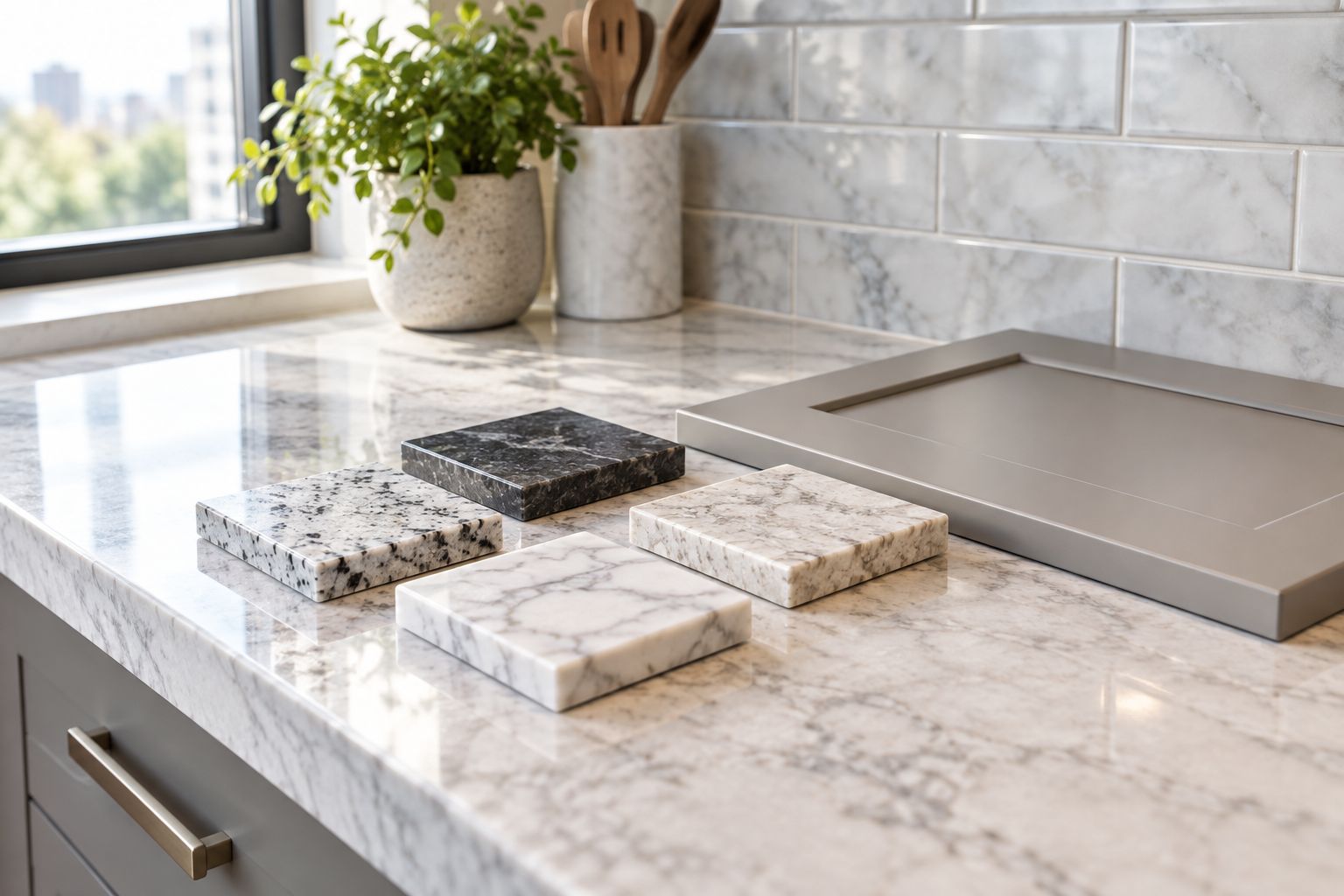
Review a physical sample beside the existing cabinets and backsplash. A countertop that looks neutral alone can read differently under the unit's lighting, so a sample photograph is not a complete selection method.
- Specify the material, finish, and approved color reference.
- Record the edge profile and exposed ends.
- Identify the sink model and mounting method.
- Mark backsplash areas that remain or require separate work.
- Require field verification for each unit's dimensions.
Confirm cabinet, sink, and appliance readiness
Use a walkthrough checklist before arranging the final template. Preliminary measurements help describe the project, but the fabricator must establish the dimensions and installation requirements used for fabrication.
Existing cabinets need assessment for condition, support, and alignment. A new stone top does not correct damaged cabinetry. Sink changes also affect plumbing connections and the space available inside the cabinet.
Record at least 3 photos per sink area as a documentation practice: the countertop opening, the cabinet interior, and the plumbing connections. These photographs help explain the existing conditions; they do not replace an on-site assessment or authorize a cutout.
- Confirm when cabinets must be fixed in their final positions.
- Supply sink and faucet specifications for cutout review.
- Identify cabinet damage, movement, or water exposure.
- Confirm appliance clearances with the relevant specifications.
- Ask who assesses supports for overhangs and vulnerable areas.
Compare written scopes before approving fabrication
Request written proposals against the same specification sheet. A short description such as a kitchen countertop replacement leaves important boundaries undefined, including removal, disposal, plumbing, and backsplash repairs.
Separate the fabricator's work from work assigned to other trades. Never assume countertop installation includes disconnecting a sink, reconnecting a dishwasher, repairing drywall, or modifying cabinets.
For your 2026 project records, require 2 approval checkpoints: the written scope and the final fabrication details. This is an internal control you can adopt, not a claimed industry requirement. Keep both approvals attached to the unit record.
- Identify removal and disposal responsibilities.
- Confirm who disconnects and reconnects plumbing.
- Review material, finish, edge, seams, and cutouts.
- Record exclusions and the process for approving changes.
- Confirm who checks surrounding finishes after installation.
Coordinate the turnover around confirmed milestones
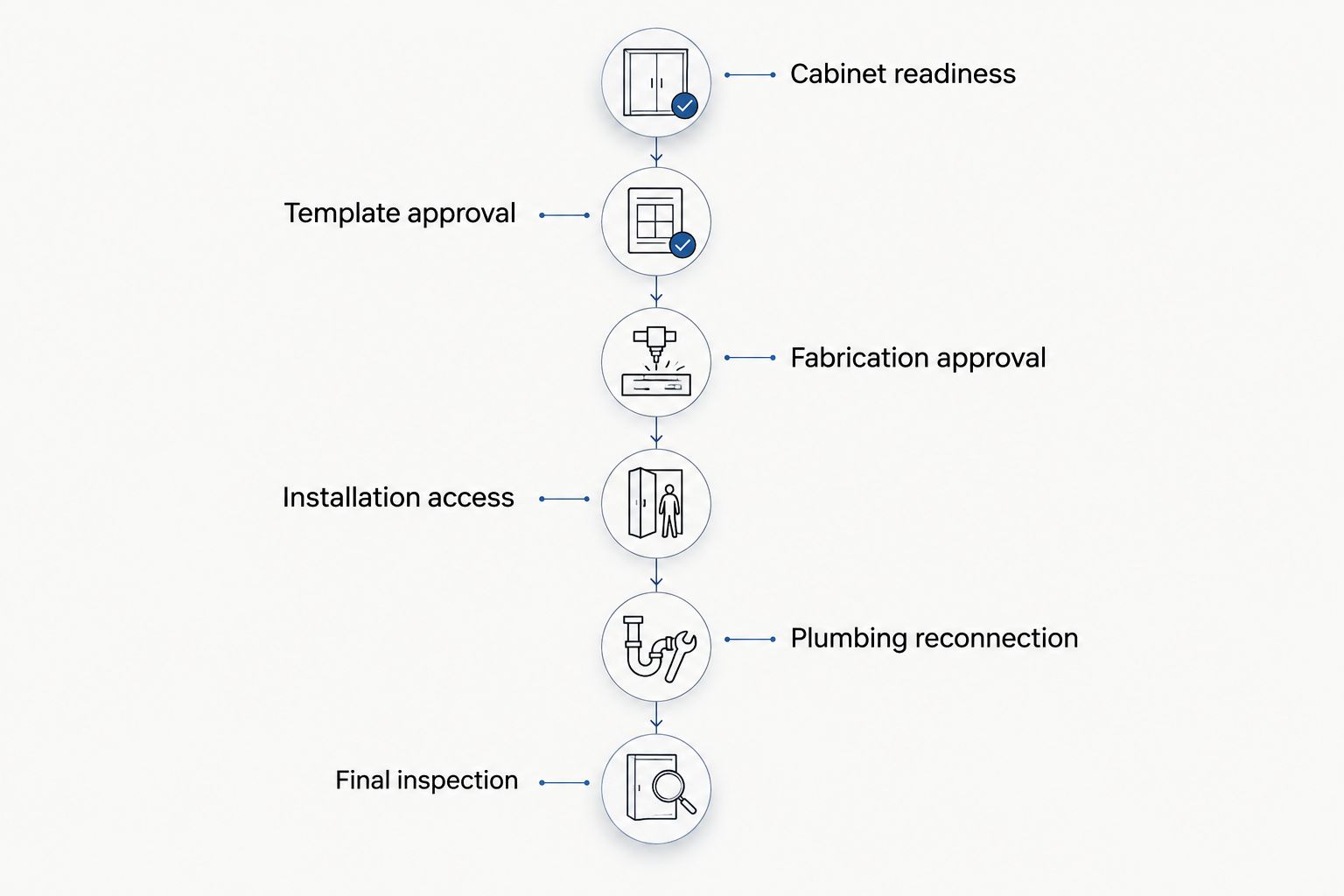
Build the sequence in a shared calendar before requesting dates from contractors. Assign an owner to each handoff, then confirm dependencies with the people doing the work rather than assuming every task can happen on the same visit.
For an occupied unit, resident notices and access arrangements belong in the schedule. For a vacant unit, access still needs coordination: locked doors, unfinished cabinets, or missing sink information can prevent a planned task from proceeding.
Treat your 2026 turnover calendar as a sequence of confirmed milestones, not an assumed installation duration. Do not promise residents a working kitchen until the required installation, reconnection, and checks are coordinated.
- Cabinet readiness: Confirm the base is ready for the fabricator's requirements.
- Template approval: Resolve dimensions, cutouts, and layout questions.
- Fabrication approval: Authorize the agreed material and details.
- Installation access: Arrange entry and a clear work route.
- Plumbing reconnection: Assign the responsible trade.
- Final inspection: Check the completed surface and connected fixtures.
Document care and inspect between tenancies
Create a short care sheet from the selected material's instructions. Give the same guidance to residents and cleaning contractors so a change of cleaner does not introduce an unsuitable chemical.
Include heat protection, spill response, and the approved cleaning method. For natural stone, record the sealing guidance supplied for that surface rather than automatically imposing a calendar interval.
Keep dated photographs at move-in and move-out. Inspect around sinks, seams, edges, and fixtures, and record changes without treating every mark as the same problem. A stain, an etched patch, and a chipped edge require different assessments.
- Store the material identification and care documents together.
- Provide approved cleaning instructions to residents and cleaners.
- Ask residents to report loose fixtures, chips, and leaks promptly.
- Photograph the same inspection areas between tenancies.
- Request professional assessment before attempting abrasive repairs.
Compare countertop options for managed properties
Engineered quartz is the best starting point when avoiding sealing is your priority. Natural stone remains a valid choice when the owner accepts its specific maintenance requirements. No material removes the need for suitable cleaning, heat protection, and careful installation.
Use this comparison for your 2026 shortlist, then confirm the actual surface's instructions. Material names alone do not establish every performance characteristic of a particular slab or manufactured surface.
| Option | Best for | Main advantage | Key limitation |
|---|---|---|---|
| Engineered quartz | Rental kitchens where avoiding sealing is a priority | Nonporous surface that does not require sealing | Excessive heat and unsuitable chemicals can damage it |
| Granite | Owners who want natural stone and accept a material-specific care plan | Natural pattern variation and good everyday wear resistance | Absorbency and sealing requirements vary by stone |
| Quartzite | Owners seeking natural stone with a quartzite appearance | Hard natural-stone surface with distinct patterns | Requires careful material identification and surface-specific maintenance |
| Marble | Owner-approved interiors where patina is acceptable | Distinct natural veining | Acid etching makes it a poor default for tenants expecting an unchanged finish |
Do not confuse quartz with quartzite when approving documents. Engineered quartz is manufactured with mineral content and binders; quartzite is natural stone. A care sheet for one is not a substitute for instructions for the other.
Common mistakes property managers make
Selecting a finish without approving its care requirements
A sample approval is incomplete if the owner expects marble to behave like engineered quartz. Explain acid etching before approval and record whether changing surface appearance is acceptable. Reject a material-care mismatch before fabrication, not after the first complaint.
Reusing dimensions from another unit
Matching floor plans do not establish matching cabinet positions, wall conditions, or sink openings. Use previous plans for preliminary coordination only. Require the fabricator's field verification for the unit receiving the countertop.
Scheduling plumbing without confirming the countertop sequence
Countertop work and plumbing reconnection are separate responsibilities unless the written scope explicitly combines them. Assign each task and confirm the handoff before notifying a resident that the kitchen is ready.
Assuming standardization guarantees a future match
A saved color name does not guarantee an indistinguishable replacement. Natural stone varies, and manufactured surfaces also need a physical match assessment. Keep selection records, but inspect replacement material before authorizing work beside an existing surface.
Treating cleaning damage as ordinary staining
An etched area on marble is surface damage from a chemical reaction, not simply a stain waiting for a stronger cleaner. Stop escalating cleaning products and identify the problem first. The wrong treatment can create another repair issue.
FAQ
What’s the best countertop for a property manager to choose?
Engineered quartz is a strong starting point for property managers who want a surface that does not require sealing. Confirm heat precautions, cleaning instructions, and installation details before approving the specific material.
Is quartz better than granite for a rental kitchen?
Quartz is better when avoiding sealing is the main priority; granite suits owners who prefer natural stone and accept its care requirements. Neither material is damage-proof, and both need appropriate cleaning and heat protection.
Should I replace countertops while tenants still live in the property?
Replace countertops during occupancy only with a coordinated access and service-interruption plan. Confirm notices, removal, installation, and plumbing responsibilities before setting expectations with residents.
Can I use the same countertop measurements for matching apartments?
No, matching apartment layouts do not replace individual field verification. Cabinet positions, wall conditions, and fixture details must be checked for the actual installation.
Does a new granite countertop always need annual sealing?
No, a fixed annual sealing schedule is not appropriate for every granite surface. Follow the selected stone’s guidance and the fabricator’s assessment rather than assuming one interval fits all units.
Are marble countertops a good choice for rental properties?
Marble is a conditional choice for rentals because acids can etch its surface. Use it only when the owner accepts that appearance change and the care instructions suit the property’s operations.
What should I confirm with Soaresstone before a managed-property project?
Confirm the property location, material, fabrication details, installation scope, and responsibility for other trades. Soaresstone serves New England homeowners; establish the managed-property requirements directly rather than assuming a portfolio service agreement.
One last thing
A countertop standard should standardize decisions, not dimensions. Keep the material, care instructions, approval process, and inspection checklist consistent, but verify every unit's physical conditions. That distinction makes your 2026 property record useful without turning an old drawing into an installation instruction.
Related guides
- How to choose durable countertops for a rental property
- How to plan a countertop template appointment
- How to clean quartz countertops without damaging them